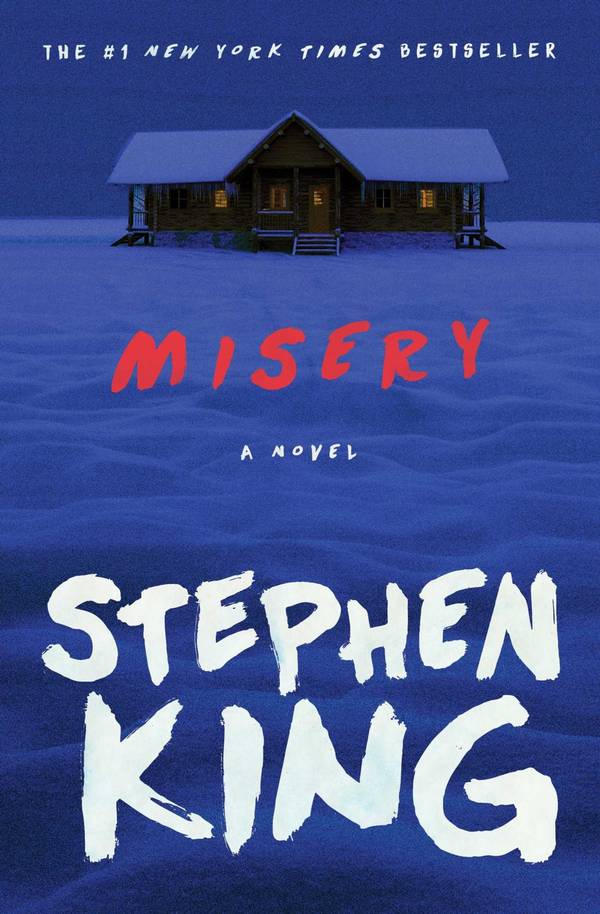
Paul Sheldon. He’s a bestselling novelist who has finally met his biggest fan. Her name is Annie Wilkes and she is more than a rabid reader—she is Paul’s nurse, tending his shattered body after an automobile accident. But she is also his captor, keeping him prisoner in her isolated house.
Now Annie wants Paul to write his greatest work—just for her. She has a lot of ways to spur him on. One is a needle. Another is an ax. And if they don’t work, she can get really nasty.
“Solid character delineation and terrifying insight. In addition to being able to scare the reader breathless, King says a tremendous amount about writing itself. We delight in his virtuosity.”
-Washington Post
a cognizant original v5 release november 13 2010
AMERICA LOVES
THE BACHMAN BOOKS “Fascinating.” — Philadelphia Inquirer
CARRIE “Horrifying.” — Chicago Tribune
CHRISTINE “Riveting.” — Playboy
CUJO “Gut-wrenching.” — Newport News Daily Press
THE DARK HALF “Scary.” — Kirkus Reviews
THE DARK TOWER: THE GUNSLINGER “Brilliant.” — Booklist
THE DARK TOWER II: THE DRAWING OF THE THREE “Superb.” — Chicago Herald-Wheaton
THE DARK TOWER III: THE WASTE LANDS “Gripping.” — Chicago Sun-Times
THE DEAD ZONE “Frightening.” — Cosmopolitan
DIFFERENT SEASONS “Hypnotic.” — New York Times Book Review
DOLORES CLAIBORNE “Unforgettable.” — San Francisco Chronicle
THE EYES OF THE DRAGON “Masterful.” — Cincinnati Post
FIRESTARTER “Terrifying.” — Miami Herald
STEPHEN KING
FOUR PAST MIDNIGHT “Chilling.” — Milwaukee Journal
GERALD’S GAME “Terrific.” — USA Today
IT “Mesmerizing.” — Washington Post Book World
MISERY “Wonderful.” — Houston Chronicle
NEEDFUL THINGS “Demonic.” — Kirkus Reviews
NIGHT SHIFT “Macabre.” — Dallas Times-Herald
PET SEMATARY “Unrelenting.” — Pittsburgh Press
’SALEM’S LOT “Tremendous.” — Kirkus Reviews
THE SHINING “Spellbinding.” — Pittsburgh Press
SKELETON CREW “Diabolical.” — Associated Press
THE STAND “Great.” — New York Times Book Review
THINNER “Extraordinary.” — Booklist
THE TOMMYKNOCKERS “Marvelous.” — Boston Globe
WORKS BY STEPHEN KING
NOVELS
Carrie ’Salem’s Lot The Shining The Stand The Dead Zone Firestarter Cujo THE DARK TOWER I: The Gunslinger Christine Pet Sematary Cycle of the Werewolf The Talisman (with Peter Straub) It The Eyes of the Dragon Misery The Tommyknockers THE DARK TOWER II: The Drawing of the Three THE DARK TOWER III: The Waste Lands The Dark Half Needful Things Gerald’s Game Dolores Claiborne Insomnia Rose Madder Desperation The Green Mile THE DARK TOWER IV: Wizard and Glass Bag of Bones The Girl Who Loved Tom Gordon Dreamcatcher Black House (with Peter Straub) From a Buick 8 THE DARK TOWER V: Wolves of the Calla THE DARK TOWER VI: Song of Susannah THE DARK TOWER VII: The Dark Tower
AS RICHARD BACHMAN Rage The Long Walk Roadwork The Running Man Thinner The Regulators
COLLECTIONS Night Shift Different Seasons Skeleton Crew Four Past Midnight Nightmares and Dreamscapes Hearts in Atlantis Everything’s Eventual
NONFICTION Danse Macabre On Writing
SCREENPLAYS Creepshow Cat’s Eye Silver Bullet Maximum Overdrive Pet Sematary Golden Years Sleepwalkers The Stand The Shining Rose Red Storm of the Century
SIGNET
Published by New American Library, a division of Penguin Group (USA) Inc., 375 Hudson Street, New York, New York 10014, USA
Penguin Group (Canada), 90 Eglinton Avenue East, Suite 700, Toronto, Ontario
M4P 2Y3, Canada (a division of Pearson Penguin Canada Inc.)
Penguin Books Ltd., 80 Strand, London WC2R ORL, England
Penguin Ireland, 25 St. Stephen’s Green, Dublin 2, Ireland (a division of Penguin Books Ltd.) Penguin Group (Australia), 250 Camberwell Road, Camberwell, Victoria 3124, Australia
(a division of Pearson Australia Group Pty. Ltd.)
Penguin Books India Pvt. Ltd., 11 Community Centre, Panchsheel Park,
New Delhi -110 017, India
Penguin Group (NZ), 67 Apollo Drive, Rosedale, North Shore 0632,
New Zealand (a division of Pearson New Zealand Ltd.)
Penguin Books (South Africa) (Pty.) Ltd., 24 Sturdee Avenue, Rosebank, Johannesburg 2196, South Africa
Penguin Books Ltd., Registered Offices: 80 Strand, London WC2R ORL, England
Without limiting the rights under copyright reserved above, no part of this publication may be reproduced, stored in or introduced into a retrieval system, or transmitted, in any form, or by any means (electronic, mechanical, photocopying, recording, or otherwise), without the prior written permission of both the copyright owner and the above publisher of this book.
PUBLISHER’S NOTE
This is a work of fiction. Names, characters, places, and incidents either are the product of the author’s imagination or are used fictitiously, and any resemblance to actual persons, living or dead, business establishments, events, or locales is entirely coincidental.
The publisher does not have any control over and does not assume any responsibility for author or third-party Web sites or their content.
The scanning, uploading, and distribution of this book via the Internet or via any other means without the permission of the publisher is illegal and punishable by law. Please purchase only authorized electronic editions, and do not participate in or encourage electronic piracy of copyrighted materials. Your support of the author’s rights is appreciated.
eISBN : 978-1-101-13812-0
http://us.penguingroup.com
This is for Stephanie and Jim Leonard, who know why. Boy, do they.
goddess
Africa
I’d like to gratefully acknowledge the help of three medical people who helped me with the factual material in this book. They are:
Russ Dorr, P.A.
Florence Dorr, R.N.
Janet Ordway, M.D. and Doctor of Psychiatry
As always, they helped with the things you don’t notice. If you see a glaring error, it’s mine.
There is, of course, no such drug as Novril, but there are several codeine-based drugs similar to it, and, unfortunately, hospital pharmacies and medical practice dispensaries are sometimes lax in keeping such drugs under tight lock and close inventory.
The places and characters in this book are fictional.
S.K.
I
ANNIE
When you look into the abyss, the abyss also looks into you.
—FRIEDRICH NIETZSCHE
1
umber whunnnn yerrrnnn umber whunnnn fayunnnn These sounds: even in the haze.
2
But sometimes the sounds—like the pain—faded, and then there was only the haze. He remembered darkness: solid darkness had come before the haze. Did that mean he was making progress? Let there be light (even of the hazy variety), and the light was good, and so on and so on? Had those sounds existed in the darkness? He didn’t know the answers to any of these questions. Did it make sense to ask them? He didn’t know the answer to that one, either.
The pain was somewhere below the sounds. The pain was east of the sun and south of his ears. That was all he did know.
For some length of time that seemed very long (and so was, since the pain and the stormy haze were the only two things which existed) those sounds were the only outer reality. He had no idea who he was or where he was and cared to know neither. He wished he was dead, but through the pain-soaked haze that filled his mind like a summer storm-cloud, he did not know he wished it.
As time passed, he became aware that there were periods of nonpain, and that these had a cyclic quality. And for the first time since emerging from the total blackness which had prologued the haze, he had a thought which existed apart from whatever his current situation was. This thought was of a broken-off piling which had jutted from the sand at Revere Beach. His mother and father had taken him to Revere Beach often when he was a kid, and he had always insisted that they spread their blanket where he could keep an eye on that piling, which looked to him like the single jutting fang of a buried monster. He liked to sit and watch the water come up until it covered the piling. Then, hours later, after the sandwiches and potato salad had been eaten, after the last few drops of Kool-Aid had been coaxed from his father’s big thermos, just before his mother said it was time to pack up and start home, the top of the rotted piling would begin to show again—just a peek and flash between the incoming waves at first, then more and more. By the time their trash was stashed in the big drum with KEEP YOUR BEACH CLEAN stencilled on the side, Paulie’s beach-toys picked up
(that’s my name Paulie I’m Paulie and tonight ma’ll put Johnson’s Baby Oil on my sunburn he thought inside the thunderhead where he now lived) and the blanket folded again, the piling had almost wholly reappeared, its blackish, slime-smoothed sides surrounded by sudsy scuds of foam. It was the tide, his father had tried to explain, but he had always known it was the piling. The tide came and went; the piling stayed. It was just that sometimes you couldn’t see it. Without the piling, there was no tide.
This memory circled and circled, maddening, like a sluggish fly. He groped for whatever it might mean, but for a long time the sounds interrupted.
fayunnnn
red everrrrrythinggg
umberrrrr whunnnn
Sometimes the sounds stopped. Sometimes he stopped.
His first really clear memory of this now. the now outside the storm-haze, was of stopping, of being suddenly aware he just couldn’t pull another breath, and that was all right, that was good, that was in fact just peachy-keen; he could take a certain level of pain but enough was enough and he was glad to be getting out of the game.
Then there was a mouth clamped over his, a mouth which was unmistakably a woman’s mouth in spite of its hard spitless lips, and the wind from this woman’s mouth blew into his own mouth and down his throat, puffing his lungs, and when the lips were pulled back he smelled his warder for the first time, smelled her on the outrush of the breath she had forced into him the way a man might force a part of himself into an unwilling woman, a dreadful mixed stench of vanilla cookies and chocolate ice cream and chicken gravy and peanut-butter fudge.
He heard a voice screaming, “Breathe, goddammit! Breathe, Paul!”
The lips clamped down again. The breath blew down his throat again. Blew down it like the dank suck of wind which follows a fast subway train, pulling sheets of newspaper and candy-wrappers after it, and the lips were withdrawn, and he thought For Christ’s sake don’t let any of it out through your nose but he couldn’t help it and oh that stink, that stink that fucking STINK.
“Breathe, goddam you!” the unseen voice shrieked, and he thought I will, anything, please just don’t do that anymore, don’t infect me anymore, and he tried, but before he could really get started her lips were clamped over his again, lips as dry and dead as strips of salted leather, and she raped him full of her air again.
When she took her lips away this time he did not let her breath out but pushed it and whooped in a gigantic breath of his own. Shoved it out. Waited for his unseen chest to go up again on its own, as it had been doing his whole life without any help from him. When it didn’t, he gave another giant whooping gasp, and then he was breathing again on his own, and doing it as fast as he could to flush the smell and taste of her out of him.
Normal air had never tasted so fine.
He began to fade back into the haze again, but before the dimming world was gone entirely, he heard the woman’s voice mutter: “Whew! That was a close one!”
Not close enough, he thought, and fell asleep.
He dreamed of the piling, so real he felt he could almost reach out and slide his palm over its green-black fissured curve.
When he came back to his former state of semiconsciousness, he was able to make the connection between the piling and his current situation—it seemed to float into his hand. The pain wasn’t tidal. That was the lesson of the dream which was really a memory. The pain only appeared to come and go. The pain was like the piling, sometimes covered and sometimes visible, but always there. When the pain wasn’t harrying him through the deep stone grayness of his cloud, he was dumbly grateful, but he was no longer fooled—it was still there, waiting to return. And there was not just one piling but two; the pain was the pilings, and part of him knew for a long time before most of his mind had knowledge of knowing that the shattered pilings were his own shattered legs.
But it was still a long time before he was finally able to break the dried scum of saliva that had glued his lips together and croak out “Where am I?” to the woman who sat by his bed with a book in her hands. The name of the man who had written the book was Paul Sheldon. He recognized it as his own with no surprise.
“Sidewinder, Colorado,” she said when he was finally able to ask the question. “My name is Annie Wilkes. And I am—”
“I know,” he said. “You’re my number-one fan.”
“Yes,” she said, smiling. “That’s just what I am.”
3
Darkness. Then the pain and the haze. Then the awareness that, although the pain was constant, it was sometimes buried by an uneasy compromise which he supposed was relief. The first real memory: stopping, and being raped back into life by the woman’s stinking breath.
Next real memory: her fingers pushing something into his mouth at regular intervals, something like Contac capsules, only since there was no water they only sat in his mouth and when they melted there was an incredibly bitter taste that was a little like the taste of aspirin. It would have been good to spit that bitter taste out, but he knew better than to do it. Because it was that bitter taste which brought the high tide in over the piling
(PILINGS it’s PILINGS there are Two okay there are two fine now just hush just you know hush shhhhhh)
and made it seem gone for awhile.
These things all came at widely spaced intervals, but then, as the pain itself began not to recede but to erode (as that Revere Beach piling must itself have eroded, he thought, because nothing is forever—although the child he had been would have scoffed at such heresy), outside things began to impinge more rapidly until the objective world, with all its freight of memory, experience, and prejudice, had pretty much re-established itself. He was Paul Sheldon, who wrote novels of two kinds, good ones and best-sellers. He had been married and divorced twice. He smoked too much (or had before all this, whatever “all this” was). Something very bad had happened to him but he was still alive. That dark-gray cloud began to dissipate faster and faster. It would be yet awhile before his number-one fan brought him the old clacking Royal with the grinning gapped mouth and the Ducky Daddles voice, but Paul understood long before then that he was in a hell of a jam.
4
That prescient part of his mind saw her before he knew he was seeing her, and must surely have understood her before he knew he was understanding her—why else did he associate such dour, ominous images with her? Whenever she came into the room he thought of the graven images worshipped by superstitious African tribes in the novels of H. Rider Haggard, and stones, and doom.
The image of Annie Wilkes as an African idol out of She or King Solomon’s Mines was both ludicrous and queerly apt. She was a big woman who, other than the large but unwelcoming swell of her bosom under the gray cardigan sweater she always wore, seemed to have no feminine curves at all—there was no defined roundness of hip or buttock or even calf below the endless succession of wool skirts she wore in the house (she retired to her unseen bedroom to put on jeans before doing her outside chores). Her body was big but not generous. There was a feeling about her of clots and roadblocks rather than welcoming orifices or even open spaces, areas of hiatus.
Most of all she gave him a disturbing sense of solidity, as if she might not have any blood vessels or even internal organs; as if she might be only solid Annie Wilkes from side to side and top to bottom. He felt more and more convinced that her eyes, which appeared to move, were actually just painted on, and they moved no more than the eyes of portraits which appear to follow you to wherever you move in the room where they hang. It seemed to him that if he made the first two fingers of his hand into a V and attempted to poke them up her nostrils, they might go less than an eighth of an inch before encountering a solid (if slightly yielding) obstruction; that even her gray cardigan and frumpy house skirts and faded outside-work jeans were part of that solid fibrous unchannelled body. So his feeling that she was like an idol in a perfervid novel was not really surprising at all. Like an idol, she gave only one thing: a feeling of unease deepening steadily toward terror. Like an idol, she took everything else.
No, wait, that wasn’t quite fair. She did give something else. She gave him the pills that brought the tide in over the pilings.
The pills were the tide; Annie Wilkes was the lunar presence which pulled them into his mouth like jetsam on a wave. She brought him two every six hours, first announcing her presence only as a pair of fingers poking into his mouth (and soon enough he learned to suck eagerly at those poking fingers in spite of the bitter taste), later appearing in her cardigan sweater and one of her half-dozen skirts, usually with a paperback copy of one of his novels tucked under her arm. At night she appeared to him in a fuzzy pink robe, her face shiny with some sort of cream (he could have named the main ingredient easily enough even though he had never seen the bottle from which she tipped it; the sheepy smell of the lanolin was strong and proclamatory), shaking him out of his frowzy, dream-thick sleep with the pills nestled in her hand and the poxy moon nestled in the window over one of her solid shoulders.
After awhile—after his alarm had become too great to be ignored—he was able to find out what she was feeding him. It was a pain-killer with a heavy codeine base called Novril. The reason she had to bring him the bedpan so infrequently was not only because he was on a diet consisting entirely of liquids and gelatines (earlier, when he was in the cloud, she had fed him intravenously), but also because Novril had a tendency to cause constipation in patients taking it. Another side-effect, a rather more serious one, was respiratory depression in sensitive patients. Paul was not particularly sensitive, even though he had been a heavy smoker for nearly eighteen years, but his breathing had stopped nonetheless on at least one occasion (there might have been others, in the haze, that he did not remember). That was the time she gave him mouth-to-mouth. It might have just been one of those things which happened, but he later came to suspect she had nearly killed him with an accidental overdose. She didn’t know as much about what she was doing as she believed she did. That was only one of the things about Annie that scared him.
He discovered three things almost simultaneously, about ten days after having emerged from the dark cloud. The first was that Annie Wilkes had a great deal of Novril (she had, in fact, a great many drugs of all kinds). The second was that he was hooked on Novril. The third was that Annie Wilkes was dangerously crazy.
5
The darkness had prologued the pain and the storm-cloud; he began to remember what had prologued the darkness as she told him what had happened to him. This was shortly after he had asked the traditional when-the-sleeper-wakes question and she had told him he was in the little town of Sidewinder, Colorado. In addition she told him that she had read each of his eight novels at least twice, and had read her very favorites, the Misery novels, four, five, maybe six times. She only wished he would write them faster. She said she had hardly been able to believe that her patient was really that Paul Sheldon even after checking the ID in his wallet.
“Where is my wallet, by the way?” he asked.
“I’ve kept it safe for you,” she said. Her smile suddenly collapsed into a narrow watchfulness he didn’t like much—it was like discovering a deep crevasse almost obscured by summer flowers in the midst of a smiling, jocund meadow. “Did you think I’d steal something out of it?”
“No, of course not. It’s just that—” It’s just that the rest of my life is in it, he thought. My life outside this room. Outside the pain. Outside the way time seems to stretch out like the long pink string of bubble-gum a kid pulls out of his mouth when he’s bored. Because that’s how it is in the last hour or so before the pills come.
‘Just what, Mister Man?” she persisted, and he saw with alarm that the narrow look was growing blacker and blacker. The crevasse was spreading, as if an earthquake was going on behind her brow. He could hear the steady, keen whine of the wind outside, and he had a sudden image of her picking him up and throwing him over her solid shoulder, where he would lie like a burlap sack slung over a stone wall, and taking him outside, and heaving him into a snowdrift. He would freeze to death, but before he did, his legs would throb and scream.
“It’s just that my father always told me to keep my eye on my wallet,” he said, astonished by how easily this lie came out. His father had made a career out of not noticing Paul any more than he absolutely had to, and had, so far as Paul could remember, offered him only a single piece of advice in his entire life. On Paul’s fourteenth birthday his father had given him a Red Devil condom in a foil envelope. “Put that in your wallet,” Roger Sheldon said, “and if you ever get excited while you’re making out at the drive-in, take a second between excited enough to want to and too excited to care and slip that on. Too many bastards in the world already, and I don’t want to see you going in the Army at sixteen.”
Now Paul went on: “I guess he told me to keep my eye on my wallet so many times that it’s stuck inside for good. If I offended you, I’m truly sorry.”
She relaxed. Smiled. The crevasse closed. Summer flowers nodded cheerfully once again. He thought of pushing his hand through that smile and encountering nothing but flexible darkness. “No offense taken. It’s in a safe place. Wait—I’ve got something for you.”
She left and returned with a steaming bowl of soup. There were vegetables floating in it. He was not able to eat much, but he ate more than he thought at first he could. She seemed pleased. It was while he ate the soup that she told him what had happened, and he remembered it all as she told him, and he supposed it was good to know how you happened to end up with your legs shattered, but the manner by which he was coming to this knowledge was disquieting—it was as if he was a character in a story or a play, a character whose history is not recounted like history but created like fiction.
She had gone into Sidewinder in the four-wheel drive to get feed for the livestock and a few groceries … also to check out the paperbacks at Wilson’s Drug Center—that had been the Wednesday that was almost two weeks ago now, and the new paperbacks always came in on Tuesday.
“I was actually thinking of you,” she said, spooning soup into his mouth and then professionally wiping away a dribble from the corner with a napkin. “That’s what makes it such a remarkable coincidence, don’t you see? I was hoping Miser’sChild would finally be out in paperback, but no such luck.”
A storm had been on the way, she said, but until noon that day the weather forecasters had been confidently claiming it would veer south, toward New Mexico and the Sangre de Cristos.
“Yes,” he said, remembering as he said it: “They said it would turn. That’s why I went in the first place.” He tried to shift his legs. The result was an awful bolt of pain, and he groaned.
“Don’t do that,” she said. “If you get those legs of yours talking, Paul, they won’t shut up … and I can’t give you any more pills for two hours. I’m giving you too much as it is.”
Why aren’t I in the hospital? This was clearly the question that wanted asking, but he wasn’t sure it was a question either of them wanted asked. Not yet, anyway.
“When I got to the feed store, Tony Roberts told me I better step on it if I was going to get back here before the storm hit, and I said—”
“How far are we from this town?” he asked.
“A ways,” she said vaguely, looking off toward the window. There was a queer interval of silence, and Paul was frightened by what he saw on her face, because what he saw was nothing; the black nothing of a crevasse folded into an alpine meadow, a blackness where no flowers grew and into which the drop might be long. It was the face of a woman who has come momentarily untethered from all of the vital positions and landmarks of her life, a woman who has forgotten not only the memory she was in the process of recounting but memory itself. He had once toured a mental asylum—this was years ago, when he had been researching Misery, the first of the four books which had been his main source of income over the last eight years—and he had seen this look … or, more precisely, this unlook. The word which defined it was catatonia, but what frightened him had no such precise word—it was, rather, a vague comparison: in that moment he thought that her thoughts had become much as he had imagined her physical self: solid, fibrous, unchannelled, with no places of hiatus.
Then, slowly, her face cleared. Thoughts seemed to flow back into it. Then he realized flowing was just a tiny bit wrong. She wasn’t filling up, like a pond or a tidal pool; she was warming up. Yes … she is warming up, like some small electrical gadget. A toaster, or maybe a heating pad.
“I said to Tony, ‘That storm is going south.’ ” She spoke slowly at first, almost groggily, but then her words began to catch up to normal cadence and to fill with normal conversational brightness. But now he was alerted. Everything she said was a little strange, a little offbeat. Listening to Annie was like listening to a song played in the wrong key.
“But he said, ‘It changed its mind.’
“‘Oh poop!’ I said. ‘I better get on my horse and ride.’
“‘I’d stay in town if you can, Miz Wilkes,’ he said. ‘Now they’re saying on the radio that it’s going to be a proper jeezer and nobody is prepared.’
“But of course I had to get back—there’s no one to feed the animals but me. The nearest people are the Roydmans, and they are miles from here. Besides, the Roydmans don’t like me.”
She cast an eye shrewdly on him as she said this last, and when he didn’t reply she tapped the spoon against the rim of the bowl in peremptory fashion.
“Done?”
“Yes, I’m full, thanks. It was very good. Do you have a lot of livestock?”
Because, he was already thinking, if you do, that means you’ve got to have some help. A hired man, at least. “Help” was the operant word. Already that seemed like the operant word, and he had seen she wore no wedding ring.
“Not very much,” she said. “Half a dozen laying hens. Two cows. And Misery.”
He blinked.
She laughed. “You won’t think I’m very nice, naming a sow after the brave and beautiful woman you made up. But that’s her name, and I meant no disrespect.” After a moment’s thought she added: “She’s very friendly.” The woman wrinkled up her nose and for a moment became a sow, even down to the few bristly whiskers that grew on her chin. She made a pig-sound: “Whoink! Whoink! Whuh-Whuh-WHOINK!”
Paul looked at her wide-eyed.
She did not notice; she had gone away again, her gaze dim and musing. Her eyes held no reflection but the lamp on the bed-table, twice reflected, dwelling faintly in each.
At last she gave a faint start and said: “I got about five miles and then the snow started. It came fast—once it starts up here, it always does. I came creeping along, with my lights on, and then I saw your car off the road, overturned.” She looked at him disapprovingly. “You didn’t have your lights on.”
“It took me by surprise,” he said, remembering only at that moment how he had been taken by surprise. He did not yet remember that he had also been quite drunk.
“I stopped,” she said. “If it had been on an upgrade, I might not have. Not very Christian, I know, but there were three inches on the road already, and even with a four-wheel drive you can’t be sure of getting going again once you lose your forward motion. It’s easier just to say to yourself, ‘Oh, they probably got out, caught a ride,’ et cetera, et cetera. But it was on top of the third big hill past the Roydmans’, and it’s flat there for awhile. So I pulled over, and as soon as I got out I heard groaning. That was you, Paul.”
She gave him a strange maternal grin.
For the first time, clearly, the thought surfaced in Paul Sheldon’s mind: I am in trouble here. This woman is not right.
6
She sat beside him where he lay in what might have been a spare bedroom for the next twenty minutes or so and talked. As his body used the soup, the pain in his legs reawakened. He willed himself to concentrate on what she was saying, but was not entirely able to succeed. His mind had bifurcated. On one side he was listening to her tell how she had dragged him from the wreckage of his ’74 Camaro—that was the side where the pain throbbed and ached like a couple of old splintered pilings beginning to wink and flash between the heaves of the withdrawing tide. On the other he could see himself at the Boulderado Hotel, finishing his new novel, which did not—thank God for small favors—feature Misery Chastain.
There were all sorts of reasons for him not to write about Misery, but one loomed above the rest, ironclad and unshakable. Misery—thank God for large favors—was finally dead. She had died five pages from the end of Misery’s Child. Not a dry eye in the house when that had happened, including Paul’s own—only the dew falling from his ocularies had been the result of hysterical laughter.
Finishing the new book, a contemporary novel about a car-thief, he had remembered typing the final sentence of Misery’s Child: “So Ian and Geoffrey left the Little Dunthorpe churchyard together, supporting themselves in their sorrow, determined to find their lives again.” While writing this line he had been giggling so madly it had been hard to strike the correct keys—he had to go back several times. Thank God for good old IBM CorrectTape. He had written THE END below and then had gone capering about the room—this same room in the Boulderado Hotel—and screaming Free at last! free at last! Great God Almighty, I’m free at last! The silly bitch finally bought the farm!
The new novel was called Fast Cars, and he hadn’t laughed when it was done. He just sat there in front of the typewriter for a moment, thinking You may have just won next year’s American Book Award, my friend. And then he had picked up—
“—a little bruise on your right temple, but that didn’t look like anything. It was your legs…. I could see right away, even with the light starting to fade, that your legs weren’t—”
—the telephone and called room service for a bottle of Dom Pérignon. He remembered waiting for it to come, walking back and forth in the room where he had finished all of his books since 1974; he remembered tipping the waiter with a fifty-dollar bill and asking him if he had heard a weather forecast; he remembered the pleased, flustered, grinning waiter telling him that the storm currently heading their way was supposed to slide off to the south, toward New Mexico; he remembered the chill feel of the bottle, the discreet sound of the cork as he eased it free; he remembered the dry, acerbic-acidic taste of the first glass and opening his travel bag and looking at his plane ticket to New York; he remembered suddenly, on the spur of the moment, deciding—
“—that I better get you home right away! It was a struggle getting you to the truck, but I’m a big woman—as you may have noticed—and I had a pile of blankets in the back. I got you in and wrapped you up, and even then, with the light fading and all, I thought you looked familiar! I thought maybe—”
—he would get the old Camaro out of the parking garage and just drive west instead of getting on the plane. What the hell was there in New York, anyway? The townhouse, empty, bleak, unwelcoming, possibly burgled. Screw it! he thought, drinking more champagne. Go west, young man, go west! The idea had been crazy enough to make sense. Take nothing but a change of clothes and his—
“—bag I found. I put that in, too, but there wasn’t anything else I could see and I was scared you might die on me or something so I fired up Old Bessie and I got your—”
—manuscript of Fast Cars and hit the road to Vegas or Reno or maybe even the City of the Angels. He remembered the idea had also seemed a bit silly at first—a trip the kid of twenty-four he had been when he had sold his first novel might have taken, but not one for a man two years past his fortieth birthday. A few more glasses of champagne and the idea no longer seemed silly at all. It seemed, in fact, almost noble. A kind of Grand Odyssey to Somewhere, a way to reacquaint himself with reality after the fictional terrain of the novel. So he had gone—
“—out like a light! I was sure you were going to die…. I mean, I was sure! So I slipped your wallet out of your back pocket, and I looked at your driver’s license and I saw the name, Paul Sheldon, and I thought, ‘Oh, that must be a coincidence,’ but the picture on the license also looked like you, and then I got so scared I had to sit down at the kitchen table. I thought at first that I was going to faint. After awhile I started thinking maybe the picture was just a coincidence, too—those driver’s-license photos really don’t look like anybody—but then I found your Writers’ Guild card, and one from PEN, and I knew you were—”
—in trouble when the snow started coming down, but long before that he had stopped in the Boulderado bar and tipped George twenty bucks to provide him with a second bottle of Dom, and he had drunk it rolling up 1-70 into the Rockies under a sky the color of gunmetal, and somewhere east of the Eisenhower Tunnel he had diverted from the turnpike because the roads were bare and dry, the storm was sliding off to the south, what the hay, and also the goddam tunnel made him nervous. He had been playing an old Bo Diddley tape on the cassette machine under the dash and never turned on the radio until the Camaro started to seriously slip and slide and he began to realize that this wasn’t just a passing upcountry flurry but the real thing. The storm was maybe not sliding off to the south after all; the storm was maybe coming right at him and he was maybe in a bucket of trouble
(the way you are in trouble now)
but he had been just drunk enough to think he could drive his way out of it. So instead of stopping in Cana and inquiring about shelter, he had driven on. He could remember the afternoon turning into a dull-gray chromium lens. He could remember the champagne beginning to wear off. He could remember leaning forward to get his cigarettes off the dashboard and that was when the last skid began and he tried to ride it out but it kept getting worse; he could remember a heavy dull thump and then the world’s up and down had swapped places. He had—
“—screamed! And when I heard you screaming, I knew that you would live. Dying men rarely scream. They haven’t the energy. I know. I decided I would make you live. So I got some of my pain medication and made you take it. Then you went to sleep. When you woke up and started to scream again, I gave you some more. You ran a fever for awhile, but I knocked that out, too. I gave you Keflex. You had one or two close calls, but that’s all over now. I promise.” She got up. “And now it’s time you rested, Paul. You’ve got to get your strength back.”
“My legs hurt.”
“Yes, I’m sure they do. In an hour you can have some medication.”
“Now. Please.” It shamed him to beg, but he could not help it. The tide had gone out and the splintered pilings stood bare, jaggedly real, things which could neither be avoided nor dealt with.
“In an hour.” Firmly. She moved toward the door with the spoon and the soup-bowl in one hand.
“Wait!”
She turned back, looking at him with an expression both stern and loving. He did not like the expression. Didn’t like it at all.
“Two weeks since you pulled me out?”
She looked vague again, and annoyed. He would come to know that her grasp of time was not good. “Something like that.”
“I was unconscious?”
“Almost all the time.”
“What did I eat?”
She considered him.
“IV,” she said briefly.
“IV?” he said, and she mistook his stunned surprise for ignorance.
“I fed you intravenously,” she said. “Through tubes. That’s what those marks on your arms are.” She looked at him with eyes that were suddenly flat and considering. “You owe me your life, Paul. I hope you’ll remember that. I hope you’ll keep that in mind.”
Then she left.
7
The hour passed. Somehow and finally, the hour passed.
He lay in bed, sweating and shivering at the same time. From the other room came first the sounds of Hawkeye and Hot Lips and then the disc jockeys on WKRP, that wild and crazy Cincinnati radio station. An announcer’s voice came on, extolled Ginsu knives, gave an 800 number, and informed those Colorado watchers who had simply been panting for a good set of Ginsu knives that Operators Were Standing By.
Paul Sheldon was also Standing By.
She reappeared promptly when the clock in the other room struck eight, with two capsules and a glass of water.
He hoisted himself eagerly on his elbows as she sat on the bed.
“I finally got your new book two days ago,” she told him. Ice tinkled in the glass. It was a maddening sound. “Misery’s Child. I love it…. It’s as good as all the rest. Better! The best!”
“Thank you,” he managed. He could feel the sweat standing out on his forehead. “Please … my legs … very painful …”
“I knew she would marry Ian,” she said, smiling dreamily, “and I believe Geoffrey and Ian will become friends again, eventually. Do they?” But immediately she said: “No, don’t tell! I want to find out for myself. I’m making it last. It always seems so long before there is another one.”
The pain throbbed in his legs and made a deep steel circlet around his crotch. He had touched himself down there, and he thought his pelvis was intact, but it felt twisted and weird. Below his knees it felt as if nothing was intact. He didn’t want to look. He could see the twisted, lumpy shapes outlined in the bedclothes, and that was enough.
“Please? Miss Wilkes? The pain—”
“Call me Annie. All my friends do.”
She gave him the glass. It was cool and beaded with moisture. She kept the capsules. The capsules in her hand were the tide. She was the moon, and she had brought the tide which would cover the pilings. She brought them toward his mouth, which he immediately dropped open … and then she withdrew them.
“I took the liberty of looking in your little bag. You don’t mind, do you?”
“No. No, of course not. The medicine—”
The beads of sweat on his forehead felt alternately hot and cold. Was he going to scream? He thought perhaps he was.
“I see there is a manuscript in there,” she said. She held the capsules in her right hand, which she now slowly tilted. They fell into her left hand. His eyes followed them. “It’s called Fast Cars. Not a Misery novel, I know that.” She looked at him with faint disapproval—but, as before, it was mixed with love. It was a maternal look. “No cars in the nineteenth century, fast or otherwise!” She tittered at this small joke. “I also took the liberty of glancing through it…. You don’t mind, do you?”
“Please,” he moaned. “No, but please—”
Her left hand tilted. The capsules rolled, hesitated, and then fell back into her right hand with a minute clicking sound.
“And if I read it? You wouldn’t mind if I read it?”
“No—” His bones were shattered, his legs filled with festering shards of broken glass. “No …” He made something he hoped was a smile. “No, of course not.”
“Because I would never presume to do such a thing without your permission,” she said earnestly. “I respect you too much. In fact, Paul, I love you.” She crimsoned suddenly and alarmingly. One of the capsules dropped from her hand to the coverlet. Paul snatched at it, but she was quicker. He moaned, but she did not notice; after grabbing the capsule she went vague again, looking toward the window. “Your mind, she said. ”Your creativity. That is all I meant.”
In desperation, because it was the only thing he could think of, he said: “I know. You’re my number-one fan.”
She did not just warm up this time; she lit up. “That’s it!” she cried. “That’s it exactly! And you wouldn’t mind if I read it in that spirit, would you? That spirit of … of fan-love? Even though I don’t like your other books as well as the Misery stories?”
“No,” he said, and closed his eyes. No, turn the pages of the manuscript into paper hats if you want, just … please … I’m dying in here….
“You’re good,” she said gently. “I knew you would be. Just reading your books, I knew you would be. A man who could think of Misery Chastain, first think of her and then breathe life into her, could be nothing else.”
Her fingers were in his mouth suddenly, shockingly intimate, dirtily welcome. He sucked the capsules from between them and swallowed even before he could fumble the spilling glass of water to his mouth.
“Just like a baby,” she said, but he couldn’t see her because his eyes were still closed and now he felt the sting of tears. “But good. There is so much I want to ask you … so much I want to know.”
The springs creaked as she got up.
“We are going to be very happy here,” she said, and although a bolt of horror ripped into his heart, Paul still did not open his eyes.
8
He drifted. The tide came in and he drifted. The TV played in the other room for awhile and then didn’t. Sometimes the clock chimed and he tried to count the chimes but he kept getting lost between.
IV. Through tubes! That’s what those marks on your arms are.
He got up on one elbow and pawed for the lamp and finally got it turned on. He looked at his arms and in the folds of his elbows he saw fading, overlapped shades of purple and ocher. a hole filled with black blood at the center of each bruise.
He lay back, looking at the ceiling, listening to the wind. He was near the top of the Great Divide in the heart of winter, he was with a woman who was not right in her head, a woman who had fed him with IV drips when he was unconscious, a woman who had an apparently never-ending supply of dope, a woman who had told no one he was here.
These things were important, but he began to realize that something else was more important: the tide was going out again. He began to wait for the sound of her alarm clock upstairs. It would not go off for some long while yet, but it was time for him to start waiting for it to be time.
She was crazy but he needed her.
Oh I am in so much trouble he thought, and stared blindly up at the ceiling as the droplets of sweat began to gather on his forehead again.
9
The next morning she brought him more soup and told him she had read forty pages of what she called his “manuscript-book.” She told him she didn’t think it was as good as his others.
“It’s hard to follow. It keeps jumping back and forth in time.”
“Technique,” he said. He was somewhere between hurting and not hurting, and so was able to think a little better about what she was saying. “Technique, that’s all it is. The subject … the subject dictates the form.” In some vague way he supposed that such tricks of the trade might interest, even fascinate her. God knew they had fascinated the attendees of the writers’ workshops to whom he had sometimes lectured when he was younger. “The boy’s mind, you see, is confused, and so—”
“Yes! He’s very confused, and that makes him less interesting. Not uninteresting—I’m sure you couldn’t create an uninteresting character—but less interesting. And the profanity! Every other word is that effword! It has—” She ruminated, feeding him the soup automatically, wiping his mouth when he dribbled almost without looking, the way an experienced typist rarely looks at the keys; so he came to understand, effortlessly, that she had been a nurse. Not a doctor, oh no; doctors would not know when the dribbles would come, or be able to forecast the course of each with such a nice exactitude.
If the forecaster in charge of that storm had been half as good at his job as Annie Wilkes is at hers, I would not be in this fucking jam, he thought bitterly.
“It has no nobility!” she cried suddenly, jumping and almost spilling beef-barley soup on his white, upturned face.
“Yes,” he said patiently. “I understand what you mean, Annie. It’s true that Tony Bonasaro has no nobility. He’s a slum kid trying to get out of a bad environment, you see, and those words … everybody uses those words in—”
“They do not!” she said, giving him a forbidding look. “What do you think I do when I go to the feed store in town? What do you think I say? ‘Now Tony, give me a bag of that effing pigfeed and a bag of that bitchly cow-corn and some of that Christing ear-mite medicine’? And what do you think he says to me? ‘You’re effing right, Annie, coming right the eff up’?”
She looked at him, her face now like a sky which might spawn tornadoes at any instant. He lay back, frightened. The soup-bowl was tilting in her hands. One, then two drops fell on the coverlet.
“And then do I go down the street to the bank and say to Mrs. Bollinger, ‘Here’s one big bastard of a check and you better give me fifty effing dollars just as effing quick as you can’? Do you think that when they put me up there on the stand in Den—”
A stream of muddy-colored beef soup fell on the coverlet. She looked at it, then at him, and her face twisted. “There! Look what you made me do!”
“I’m sorry.”
“Sure! You! Are!” she screamed, and threw the bowl into the corner, where it shattered. Soup splashed up the wall. He gasped.
She turned off then. She just sat there for what might have been thirty seconds. During that time Paul Sheldon’s heart did not seem to beat at all.
She roused a little at a time, and suddenly she tittered.
“I have such a temper,” she said.
“I’m sorry,” he said out of a dry throat.
“You should be.” Her face went slack again and she looked moodily at the wall. He thought she was going to blank out again, but instead she fetched a sigh and lifted her bulk from the bed.
“You don’t have any need to use such words in the Misery books, because they didn’t use such words at all back then. They weren’t even invented. Animal times demand animal words, I suppose, but that was a better time. You ought to stick to your Misery stories, Paul. I say that sincerely. As your number-one fan.”
She went to the door and looked back at him. “I’ll put that manuscript-book back in your bag and finish Misery’s Child. I may go back to the other one later, when I’m done.”
“Don’t do that if it makes you mad,” he said. He tried to smile. “I’d rather not have you mad. I sort of depend on you, you know.”
She did not return his smile! “Yes,” she said. “You do. You do, don’t you, Paul?”
She left.
10
The tide went out. The pilings were back. He began to wait for the clock to chime. Two chimes. The chimes came. He lay propped up on the pillows, watching the door. She came in. She was wearing an apron over her cardigan and one of her skirts. In one hand she held a floor-bucket.
“I suppose you want your cockadoodie medication,” she said.
“Yes, please.” He tried to smile at her ingratiatingly and felt that shame again—he felt grotesque to himself, a stranger.
“I have it,” she said, “but first I have to clean up the mess in the corner. The mess you made. You’ll have to wait until I do that.”
He lay in the bed with his legs making shapes like broken branches under the coverlet and cold sweat running down his face in little slow creeks, he lay and watched as she crossed to the comer and set the bucket down and then picked up the pieces of the bowl and took them out and came back and knelt by the bucket and fished in it and brought out a soapy rag and wrung it out and began to wash the dried soup from the wall. He lay and watched and at last he began to shiver and the shivering made the pain worse but he could not help it. Once she turned around and saw him shivering and soaking the bedclothes in sweat, and she favored him with such a sly knowing smile that he could easily have killed her.
“It’s dried on,” she said, turning her face back into the corner. “I’m afraid this is going to take awhile, Paul.”
She scrubbed. The stain slowly disappeared from the plaster but she went on dipping the cloth, wringing it out, scrubbing, and then repeating the whole process. He could not see her face, but the idea—the certainty—that she had gone blank and might go on scrubbing the wall for hours tormented him.
At last—just before the clock chimed once, marking two-thirty—she got up and dropped the rag into the water. She took the bucket from the room without a word. He lay in bed, listening to the creaking boards which marked her heavy, stolid passage, listening as she poured the water out of her bucket—and, incredibly, the sound of the faucet as she drew more. He began to cry soundlessly. The tide had never gone out so far; he could see nothing but drying mudflats and those splintered pilings which cast their eternal damaged shadows.
She came back and stood for just a moment inside the doorway, observing his wet face with that same mixture of sternness and maternal love. Then her eyes drifted to the corner, where no sign of the splashed soup remained.
“Now I must rinse,” she said, “or else the soap will leave a dull spot. I must do it all; I must make everything right. Living alone as I do is no excuse whatever for scamping the job. My mother had a motto, Paul, and I live by it. ‘Once nasty, never neat,’ she used to say.”
“Please,” he groaned. “Please, the pain, I’m dying.”
“No. You’re not dying.”
“I’ll scream,” he said, beginning to cry harder. It hurt to cry. It hurt his legs and it hurt his heart. “I won’t be able to help it.”
“Then scream,” she said. “But remember that you made that mess. Not me. It’s nobody’s fault but your own.”
Somehow he was able to keep from screaming. He watched as she dipped and wrung and rinsed, dipped and wrung and rinsed. At last, just as the clock in what he assumed was the parlor began to strike three, she rose and picked up the bucket.
She’s going to go out now. She’s going to go out and I’ll hear her pouring the rinse-water down the sink and maybe she won’t come back for hours because maybe she’s not done punishing me yet.
But instead of leaving, she walked over to the bed and fished in her apron pocket. She brought out not two capsules but three.
“Here,” she said tenderly.
He gobbled them into his mouth, and when he looked up he saw her lifting the yellow plastic floor-bucket toward him. It filled his field of vision like a falling moon. Grayish water slopped over the rim onto the coverlet.
“Wash them down with this,” she said. Her voice was still tender.
He stared at her, and his face was all eyes.
“Do it,” she said. “I know you can dry-swallow them, but please believe me when I say I can make them come right back up again. After all, it’s only rinse-water. It won’t hurt you.”
She leaned over him like a monolith, the bucket slightly tipped. He could see the rag twisting slowly in its dark depths like a drowned thing; he could see a thin scrum of soap on top. Part of him groaned but none of him hesitated. He drank quickly, washing the pills down, and the taste in his mouth was as it had been on the occasions when his mother made him brush his teeth with soap.
His belly hitched and he made a thick sound.
“I wouldn’t throw them up, Paul. No more until nine tonight.”
She looked at him for a moment with a flat empty gaze, and then her face lit up and she smiled.
“You won’t make me mad again, will you?”
“No,” he whispered. Anger the moon which brought the tide? What an idea! What a bad idea!
“I love you,” she said, and kissed him on the cheek. She left, not looking back, carrying the floor-bucket the way a sturdy countrywoman might carry a milk-pail, slightly away from her body with no thought at all, so that none would spill.
He lay back, tasting grit and plaster in his mouth and throat. Tasting soap.
I won’t throw up … won’t throw up … won’t throw up!
At last the urgency of this thought began to fade and he realized he was going to sleep. He had held everything down long enough for the medication to begin its work. He had won.
This time.
11
He dreamed he was being eaten by a bird. It was not a good dream. There was a bang and he thought, Yes, good, all right! Shoot it! Shoot the goddamned thing!
Then he was awake, knowing it was only Annie Wilkes, pulling the back door shut. She had gone out to do the chores. He heard the dim crunch of her footsteps in the snow. She went past his window, wearing a parka with the hood up. Her breath plumed out, then broke apart on her moving face. She didn’t look in at him, intent on her chores in the barn, he supposed. Feeding the animals, cleaning the stalls, maybe casting a few runes—he wouldn’t put it past her. The sky was darkening purple—sunset. Five-thirty, maybe six o’clock!
The tide was still in and he could have gone back to sleep—wanted to go back to sleep—but he had to think about this bizarre situation while he was still capable of something like rational thought.
The worst thing, he was discovering, was that he didn’t want to think of it even while he could, even when he knew he could not bring the situation to an end without thinking about it. His mind kept trying to push it away, like a child pushing away his meal even though he has been told he cannot leave the table until he has eaten it.
He didn’t want to think about it because just living it was hard enough. He didn’t want to think about it because whenever he did unpleasant images intervened—the way she went blank, the way she made him think of idols and stones, and now the way the yellow plastic floor-bucket had sped toward his face like a crashing moon. Thinking of those things would not change his situation, was in fact worse than not thinking at all, but once he turned his mind to Annie Wilkes and his position here in her house, they were the thoughts that came, crowding out all others. His heart would start to beat too fast, mostly in fear, but partly in shame, too. He saw himself putting his lips to the rim of the yellow floorbucket, saw the rinse-water with its film of soap and the rag floating in it, saw these things but drank anyway, never hesitating a bit. He would never tell anyone about that, assuming he ever got out of this, and he supposed he might try to lie about it to himself, but he would never be able to do it.
Yet, miserable or not (and he was), he still wanted to live.
Think about it, goddammit! Jesus Christ, are you already so cowed you can’t even try.
No—but almost that cowed.
Then an odd, angry thought occurred to him: She doesn’t like the new book because she’s too stupid to understand what it’s up to.
The thought wasn’t just odd; under the circumstances, how she felt about Fast Cars was totally immaterial. But thinking about the things she had said was at least a new avenue, and feeling angry at her was better than feeling scared of her, and so he went down it with some eagerness.
Too stupid? No. Too set. Not just unwilling to change, but antagonistic to the very idea of change!
Yes. And while she might be crazy, was she so different in her evaluation of his work from the hundreds of thousands of other people across the country—ninety percent of them women—who could barely wait for each new five-hundred-page episode in the turbulent life of the foundling who had risen to marry a peer of the realm? No, not at all. They wanted Misery, Misery, Misery. Each time he had taken a year or two off to write one of the other novels—what he thought of as his “serious” work with what was at first certainty and then hope and finally a species of grim desperation—he had received a flood of protesting letters from these women, many of whom signed themselves “your number-one fan.” The tone of these letters varied from bewilderment (that always hurt the most, somehow), to reproach, to outright anger, but the message was always the same: It wasn’t what I expected, it wasn’t what I wanted. Please go back to Misery. I want to know what Misery is doing! He could write a modern Under the Volcano, Tess of the D’Urbervilles, The Sound and the Fury; it wouldn’t matter. They would still want Misery, Misery, Misery.
It’s hard to follow … he’s not interesting … and the profanity!
The anger sparked again. Anger at her obdurate density, anger that she could actually kidnap him—keep him prisoner here, force him into a choice between drinking dirty rinse-water from a floor-bucket or suffering the pain of his shattered legs—and then, on top of all that, find the nerve to criticize the best thing he had ever written.
“Bugger you and the effword you rode in on,” he said, and he suddenly felt better again, felt himself again, even though he knew this rebellion was petty and pitiful and meaningless—she was in the barn where she couldn’t hear him, and the tide was safely in over the splintered pilings. Still …
He remembered her coming in here, withholding the capsules, coercing permission to read the manuscript of Fast Cars. He felt a flush of shame and humiliation warming his face, but now they were mixed with real anger: it had bloomed from a spark into a tiny sunken flame. He had never shown anyone a manuscript before he had proof-read it and then retyped it. Never. Not even Bryce, his agent. Never. Why, he didn’t even—
For a moment his thoughts broke off cleanly. He could hear the dim sound of a cow mooing.
Why, he didn’t even make a copy until the second draft was done.
The manuscript copy of Fast Cars which was now in Annie Wilkes’s possession was, in fact, the only existing copy in the whole world. He had even burned his notes.
Two years of hard work, she didn’t like it, and she was crazy.
Misery was what she liked; Misery was who she liked, not some foul-talking little spic car-thief from Spanish Harlem.
He remembered thinking: Turn the pages of the manuscriptinto paper hats if you want, just … please …
The anger and humiliation surged again, awakening the first dull answering throb in his legs. Yes. The work, the pride in your work, the worth of the work itself . . . all those things faded away to the magic-lantern shades they really were when the pain got bad enough. That she would do that to him—that she could, when he had spent most of his adult life thinking the word writer was the most important definition of himself—made her seem utterly monstrous, something he must escape. She really was an idol, and if she didn’t kill him, she might kill what was in him.
Now he heard the eager squeal of the pig—she had thought he would mind, but he thought Misery was a wonderful name for a pig. He remembered how she had imitated it, the way her upper lip had wrinkled toward her nose, how her cheeks had seemed to flatten, how she had actually looked like a pig for a moment: Whoink! WHOINKK!
From the barn, her voice: “Sooo-ey pig-pig-pig!”
He lay back, put his arm over his eyes, and tried to hold onto the anger, because the anger made him feel brave. A brave man could think. A coward couldn’t.
Here was a woman who had been a nurse—he was sure of that. Was she still a nurse? No, because she did not go to work. Why did she no longer practice her trade? That seemed obvious. Not all her gear was stowed right; lots of it was rolling around in the holds. If it was obvious to him even through the haze of pain he had been living in, it would surely have been obvious to her colleagues.
And he had a little extra information on which to judge just how much of her gear wasn’t stowed right, didn’t he? She had dragged him from the wreck of his car and instead of calling the police or an ambulance she had installed him in her guest-room, put IV drips in his arms and a shitload of dope in his body. Enough so he had gone into what she called respiratory depression at least once. She had told no one he was here, and if she hadn’t by now, that meant she didn’t mean to.
Would she have behaved in this same fashion if it had been Joe Blow from Kokomo she had hauled out of the wreck? No. No, he didn’t think so. She had kept him because he was Paul Sheldon, and she—
“She’s my number-one fan,” Paul muttered, and put an arm over his eyes.
An awful memory bloomed there in the dark: his mother had taken him to the Boston Zoo, and he had been looking at a great big bird. It had the most beautiful feathers—red and purple and royal blue—that he had ever seen … and the saddest eyes. He had asked his mother where the bird came from and when she said Africa he had understood it was doomed to die in the cage where it lived, far away from wherever God had meant it to be, and he cried and his mother bought him an ice-cream cone and for awhile he had stopped crying and then he remembered and started again and so she had taken him home, telling him as they rode the trolley back to Lynn that he was a bawl-baby and a sissy.
Its feathers. Its eyes.
The throbbing in his legs began to cycle up.
No. No, no.
He pressed the crook of his elbow more tightly against his eyes. From the barn he could hear spaced thudding noises. Impossible to tell what they were, of course, but in his imagination
(your MIND your CREATIVITY that is all I meant)
he could see her pushing bales of hay out of the loft with the heel of her boot, could see them tumbling to the barn floor.
Africa. That bird came from Africa. From—
Then, cutting cleanly through this like a sharp knife, came her agitated, almost screaming voice: Do you think that when they put me up there on the stand in Den—
Up on the stand. When they put me up on the stand in Denver.
Do you swear to tell the truth, the whole truth, and nothing but the truth, so help you God?
(“I don’t know where he gets it.”)
I do.
(“He’s ALWAYS writing things like this down.”)
State your name.
(“Nobody on MY side of the family had an imagination like his.”)
Annie Wilkes.
(“So vivid!”)
My name is Annie Wilkes.
He willed her to say more; she would not.
“Come on,” he muttered, his arm over his eyes—this was the way he thought best, the way he imagined best. His mother liked to tell Mrs. Mulvaney on the other side of the fence what a marvellous imagination he had, so vivid, and what wonderful little stories he was always writing down (except, of course, when she was calling him a sissy and a bawl-baby). “Come on, come on, come on.”
He could see the courtroom in Denver, could see Annie Wilkes on the stand, not wearing jeans now but a rusty purple-black dress and an awful hat. He could see that the courtroom was crowded with spectators, that the judge was bald and wearing glasses. The judge had a white moustache. There was a birthmark beneath the white moustache. The white moustache covered most of it but not quite all.
Annie Wilkes.
(“He read at just three! Can you imagine!”)
That spirit of… of fan-love …
(“He’s always writing things down, making things up.”)
Now I must rinse.
(“Africa. That bird came from”)
“Come on,” he whispered, but could get no further. The bailiff asked her to state her name, and over and over again she said it was Annie Wilkes, but she said no more; she sat there with her fibrous solid ominous body displacing air and said her name over and over again but no more than that.
Still trying to imagine why the ex-nurse who had taken him prisoner might have once been put on the stand in Denver, Paul drifted off to sleep.
12
He was in a hospital ward. Great relief swept through him—so great he felt like crying. Something had happened when he was asleep, someone had come, or perhaps Annie had had a change of heart or mind. It didn’t matter. He had gone to sleep in the monster-woman’s house and had awakened in the hospital.
But surely they would not have put him in a long ward like this? It was as big as an airplane hangar! Identical rows of men (with identical bottles of nutrient hung from identical IV trays beside their beds) filled the place. He sat up and saw that the men themselves were also identical—they were all him. Then, distantly, he heard the clock chime, and understood that it was chiming from beyond the wall of sleep. This was a dream. Sadness replaced the relief.
The door at the far end of the huge ward opened and in came Annie Wilkes—only she was dressed in a long aproned dress and there was a mobcap on her head; she was dressed as Misery Chastain in Miser’sLove. Over one arm she held a wicker basket. There was a towel over the contents. She folded the towel back as he watched. She reached in and took out a handful of something and flung it into the face of the first sleeping Paul Sheldon. It was sand, he saw—this was Annie Wilkes pretending to be Misery Chastain pretending to be the sandman. Sand woman.
Then he saw that the first Paul Sheldon’s face had turned a ghastly white as soon as the sand struck it and fear jerked him out of the dream and into the bedroom, where Annie Wilkes was standing over him. She was holding the fat paperback of Misery’s Child in one hand. Her bookmark suggested she was about three-quarters of the way through.
“You were moaning,” she said.
“I had a bad dream.”
“What was it about?”
The first thing which was not the truth that popped into his head was what he replied:
“Africa.”
13
She came in late the following morning, her face the color of ashes. He had been dozing, but he came awake at once, jerking up on his elbows.
“Miss Wilkes? Annie? Are you all r—”
“No.”
Christ, she’s had a heart attack, he thought, and there was a moment’s alarm which was immediately replaced by joy. Let her have one! A big one! A fucking chest-buster! He would be more than happy to crawl to the telephone, no matter how much it might hurt. He would crawl to the telephone over broken glass, if that was what it took.
And it was a heart attack … but not the right kind.
She came toward him, not quite staggering but rolling, the way a sailor will when he’s just gotten off his ship at the end of a long voyage.
“What—” He tried to shrink away from her, but there was no place to go. There was only the headboard, and behind that, the wall.
“No!” She reached the side of the bed, bumped it, wavered, and for a moment seemed on the verge of falling on top of him. Then she just stood there, looking down at him out of her paper-white face, the cords on her neck standing out, one vein pulsing in the center of her forehead. Her hands snapped open, hooked shut into solid rocklike fists, then snapped open again.
“You… you … you dirty bird!”
“What—I don’t—” But suddenly he did, and his entire midsection first seemed to turn hollow and then to entirely disappear. He remembered where her bookmark had been last night, three-quarters of the way through. She had finished it. She knew all there was to know. She knew that Misery hadn’t been the barren one, after all; it had been Ian. Had she sat there in her as-yet-unseen-by-him parlor with her mouth open and her eyes wide as Misery finally realized the truth and made her decision and sneaked off to Geoffrey? Had her eyes filled with tears when she realized that Misery and Geoffrey, far from having a clandestine affair behind the back of the man they both loved, were giving him the greatest gift they could—a child he would believe to be his own? And had her heart risen up when Misery told Ian she was pregnant and Ian had crushed her to him, tears flowing from his eyes, muttering “My dear, oh, my dear!” over and over again? He was sure, in those few seconds, that all of those things had happened. But instead of weeping with exalted grief as she should have done when Misery expired giving birth to the boy whom Ian and Geoffrey would presumably raise together, she was mad as hell.
“She can’t be dead!” Annie Wilkes shrieked at him Her hands snapped open and hooked closed in a faster and faster rhythm. “Misery Chastain CANNOT BE DEAD!”
“Annie—Annie, please—”
There was a glass water-pitcher on the table. She seized it up and brandished it at him. Cold water splashed his face. An ice-cube landed-beside his left ear and slid down the pillow into the hollow of his shoulder. In his mind
(“So vivid!”)
he saw her bringing the pitcher down into his face, he saw himself dying of a fractured skull and a massive cerebral hemorrhage in a freezing flood of ice-water while goosepimples formed on his arms.
She wanted to do it; there was no question of that.
At the very last moment she pivoted away from him and flung the water-pitcher at the door instead, where it shattered as the soupbowl had the other day.
She looked back at him and brushed her hair away from her face—two hard little spots of red had now bloomed in the white—with the backs of her hands.
“Dirty bird!” she panted. “Oh you dirty birdie, how could you!”
He spoke rapidly, urgently, eyes flashing, riveted on her face—he was positive in that moment that his life might depend on what he was able to say in the next twenty seconds.
“Annie, in 1871 women frequently died in childbirth. Misery gave her life for her husband and her best friend and her child. The spirit of Misery will always—”
“I don’t want her spirit!” she screamed, hooking her fingers into claws and shaking them at him, as if she would tear his eyes out. “I want her! You killed her! You murdered her!” Her hands snapped shut into fists again and she drove them down like pistons, one on either side of his head. They punched deep into the pillow and he bounced like a ragdoll. His legs flared and he cried out.
“I didn’t kill her!” he screamed.
She froze, staring at him with that narrow black expression—that look of crevasse.
“Of course not,” she said, bitterly sarcastic. “And if you didn’t, Paul Sheldon, who did?”
“No one,” he said more quietly. “She just died.”
Ultimately he knew this to be the truth. If Misery Chastain had been a real person, he knew he might very well have been called upon “to aid the police in their inquiries,” as the euphemism went. After all, he had a motive—he had hated her. Ever since the third book, he had hated her. For April Fools’ Day four years ago he’d had a small booklet privately printed and had sent it to a dozen close acquaintances. It had been called Misery’s Hobby. In it Misery spent a cheerful country weekend boffing Growler, Ian’s Irish setter.
He might have murdered her … but he hadn’t. In the end, in spite of his having grown to despise her, Misery’s death had been something of a surprise to him. He had remained true enough to himself for art to imitate life—however feebly—to the very end of Misery’s hackneyed adventures. She had died a mostly unexpected death. His cheerful capering had in no way changed the fact.
“You lie,” Annie whispered. “I thought you were good, but you are not good. You are just a lying old dirty birdie.”
“She slipped away, that’s all. Sometimes that happens. It was like life, when someone just—”
She overturned the table by the bed. The one shallow drawer spilled out. His wristwatch and pocket-change spilled out with it. He hadn’t even known they were in there. He cringed back from her.
“You must think I was born yesterday,” she said. Her lips drew back from her teeth. “In my job I saw dozens of people die— hundreds, now that I think about it. Sometimes they go screaming and sometimes they go in their sleep—they just slip away, the way you said, sure.
“But characters in stories DO NOT just slip away! God takes us when He thinks it’s time and a writer is God to the people in a story, he made them up just like God made us up and no one can get hold of God to make him explain, all right, okay, but as far as Misery goes I’ll tell you one thing you dirty bird, I’ll tell you that God just happens to have a couple of broken legs and God just happens to be in MY house eating my food … and…”
She went blank then. She straightened up with her hands hanging limply by her sides, looking at the wall where an old photograph of the Arc de Triomphe was hung. She stood there and Paul lay in his bed with round marks in the pillow beside his ears and looked at her. He could hear the water which had been in the pitcher dripping on the floor, and it came to him that he could commit murder. This was a question which had occurred to him from time to time, strictly academic, of course, only now it wasn’t and he had the answer. If she hadn’t thrown the pitcher, he would have shattered it on the floor himself and tried to shove one of the broken pieces of glass into her throat while she stood there, as inert as an umbrella-stand.
He looked down into the spillage from the drawer, but there was only the change, a pen, a comb, and his watch. No wallet. More important, no Swiss Army knife.
She came back a little at a time, and the anger, at least, was gone. She looked down at him sadly.
“I think I better go now. I don’t think I better be around you for awhile. I don’t think it’s … wise.”
“Go? Where?”
“It doesn’t matter. A place I know. If I stay here, I’ll do something unwise. I need to think. Goodbye, Paul.”
She strode across the room.
“Will you be back to give me my medication?” he asked, alarmed.
She grasped the doorknob and pulled the door shut without answering. For the first time he heard the rattle of a key.
He heard her footsteps going off down the hall; he winced as she cried out angrily—words he couldn’t understand—and something else fell and shattered. A door slammed. An engine cranked over and then started up. The low, crunching squeal of tires turning on packed snow. Now the motor-sound began to go away. It dwindled to a snore and then to a drone and was finally gone.
He was alone.
Alone in Annie Wilkes’s house, locked in this room. Locked in this bed. The distance between here and Denver was like… well, like the distance between the Boston Zoo and Africa.
He lay in bed looking at the ceiling, his throat dry and his heart beating fast.
After awhile the parlor clock chimed noon and the tide began to go out.
14
Fifty-one hours.
He knew just how long because of the pen, the Flair Fine-Liner he had been carrying in his pocket at the time of the crash. He had been able to reach down and snag it. Every time the clock chimed he made a mark on his arm—four vertical marks and then a diagonal slash to seal the quintet. When she came back there were ten groups of five and one extra. The little groups, neat at first, grew increasingly jagged as his hands began to tremble. He didn’t believe he had missed a single hour. He had dozed, but never really slept. The chiming of the clock woke him each time the hour came around.
After awhile he began to feel hunger and thirst—even through the pain. It became something like a horse race. At first King of Pain was far in the lead and I Got the Hungries was some twelve furlongs back. Pretty Thirsty was nearly lost in the dust. Then, around sunup on the day after she had left, I Got the Hungries actually gave iKing of Pain a brief run for his money.
He had spent much of the night alternately dozing and waking in a cold sweat, sure he was dying. After awhile he began to hope he was dying. Anything to be out of it. He’d never had any idea how bad hurting could get. The pilings grew and grew. He could see the barnacles which encrusted them, could see pale drowned things lying limply in the clefts of the wood. They were the lucky things. For them the hurting was over. Around three he had lapsed into a bout of useless screaming.
By noon of the second day—Hour Twenty-four—he realized that, as bad as the pain in his legs and pelvis was, something else was also making him hurt. It was withdrawal. Call this horse Junkie’s Revenge, if you wanted. He needed the capsules in more ways than one.
He thought of trying to get out of bed, but the thought of the thump and the drop and the accompanying escalation of pain constantly deterred him. He could imagine all too well
(“So vivid!”)
how it would feel. He might have tried anyway, but she had locked the door. What could he do besides crawl across to it, snaillike, and lie there?
In desperation he pushed back the blankets with his hands for the first time, hoping against hope that it wasn’t as bad as the shapes the blankets made seemed to suggest it was. It wasn’t as bad; it was worse. He stared with horror at what he had become below the knees. In his mind he heard the voice of Ronald Reagan in King’s Row, shrieking “Where’s the rest of me?”
The rest of him was here, and he might get out of this; the prospects for doing so seemed ever more remote, but he supposed it was technically possible … but he might well never walk again—and surely not until each of his legs had been rebroken, perhaps in several places, and pinned with steel, and mercilessly overhauled, and subjected to half a hundred shriekingly painful indignities.
She had splinted them—of course he had known that, felt the rigid ungiving shapes, but until now he had not known what she had done it with. The lower parts of both legs were circled with slim steel rods that looked like the hacksawed remains of aluminum crutches. The rods had been strenuously taped, so that from the knees down he looked a bit like Im-Ho-Tep when he had been discovered in his tomb. The legs themselves meandered strangely up to his knees, turning outward here, jagging inward there. His left knee—a throbbing focus of pain—no longer seemed to exist at all. There was a calf, and a thigh, and then a sickening bunch in the middle that looked like a salt-dome. His upper legs were badly swollen and seemed to have bowed slightly outward. His thighs, crotch, even his penis, were all still mottled with fading bruises.
He had thought his lower legs might be shattered. That was not so, as it turned out. They had been pulverized.
Moaning, crying, he pulled the blankets back up. No rolling out of bed. Better to lie here, die here, better to accept this level of pain, terrific as it was, until all pain was gone.
Around four o’clock of the second day, Pretty Thirsty made its move. He had been aware of dryness in his mouth and throat for a long time, but now it began to seem more urgent. His tongue felt thick, too large. Swallowing hurt. He began to think of the pitcher of water she had dashed away.
He dozed, woke, dozed.
Day passed away. Night fell.
He had to urinate. He laid the top sheet over his penis, hoping to create a crude filter, and urinated through it into his cupped and shaking hands. He tried to think of it as recycling and drank what he had managed to hold and then licked his wet palms. Here was something else he reckoned he would not tell people about, if he lived long enough to tell them anything.
He began to believe she was dead. She was deeply unstable, and unstable people frequently took their own lives. He saw her
(“So vivid”)
pulling over to the side of the road in Old Bessie, taking a .44 from under the seat, putting it in her mouth, and shooting herself. “With Misery dead I don’t want to live. Goodbye, cruel world!” Annie cried through a rain of tears, and pulled the trigger.
He cackled, then moaned, then screamed. The wind screamed with him … but took no other notice.
Or an accident? Was that possible? Oh, yes, sir! He saw her driving grimly, going too fast, and then
(“He doesn’t get it from MY side of the family!”)
going blank and driving right off the side of the road. Down and down and down. Hitting once and bursting into a fireball, dying without even knowing it.
If she was dead he would die in here, a rat in a dry trap.
He kept thinking unconsciousness would come and relieve him, but unconsciousness declined; instead Hour Thirty came, and Hour Forty; now King of Pain and Pretty Thirsty merged into one single horse (I Got the Hungries had been left in the dust long since) and he began to feel like nothing more than a slice of living tissue on a microscope slide or a worm on a hook—something, anyway, twisting endlessly and waiting only to die.
15
When she came in he thought at first that she must be a dream, but then reality—or mere brute survival—took over and he began to moan and beg and plead, all of it broken, all of it coming from a deepening well of unreality. The one thing he saw clearly was that she was wearing a dark-blue dress and a sprigged hat—it was exactly the sort of outfit he had imagined her wearing on the stand in Denver.
Her color was high and her eyes sparkled with life and vivacity. She was as close to pretty as Annie Wilkes ever could be, and when he tried to remember that scene later the only clear images he could fix upon were her flushed cheeks and the sprigged hat. From some final stronghold of sanity and evaluative clarity the rational Paul Sheldon had thought: She looks like a widow who just got fucked after a ten-year dry spell.
In her hand she held a glass of water—a tall glass of water.
“Take this,” she said, and put a hand still cool from the out-of-doors on the back of his neck so he could sit up enough to drink without choking. He took three fast mouthfuls, the pores on the arid plain of his tongue widening and clamoring at the shock of the water, some of it spilling down his chin and onto the tee-shirt he wore, and then she drew it away from him.
He mewled for it, holding his shaking hands out.
“No,” she said. “No, Paul. A little at a time, or you’ll vomit.”
After a bit she gave it back to him and allowed two more swallows.
“The stuff,” he said, coughing. He sucked at his lips and ran his tongue over them and then sucked his tongue. He could vaguely remember drinking his own piss, how hot it had been, how salty. “The capsules—pain—please, Annie, please, for God’s sake help me the pain is so bad—”
“I know it is, but you must listen to me,” she said, looking at him with that stem yet maternal expression. “I had to get away and think. I have thought deeply, and I hope I’ve thought well. I was not entirely sure; my thoughts are often muddy, I know that. I accept that. It’s why I couldn’t remember where I was all those times they kept asking me about. So I prayed. There is a God, you know, and He answers prayers. He always does. So I prayed. I said, ‘Dear God, Paul Sheldon may be dead when I get back.’ But God said, ‘He will not be. I have spared him, so you may shew him the way he must go.”’
She said shew as shoe, but Paul was barely hearing her anyway; his eyes were fixed on the glass of water. She gave him another three swallows. He slurped like a horse, burped, then cried out as shudder-cramps coursed through him.
During all of this she looked at him benignly.
“I will give you your medication and relieve your pain,” she said, “but first you have a job to do. I’ll be right back.”
She got up and headed for the door.
“No!” he screamed.
She took no notice at all. He lay in bed, cocooned in pain, trying not to moan and moaning anyway.
16
At first he thought he had lapsed into delirium. What he was seeing was too bizarre to be sane. When Annie returned, she was pushing a charcoal grill in front of her.
“Annie, I’m in terrible pain.” Tears coursed down his cheeks.
“I know, my dear.” She kissed his cheek, the touch of her lips as gentle as the fall of a feather. “Soon.”
She left and he looked stupidly at the charcoal grill, something meant for an outdoor summer patio which now stood in his room, calling up relentless images of idols and sacrifices.
And sacrifice was what she had in mind, of course—when she came back she was carrying the manuscript of Fast Cars, the only existing result of his two years’ work, in one hand. In the other she had a box of Diamond Blue Tip wooden matches.
17
“No,” he said, crying and shaking. One thought worked at him, burned in him like acid: for less than a hundred bucks he could have had the manuscript photocopied in Boulder. People—Bryce, both of his ex-wives, hell, even his mother—had always told him he was crazy not to make at least one copy of his work and put it aside; after all, the Boulderado could catch on fire, or the New York townhouse; there might be a tornado or a flood or some other natural disaster. He had constantly refused, for no rational reason: it was just that making copies seemed a jinx thing to do.
Well, here was the jinx and the natural disaster all rolled up in one; here was Hurricane Annie. In her innocence it had apparently never even crossed her mind that there might be another copy of Fast Cars someplace, and if he had just listened, if he had just invested the lousy hundred dollars—
“Yes,” she replied, holding out the matches to him. The manuscript, clean white Hammermill Bond with the title page topmost, lay on her lap. Her face was still clear and calm.
“No,” he said, turning his burning face away from her.
“Yes. It’s filthy. That aside, it’s also no good.”
“You wouldn’t know good if it walked up and bit your nose off!” he yelled, not caring.
She laughed gently. Her temper had apparently gone on vacation. But, Paul thought, knowing Annie Wilkes, it could arrive back unexpectedly at any moment, bags in hand: Couldn’t stand to stay away! How ya doin?
“First of all,” she said, “good would not bite my nose off. Evil might, but not good. Second of all, I do know good when I see it— you are good, Paul. All you need is a little help. Now, take the matches.”
He shook his head stiffly back and forth. “No.”
“Yes.”
“No!”
“Yes.”
“No goddammit!”
“Use all the profanity you want. I’ve heard it all before.”
“I won’t do it.” He closed his eyes.
When he opened them she was holding out a cardboard square with the word NOVRIL printed across the top in bright blue letters. SAMPLE, the red letters just below the trade name read. NOT TO BE DISPENSED WITHOUT PHYSICIAN’ S PRESCRIPTION. Below the warning were four capsules in blister-packs. He grabbed. She pulled the cardboard out of his reach.
“When you burn it,” she said. “Then I’ll give you the capsules—all four of these, I think—and the pain will go away. You will begin to feel serene again, and when you’ve got hold of yourself, I will change your bedding—I see you’ve wet it, and it must be uncomfortable—and I’ll also change you. By then you will be hungry and I can give you some soup. Perhaps some unbuttered toast. But until you burn it, Paul, I can do nothing. I’m sorry.”
His tongue wanted to say Yes! Yes, okay! and so he bit it. He rolled away from her again—away from the enticing, maddening cardboard square, the white capsules in their lozenge-shaped transparent blisters. “You’re the devil,” he said.
Again he expected rage and got the indulgent laugh, with its undertones of knowing sadness.
“Oh yes! Yes! That’s what a child thinks when mommy comes into the kitchen and sees him playing with the cleaning fluid from under the sink. He doesn’t say it that way, of course, because he doesn’t have your education. He just says, ‘Mommy, you’re mean!’ ”
Her hand brushed his hair away from his hot brow. The fingers trailed down his cheek, across the side of his neck, and then squeezed his shoulder briefly, with compassion, before drawing away.
“The mother feels badly when her child says she’s mean or if he cries for what’s been taken away, as you are crying now. But she knows she’s right, and so she does her duty. As I am doing mine.”
Three quick dull thumps as Annie dropped her knuckles on the manuscript—190,000 words and five lives that a well and pain-free Paul Sheldon had cared deeply about, 190,000 words and five lives that he was finding more dispensable as each moment passed.
The pills. The pills. He had to have the goddam pills. The lives were shadows, the pills were not. They were real.
“Paul?”
“No!” he sobbed.
The faint rattle of the capsules in their Misters—silence—then the woody shuffle of the matches in their box.
“Paul?”
“No!”
“I’m waiting, Paul.”
Oh why in Christ’s name are you doing this asshole Horatio-at-the-bridge act and who in Christ’s name are you trying to impress? Do you think this is a movie or a TV show and you are getting graded by some audience on your bravery? You can do what she wants or you can hold out. If you hold out you’ll die and then she’ll burn the manuscript anyway. So what are you going to do, lie here and suffer for a book that would sell half as many copies as the least successful Misery book you ever wrote; and which Peter Prescott would shit upon in his finest genteel disparaging manner when he reviewed it for that great literary oracle, Newsweek? Come on, come on, wise up! Even Galileo recanted when he saw they really meant to go through with it!
“Paul? I’m waiting. I can wait all day. Although I rather suspect that you may go into a coma before too long; I believe you are in a near-comatose state now, and I have had a lot of …”
Her voice droned away.
Yes! Give me the matches! Give me a blowtorch! Give me a Baby Huey and a load of napalm! I’ll drop a tactical nuke on it if that’s what you want, you fucking beldame!
So spoke the opportunist, the survivor. Yet another part, failing now, near-comatose itself, went wailing off into the darkness: A hundred and ninety thousand words! Five lives! Two years’ work! And what was the real bottom line: The truth! What you knew about THE FUCKING TRUTH!
There was the creak of bedsprings as she stood up.
“Well! You are a very stubborn little boy, I must say, and I can’t sit by your bed all night, as much as I might like to! After all, I’ve been driving for nearly an hour, hurrying to get back here. I’ll drop by in a bit and see if you’ve changed y—”
“You burn it, then!” he yelled at her.
She turned and looked at him. “No,” she said, “I cannot do that, as much as I would like to and spare you the agony you feel.”
“Why not?”
“Because,” she said primly, “you must do it of your own free will.”
He began to laugh then, and her face darkened for the first time since she had come back, and she left the room with the manuscript under her arm.
18
When she came back an hour later he took the matches.
She laid the title page on the grill. He tried to light one of the Blue Tips and couldn’t because it kept missing the rough strip or falling out of his hand.
So Annie took the box and lit the match and put the lit match in his hand and he touched it to the corner of the paper and then let the match fall into the pot and watched, fascinated, as the flame tasted, then gulped. She had a barbecue fork with her this time, and when the page began to curl up, she poked it through the gaps in the grill.
“This is going to take forever,” he said. “I can’t—”
“No, we’ll make quick work of it,” she said. “But you must burn a few of the single pages, Paul—as a symbol of your understanding.”
She now laid the first page of Fast Cars on the grill, words he remembered writing some twenty-four months ago, in the New York townhouse: “ ‘I don’t have no wheels,’ Tony Bonasaro said, walking up to the girl coming down the steps, ‘and I am a slow learner, but I am a fast driver.’ ”
Oh it brought that day back like the right Golden Oldie on the radio. He remembered walking around the apartment from room to room, big with book, more than big, gravid, and here were the labor pains. He remembered finding one of Joan’s bras under a sofa cushion earlier in the day, and she had been gone a full three months, showed you what kind of a job the cleaning service did; he remembered hearing New York traffic, and, faintly, the monotonous tolling of a church bell calling the faithful to mass.
He remembered sitting down.
As always, the blessed relief of starting, a feeling that was like falling into a hole filled with bright light.
As always, the glum knowledge that he would not write as well as he wanted to write.
As always, the terror of not being able to finish, of accelerating into a blank wall.
As always, the marvellous joyful nervy feeling of journey begun.
He looked at Annie Wilkes and said, clearly but not loud: “Annie, please don’t make me do this.”
She held the matches immovably before him and said: “You can do as you choose.”
So he burned his book.
19
She made him burn the first page, the last page, and nine pairs of pages from various points in the manuscript—because nine, she said, was a number of power, and nine doubled was lucky. He saw that she had used a magic marker to black out the profanities, at least as far as she had read.
“Now,” she said, when the ninth pair was burned. “You’ve been a good boy and a real sport and I know this hurts you almost as badly as your legs do and I won’t draw it out any longer.”
She removed the grill and set the rest of the manuscript into the pot, crunching down the crispy black curls of the pages he had already burned. The room stank of matches and burned paper. Smells like the devil’s cloakroom, he thought deliriously, and if there had been anything in the wrinkled walnut-shell that had once been his stomach, he supposed he would have vomited it up.
She lit another match and put it in his hand. Somehow he was able to lean over and drop the match into the pot. It didn’t matter anymore. It didn’t matter.
She was nudging him.
Wearily, he opened his eyes.
“It went out.” She scratched another match and put it in his hand.
So he somehow managed to lean over again, awakening rusty bandsaws in his legs as he did so, and touched the match to the corner of the pile of manuscript. This time the flame spread instead of shrinking and dying around the stick.
He leaned back, eyes shut, listening to the crackling sound, feeling the full, baking heat.
“Goodness!” she cried, alarmed.
He opened his eyes and saw that charred bits of paper were wafting up from the barbecue on the heated air.
Annie lumbered from the room. He heard water from the tub taps thud into the floorpail. He idly watched a dark piece of manuscript float across the room and land on one of the gauzy curtains. There was a brief spark—he had time to wonder if perhaps the room was going to catch on fire—that winked once and then went out, leaving a tiny hole like a cigarette burn. Ash sifted down on the bed. Some landed on his arms. He didn’t really care, one way or the other.
Annie came back, eyes trying to dart everywhere at once, trying to trace the course of each carbonized page as it rose and seesawed. Flames flipped and flickered over the edge of the pot.
“Goodness!” she said again, holding the bucket of water and looking around, trying to decide where to throw it or if it needed to be thrown at all. Her lips were trembling and wet with spit. As Paul watched, her tongue darted out and slicked them afresh. “Goodness! Goodness!” It seemed to be all she could say.
Even caught in the squeezing vise of his pain, Paul felt an instant of intense pleasure—this was what Annie Wilkes looked like when she was frightened. It was a look he could come to love.
Another page wafted up, this one still running with little tendrils of low blue fire, and that decided her. With another “Goodness!” she carefully poured the bucket of water into the barbecue pot. There was a monstrous hissing and a plume of steam. The smell was wet and awful, charred and yet somehow creamy.
When she left he managed to get up on his elbow one final time. He looked into the barbecue pot and saw something that looked like a charred lump of log floating in a brackish pond.
After awhile, Annie Wilkes came back.
Incredibly, she was humming.
She sat him up and pushed capsules into his mouth.
He swallowed them and lay back, thinking: I’m going to kill her.
20
“Eat,” she said from far away, and he felt stinging pain. He opened his eyes and saw her sitting beside him—for the first time he was actually on a level with her, facing her. He realized with bleary, distant surprise that for the first time in untold eons he was sitting, too … actually sitting up.
Who gives a shit? he thought, and let his eyes slip shut again. The tide was in. The pilings were covered. The tide had finally come in and the next time it went out it might go out forever and so he was going to ride the waves while there were waves left to ride, he could think about sitting up later….
“Eat!” she said again, and this was followed by a recurrence of pain. It buzzed against the left side of his head, making him whine and try to pull away.
“Eat, Paul! You’ve got to come out of it enough to eat or . . .”
Zzzzzing! His earlobe. She was pinching it.
“‘Kay,” he muttered. “’Kay! Don’t yank it off, for God’s sake.”
He forced his eyes open. Each lid felt as if it had a cement block dangling from it. Immediately the spoon was in his mouth, dumping hot soup down his throat. He swallowed to keep from drowning.
Suddenly, out of nowhere—the most amazing come-back this announcer has ever seen, ladies and gentlemen!—I Got the Hungries came bursting into view. It was as if that first spoonful of soup had awakened his gut from a hypnotic trance. He took the rest as fast as she could spoon it into his mouth, seeming to grow more rather than less hungry as he slurped and swallowed.
He had a vague memory of her wheeling out the sinister, smoking barbecue and then wheeling in something which, in his drugged and fading state, he had thought might be a shopping cart. The idea had caused him to feel neither surprise nor wonder; he was visiting with Annie Wilkes, after all. Barbecues, shopping carts; maybe tomorrow a parking meter or a nuclear warhead. When you lived in the funhouse, the laff riot just never stopped.
He had drifted off, but now he realized that the shopping cart had been a folded-up wheelchair. He was sitting in it, his splinted legs stuck stiffly out in front of him, his pelvic area feeling uncomfortably swollen and not very happy with the new position.
She put me in it while I was conked out, he thought. Lifted me. Dead weight. Christ she must be strong.
“Finished!” she said. “I’m pleased to see how well you took that soup, Paul. I believe you are going to mend. We will not say ‘Good as new’—alas, no—but if we don’t have any more of these … these contretemps … I believe you’ll mend just fine. Now I’m going to change your nasty old bed, and when that’s done I’m going to change nasty old you, and then, if you’re not having too much pain and still feel hungry, I am going to let you have some toast.”
“Thank you, Annie,” he said humbly, and thought: Your throat. If I can, I’ll give you a chance to lick your lips and say ‘Goodness!’ But only once, Annie.
Only once.
21
Four hours later he was back in bed and he would have burned all his books for even a single Novril. Sitting hadn’t bothered him a bit while he was doing it—not with enough shit in his bloodstream to have put half the Prussian Army to sleep—but now it felt as if a swarm of bees had been loosed in the lower half of his body.
He screamed very loudly—the food must have done something for him, because he could not remember being able to scream so loudly since he had emerged from the dark cloud.
He sensed her standing just outside the bedroom door in the hallway for a long time before she actually came in, immobile, turned off, unplugged, gazing blankly at no more than the doorknob or perhaps the pattern of lines on her own hands.
“Here.” She gave him his medication—two capsules this time.
He swallowed them, holding her wrist to steady the glass.
“I bought you two presents in town,” she said, getting up.
“Did you?” he croaked.
She pointed at the wheelchair which brooded in the corner with its steel leg-rests stuck stiffly out.
“I’ll show you the other one tomorrow. Now get some sleep, Paul.”
22
But for a long time no sleep came. He floated on the dope and thought about the situation he was in. It seemed a little easier now. It was easier to think about than the book which he had created and then uncreated.
Things … isolated things like pieces of cloth which may be pieced together to make a quilt.
They were miles from the neighbors who, Annie said, didn’t like her. What was the name? Boynton. No, Roydman. That was it. Roydman. And how far from town? Not too far, surely. He was in a circle whose diameter might be as small as fifteen miles, or as large as forty-five. Annie Wilkes’s house was in that circle, and the Roydmans’, and downtown Sidewinder, however pitifully small that might be….
And my car. My Camaro’s somewhere in that circle, too. Did the police find it?
He thought not. He was a well-known person; if a car had been found with tags registered in his name, a little elementary checking would have shown he had been in Boulder and had then dropped out of sight. The discovery of his wrecked and empty car would have prompted a search, stories on the news….
She never watches the news on TV, never listens to the radio at all—unless she’s got one with an earplug, or phones.
It was all a little like the dog in the Sherlock Holmes story—the one that didn’t bark. His car hadn’t been found because the cops hadn’t come. If it had been found, they would have checked everyone in his hypothetical circle, wouldn’t they? And just how many people could there be in such a circle, here close to the top of the Western Slope? The Roydmans, Annie Wilkes, maybe ten or twelve others?
And just because it hadn’t been found so far didn’t mean it wouldn’t be found.
His vivid imagination (which he had not gotten from anyone on his mother’s side of the family) now took over. The cop was tall, handsome in a cold way, his sideburns perhaps a bit longer than regulation. He was wearing dark sunglasses in which the person being questioned would see his own face in duplicate. His voice had a flat Midwestern twang.
We’ve found an overturned car halfway down Humbuggy Mountain which belongs to a famous writer named Paul Sheldon. There’s some blood on the seats and the dashboard, but no sign of him. Must have crawled out, may even have wandered away in a daze—
That was a laugh, considering the state of his legs, but of course they would not know what injuries he might have sustained. They would only assume that, if he was not here, he must have been strong enough to get at least a little way. The course of their deductions was not apt to lead to such an unlikely possibility as kidnapping, at least not at first, and probably never.
Do you remember seeing anyone on the road the day of the storm? Tall man, forty-two years old, sandy hair? Probably wearing blue jeans and a checked flannel shirt and a parka? Might have looked sort of bunged up? Hell, might not even have known who he was?
Annie would give the cop coffee in the kitchen; Annie would be mindful that all the doors between there and the spare bedroom should be closed. In case he should groan.
Why, no, officer—I didn’t see a soul. In fact, I came back from town just as quick as I could chase when Tony Roberts told me that bad old storm wasn’t turning south after all.
The cop, setting down the coffee cup and getting up: Well, if you should see anyone fitting the description, ma’am, I hope you’ll get in touch with us just as fast as you can. He’s quite a famous person. Been in People magazine. Some other ones, too.
I certainly will, officer!
And away he would go.
Maybe something like that had already happened and he just didn’t know about it. Maybe his imaginary cop’s actual counterpart or counterparts had visited Annie while he was doped out. God knew he spent enough time doped out. More thought convinced him it was unlikely. He wasn’t Joe Blow from Kokomo, just some transient blowing through. He had been in People (first best-seller) and Us (first divorce); there had been a question about him one Sunday in Walter Scott’s Personality Parade. There would have been re-checks, maybe by phone, probably by the cops themselves. When a celebrity—even a quasi-celebrity like a writer—disappeared, the heat came on.
You’re only guessing, man.
Maybe guessing, maybe deducing. Either way it was better than just lying here and doing nothing.
What about guardrails?
He tried to remember and couldn’t. He could only remember reaching for his cigarettes, then the amazing way the ground and the sky had switched places, then darkness. But again, deduction (or educated guesswork, if you wanted to be snotty) made it easier to believe there had been none. Smashed guardrails and snapped guywires would have alerted roadcrews.
So what exactly had happened?
He had lost control at a place where there wasn’t much of a drop, that was what—just enough grade to allow the car to flip over in space. If the drop had been steeper, there would have been guardrails. If the drop had been steeper, Annie Wilkes would have found it difficult or impossible to get to him, let alone drag him back to the road by herself.
So where was his car? Buried in the snow, of course.
Paul put his arm over his eyes and saw a town plow coming up the road where he has crashed only two hours earlier. The plow is a dim orange blob in the driving snow near the end of this day. The man driving is bundled to the eyes; on his head he wears an old-fashioned trainman’s cap of blue-and-white pillowtick. To his right, at the bottom of a shallow slope which will, not far from here, deepen into a more typical upcountry gorge, lies Paul Sheldon’s Camaro, with the faded blue HART FOR PRESIDENT sticker on the rear bumper just about the brightest thing down there. The guy driving the plow doesn’t see the car; bumper sticker is too faded to catch his eye. The wing-plows block most of his side-vision, and besides, it’s almost dark and he’s beat. He just wants to finish this last run so he can turn the plow over to his relief and get a hot cup of joe.
He sweeps past, the plow spuming cloudy snow into the gully. The Camaro, already drifted to the windows, is now buried to the roof-line. Later, in the deepest part of a stormy twilight when even the things directly in front of you look unreal, the second-shift man drives by, headed in the opposite direction, and entombs it.
Paul opened his eyes and looked at the plaster ceiling. There was a fine series of hairline cracks up there that seemed to make a trio of interlocked W’s. He had become very familiar with them over the endless run of days he had lain here since coming out of the cloud, and now he traced them again, idly thinking of w words such as wicked and wretched and witchlike and wriggling.
Yes.
Could have been that way. Could have been.
Had she thought of what might happen when his car was found?
She might have. She was nuts, but being nuts didn’t make her stupid.
Yet it had never crossed her mind that he might have a duplicate of Fast Cars.
Yeah. And she was right. The bitch was right. I didn’t.
Images of the blackened pages floating up, the flames, the sounds, the smell of the uncreation—he gritted his teeth against the images and tried to shut his mind away from them; vivid was not always good.
No, you didn’t, but nine out of ten writers would have—at least they would if they were getting paid as much as you have been for even the non-Misery books. She never even thought of it.
She’s not a writer.
Neither is she stupid, as I think we have both agreed. I think that she is filled with herself—she does not just have a large ego but one which is positively grandiose. Burning it seemed to her the proper thing to do, and the idea that her concept of the proper thing to do might be shortcircuited by something so piddling as a bank Xerox machine and a couple of rolls of quarters… that blip just never crossed her screen, my friend.
His other deductions might be like houses built on quicksand, but this view of Annie Wilkes seemed to him as solid as the Rock of Gibraltar. Because of his researches for Misery, he had rather more than a layman’s understanding of neurosis and psychosis, and he knew that although a borderline psychotic might have alternating periods of deep depression and almost aggressive cheerfulness and hilarity, the puffed and infected ego underlay all, positive that all eyes were upon him or her, positive that he or she was starring in a great drama; the outcome was a thing for which untold millions waited with held breath.
Such an ego simply forbade certain lines of thought. These lines were predictable because they all stretched in the same direction: from the unstable person to objects, situations, or other persons outside of the subject’s field of control (or fantasy: to the neurotic there might be some difference but to the psychotic they were one and the same).
Annie Wilkes had wanted Fast Cars destroyed, and so, to her, there had been only the one copy.
Maybe I could have saved the damn thing by telling her there were more. She would have seen destroying the manuscrit was futile. She—
His breathing, which had been slowing toward sleep, suddenly caught in his throat and his eyes widened.
Yes, she would have seen it was futile. She would have been forced to acknowledge one of those lines leading to a place beyond her control. The ego would be hurt, squealing—
I have such a temper!
If she had been clearly faced with the fact that she couldn’t destroy his “dirty book,” might she not have decided to destroy the creator of the dirty book instead? After all, there was no copy of Paul Sheldon.
His heart was beating fast. In the other room the clock began to bong, and overhead he heard her thumping footfalls cross his ceiling. The faint sound of her urinating. The toilet flushing. The heavy pad of her feet as she went back to bed. The creak of the springs.
You won’t make me mad again, will you?
His mind suddenly tried to break into a gallop, an overbred trotter trying to break stride. What, if anything, did all this dime-store psychoanalysis mean in terms of his car? About when it was found? What did it mean to him?
“Wait a minute,” he whispered in the dark. “Wait a minute, wait a minute, just hold the phone. Slow down.”
He put his arm across his eyes again and again conjured up the state trooper with the dark sunglasses and the overlong sideburns. We’ve found an overturned car halfway down Humbuggy Mountain, the state trooper was saying, and blah-de-blah-de-blah.
Only this time Annie doesn’t invite him to stay for coffee. This time she isn’t going to feel safe until he’s out of her house and far down the road. Even in the kitchen, even with two closed doors between them and the guest-room, even with the guest doped to the ears, the trooper might hear a groan.
If his car was found, Annie Wilkes would know she was in trouble, wouldn’t she?
“Yes,” Paul whispered. His legs were beginning to hurt again, but in the dawning horror of this recognition he barely noticed.
She would be in trouble not because she had taken him to her house, especially if it was closer than Sidewinder (and so Paul believed it to be); for that they would probably give her a medal and a lifetime membership in the Misery Chastain Fan Club (to Paul’s endless chagrin there actually was such a thing). The problem was, she had taken him to her house and installed him in the guest-room and told no one. No phone-call to the local ambulance service: “This is Annie up on the Humbuggy Mountain Road and I’ve got a fellow here, looks a little bit like King Kong used him for a trampoline.” The problem was, she had filled him full of dope to which she was certainly not supposed to have access—not if he was even half as hooked as he thought he was. The problem was, she had followed the dope with a weird sort of treatment, sticking IV needles in his arms, splinting his legs with sawed-off pieces of aluminum crutches. The problem was, Annie Wilkes had been on the stand up there in Denver … and not as a supporting witness, either, Paul thought. I’d bet the house and lot on that.
So she watches the cop go down the road in his spandy-clean cruiser (spandy-clean except for the caked chunks of snow and salt nestled in the wheel-wells and under the bumpers, that is), and she feels safe again … but not too safe, because now she is like an animal with its wind up. Way, way up.
The cops will look and look and look, because he is not just good old Joe Blow from Kokomo; he is Paul Sheldon, the literary Zeus from whose brow sprang Misery Chastain, darling of the dumpbins and sweetheart of the supermarkets. Maybe when they don’t find him they’ll stop looking, or at least look someplace else, but maybe one of the Roydmans saw her going by that night and saw something funny in the back of Old Bessie, something wrapped in a quilt, something vaguely manlike. Even if they hadn’t seen a thing, she wouldn’t put it past the Roydmans to make up a story to get her in trouble; they didn’t like her.
The cops might come back, and next time her house-guest might not be so quiet.
He remembered her eyes darting around aimlessly when the fire in the barbecue pot was on the verge of getting out of control. He could see her tongue slicking her lips. He could see her walking back and forth, hands clenching and unclenching, peeking every now and then into the guest-room where he lay lost in his cloud. Every now and then she would utter “Goodness!” to the empty rooms.
She had stolen a rare bird with beautiful feathers—a rare bird which came from Africa.
And what would they do if they found out?
Why, put her up on the stand again, of course. Put her up on the stand again in Denver. And this time she might not walk free.
He took his arm away from his eyes. He looked at the interlocking W’s swaying drunkenly across the ceiling. He didn’t need his elbow over his eyes to see the rest. She might hang on to him for a day or a week. It might take a follow-up phone-call or visit to make her decide to get rid of her rara avis. But in the end she would do it, just as wild dogs begin to bury their illicit kills after they have been hunted awhile.
She would give him five pills instead of two, or perhaps smother him with a pillow; perhaps she would simply shoot him. Surely there was a rifle around somewhere—almost everyone living in the high country had one—and that would take care of the problem.
No—not the gun.
Too messy.
Might leave evidence.
None of that had happened yet because no one had found the car. They might be looking for him in New York or in L.A., but no one was looking for him in Sidewinder, Colorado.
But in the spring.
The W’s straggled across the ceiling. Washed. Wiped. Wasted.
The throbbing in his legs was more insistent; the next time the clock bonged she would come, but he was almost afraid she would read his thoughts on his face, like the bare premise of a story too gruesome to write. His eyes drifted left. There was a calendar on the wall. It showed a boy riding a sled down a hill. It was February according to the calendar, but if his calculations were right it was already early March. Annie Wilkes had just forgotten to turn the page.
How long before the melting snows revealed his Camaro with its New York plates and its registration in the glove compartment proclaiming the owner to be Paul Sheldon? How long before that trooper called on her, or until she read it in the paper? How long until the spring melt?
Six weeks? Five?
That could be the length of my life, Paul thought, and began shuddering. By then his legs were fully awake, and it was not until she had come in and given him another dose of medicine that he was able to fall asleep.