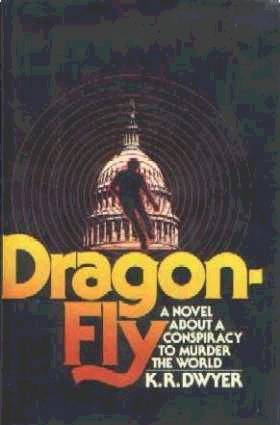
Dean Koontz – Dragonfly [Version 2.0 by BuddyDk – august 9 2003] [Easy read, easy print] [Completely new scan]
“. . . This special project . . . centers on an as yet unknown Chinese citizen who has been made, quite literally, into a walking bomb casing for a chemical-biological weapon that could kill tens of thousands of his people. The Committeemen have a code name for him— Dragonfly.”
“Berlinson has no idea who the carrier is?”
“All he knew was that Dragonfly is a Chinese citizen who was in the United States or Canada sometime between New Year’s Day and February fifteenth of this year.”
“How many suspects are there?”
“Five hundred and nine.”
DRAGONFLY White-knuckle suspense in the shock novel of the year!
All rights reserved under International and Pan-American Copyright Conventions. Published in the United States by Ballantine Books, a division of Random House, Inc., New York, and simultaneously in Canada by Ballantine Books of Canada, Ltd., Toronto, Canada.
Library of Congress Catalog Card Number: 75-9877
ISBN 0-345-25140-7-175
This edition published by arrangement with Random House, Inc.
Manufactured in the United States of America
First Ballantine Books Edition: August, 1976
To Bill Pronzini and Barry Malzberg— two-thirds of a friendship that keeps the telephone company solvent
ONE
ONE
Carpinteria, California
When he woke shortly after three o’clock Wednesday morning, Roger Berlinson thought he heard strange voices in the house. A quick word or two. Then silence. An unnatural silence? He was clutching the sweat-dampened sheets so tightly that his arms ached all the way to his shoulders. He let go of the sodden linens and worked the cramps out of his fingers. Trembling, he reached out with his right hand, pulled open the top drawer of the nightstand, and picked up the loaded pistol that was lying there. In the moon-dappled darkness he performed a blind man’s exploration of the gun until he was certain that both of the safeties were switched off. Then he lay perfectly still, listening. The house was on a low bluff overlooking the Pacific Ocean. In the empty early-morning hours the only sounds at the windows were the voices of nature: the soughing of a southwesterly wind, distant thunder, and the steady rush of the tide. Inside the house there were no voices, no squeaking floorboards, nothing but Berlinson’s own heavy breathing. It’s just your imagination, he told himself. Putney is on the midnight-to-eight duty. He’s downstairs in the kitchen right now, monitoring the alarm systems. If there was any trouble, he’d take care of it before it got serious. Putney’s a damned good man; he doesn’t make mistakes. So we’re safe. There’s absolutely no danger. You’ve had another nightmare, that’s all. Nevertheless, Berlinson threw back the covers and got out of bed and stepped into his felt-lined slippers. His moist pajamas clung to his back and thighs; chills swept down his spine. He held the gun at his side. In an instant he could bring it up, swivel, and fire in any direction. He was well trained. His wife, Anna, stirred in her sleep, but thanks to her nightly sedative, did not wake up. She turned over on her stomach and mumbled into the pillow and sighed. Quietly, cautiously, Berlinson crossed the room to the open door and eased into the second-floor hall. The corridor was much darker than the bedroom, for it had only one window at the far end. Berlinson had just enough light to see that everything was as it should be: the telephone table was at the head of the stairs; a large vase full of straw flowers stood on the window bench at the end of the hall; and the flimsy curtains billowed in the draft from the air-conditioning vent high on the right-hand wall. Berlinson walked past the staircase and on down the hall to his son’s room. Peter was in bed, lying on his side, facing the door, snoring softly. Under the circumstances, no one but a teenager, with an appetite for sleep as great as his appetite for food and activity, could possibly have slept so soundly, so serenely, without the aid of a drug. There you are, Berlinson told himself. Everyone’s safe. There’s no danger here. No one from the agency can possibly know where you are. No one. Except McAlister. Well, what about McAlister? Hell, he’s on your side. You can trust him. Can’t you? Yes. Implicitly. So there you are. However, instead of returning straight to bed, he went to the stairs and down to the first floor. The living room was full of dark, lumpish furniture. A grandfather clock ticked in a far corner; its pendulum provided the only movement, the only noise, the only sign of life, either animal or mechanical, in the room. The dining room was also deserted. The many-paned glass doors of the china hutch—and the dishes shelved beyond the glass—gleamed in the eerie orange light. Berlinson went into the kitchen, where the Halloweenish glow, the only light in the house, emanated from several expensive, complicated machines that stood on the Formica-topped breakfast table. Putney was gone. “Joe?” There was no reply. Berlinson went to look at the monitors—and he found Joseph Putney on the other side of the table. The night guard was sprawled on the floor, on his back, his arms out to his sides as if he were trying to fly, a bullet hole in the center of his forehead. His eyes glittered demonically in the orange light from the screens. Now hold on, keep control, keep cool, Berlinson thought as he automatically crouched and turned to see if anyone had moved in behind him. He was still alone. Glancing at the four repeater screens of the infrared alarm system which protected the house, Berlinson saw that the machines were functioning and had detected no enemies. All approaches to the house—north, east, south, and west from the beach—were drawn in thermal silhouette on these monitors. No heat-producing source, neither man nor animal nor machine, could move onto the property without immediately registering on the system, setting off a loud alarm, and thereby alerting the entire household. Yet Putney was dead. The alarm system had been circumvented. Someone was in the house. His cover was blown; the agency had come after him. In the morning Anna would find him just as he had found Putney . . . No, dammit! You’re a match for them. You’re as good and as fast as they are: you’re one of them, for Christ’s sake, a snake from the same nest. You’ll get Anna and Petey out of here, and you’ll go with them. He moved along the wall, back toward the dining room, through the archway, past the hutch, into the living room, to the main stairs. He studied the darkness at the top of the staircase. The man—or men— who had killed Putney might be up there now. Probably was. But there was no other way Berlinson could reach his family. He had to risk it. Keeping his back to the wall, alternately glancing at the landing above and at the living room below, expecting to be caught in a crossfire at any moment, he went up step by step, slowly, silently. Unmolested, he covered sixteen of the twenty risers, then stopped when he saw that there was someone sitting on the top step and leaning against the banister. He almost opened fire, but even in these deep shadows, the other man was somehow familiar. When there was no challenge made, no threat, no movement at all, Berlinson inched forward—and discovered that the man on the steps was Peter, his son. The front of Petey’s pajama shirt was soaked with blood; he had been shot in the throat. No! Dammit, no! Berlinson thought, weeping, shuddering, cursing, sick to his stomach. Not my family, damn you. Me, but not my family. That’s the rule. That’s the way the game’s played. Never the family. You crazy sonsofbitches! No, no, no! He stumbled off the steps and ran across the hall, crouching low, the pistol held out in front of him. He fell and rolled through the open bedroom door, came up onto his knees fast, and fired twice into the wall beside the door. No one was there. Should have been, dammit. Should have been someone there. He crawled around behind the bed, using it as a shield. Cautiously, he rose up to see if Anna was all right. In the moonlight the blood on the sheets looked as viscous and black as sludge oil. At the sight of her, Berlinson lost control of himself. “Come out!” he shouted to the men who must now be in the corridor, listening, waiting to burst in on him. “Show yourselves, you bastards!” On his right the closet door was flung open. Berlinson fired at it. A man cried out and fell full length into the room. His gun clattered against the legs of a chair. “Roger!” Berlinson whirled toward the voice which came from the hall door. A silenced pistol hissed three times. Berlinson collapsed onto the bed, clutching at the covers and at Anna. Absurdly, he thought: I can’t be dying. My life hasn’t flashed before my eyes. I can’t be dying if my life hasn’t
TWO
Washington, D.C.
When the doorbell rang at eleven o’clock that morning, David Canning was studying the leaves of his schefflera plant for signs of the mealybugs he had routed with insecticide a week ago. Seven feet tall and with two hundred leaves, the schefflera was more accurately a tree than a house plant. He had purchased it last month and was already as attached to it as he had once been, as a boy, to a beagle puppy. The tree offered none of the lively companionship that came with owning a pet; however, Canning found great satisfaction in caring for it—watering, misting, sponging, spraying with Malathion—and in watching it respond with continued good health and delicate new shoots. Satisfied that the mealybugs had not regenerated, he went to the door, expecting to find a salesman on the other side. Instead, McAlister was standing in the hall. He was wearing a five-hundred-dollar raincoat and was just pulling the hood back from his head. He was alone, and that was unusual; he always traveled with one or two aides and a bodyguard. McAlister glanced at the round magnifying glass in Canning’s hand, then up at his face. He smiled. “Sherlock Holmes, I presume.” “I was just examining my tree,” Canning said. “You’re a wonderful straight man. Examining your tree?” “Come in and have a look.” McAlister crossed the living room to the schefflera. He moved with grace and consummate self-assurance. He was slender: five ten, a hundred forty pounds. But he was in no way a small man, Canning thought. His intelligence, cunning, and self-possession were more impressive than size and muscle. His oblong face was square-jawed and deeply tanned. Inhumanly blue eyes, an electrifying shade that existed nowhere else beyond the technicolor fantasies on a Cinema-Scope screen, were accentuated by old-fashioned hornrimmed glasses. His lips were full but bloodless. He looked like a Boston Brahmin, which he was: at twenty-one he had come into control of a two-million-dollar trust fund. His dark hair was gray at the temples, an attribute he used, as did bankers and politicians, to make himself seem fatherly, experienced, and trustworthy. He was experienced and trustworthy; but he was too shrewd and calculating ever to seem fatherly. In spite of his gray hair he appeared ten years younger than his fifty-one. Standing now with his fists balled on his hips, he had the aura of a cocky young man. “By God, it is a tree!” “I told you,” Canning said, joining him in front of the schefflera. He was taller and heavier than McAlister: six one, a hundred seventy pounds. In college he had been on the basketball team. He was lean, almost lanky, with long arms and large hands. He was wearing only jeans and a blue T-shirt, but his clothes were as neat, clean, and well pressed as were McAlister’s expensive suit and coat. Everything about Canning was neat, from his full-but-not-long razor-cut hair to his brightly polished loafers. “What’s it doing here?” McAlister asked. “Growing.” “That’s all?” “That’s all I ask of it.” “What were you doing with the magnifying glass?” “The tree had mealybugs. I took care of them, but they can come back. You have to check every few days for signs of them.” “What are mealybugs?” Canning knew McAlister wasn’t just making small talk. He had a bottomless curiosity, a need to know something about everything; yet his knowledge was not merely anecdotal, for he knew many things well. A lunchtime conversation with him could be fascinating. The talk might range from primitive art to current developments in the biological sciences, and from there, to pop music to Beethoven to Chinese cooking to automobile comparisons to American history. He was a Renaissance man—and he was more than that. “Mealybugs are tiny,” Canning said. “You need a magnifying glass to see them. They’re covered with white fuzz that makes them look like cotton fluff. They attach themselves to the undersides of the leaves, along the leaf veins, and especially in the green sheaths that protect new shoots. They suck the plant’s juices, destroy it.” “Vampires.” “In a way.” “I meet them daily. In fact, I want to talk to you about mealybugs.” “The human kind.” “That’s right.” He stripped off his coat and almost dropped it on a nearby chair. Then he caught himself and handed it to Canning, who had a neatness fetish well known to anyone who had ever worked with him. As Canning hung the coat in the carefully ordered foyer closet, McAlister said, “Would it be possible to fix some coffee, David?” “Already done,” he said, leading McAlister into the kitchen. “I made a fresh pot this morning. Cream? Sugar?” “Cream,” McAlister said. “No sugar.” “A breakfast roll?” “Yes, that would be nice. I didn’t have time to eat this morning.” Motioning to the table that stood by the large mullioned window, Canning said, “Sit down. Everything’ll be ready in a few minutes.” Of the four available chairs McAlister took that one which faced the living-room archway and which put him in a defensible corner. He chose not to sit with his back to the window. Instead, the glass was on his right side, so that he could look through it but probably could not be seen by anyone in the gardened courtyard outside. He’s a natural-born agent, Canning thought. But McAlister would never spend a day in the field. He always started at the top—and did his job as well as he could have done had he started at the bottom. He had served as Secretary of State during the previous administration’s first term, then moved over to the White House, where he occupied the chief advisory post during half of the second term. He had quit that position when, in the midst of a White House scandal, the President had asked him to lie to a grand jury. Now, with the opposition party in power, McAlister had another important job, for he was a man whose widely recognized integrity made it possible for him to function under Republicans or Democrats. In February he had been appointed to the directorship of the Central Intelligence Agency, armed with a Presidential mandate to clean up that dangerously autonomous, corrupt organization. The McAlister nomination was approved swiftly by the Senate, one month to the day after the new President was inaugurated. McAlister had been at the agency—cooperating with the Justice Department in exposing crimes that had been committed by agency men—ever since the end of February, seven headline-filled months ago. Canning had been in this business more than six months. He’d been a CIA operative for twenty years, ever since he was twenty-five. During the cold war he carried out dozens of missions in the Netherlands, West Germany, East Germany, and France. He had gone secretly behind the Iron Curtain on seven separate occasions, usually to bring out an important defector. Then he was transferred Stateside and put in charge of the agency’s Asian desk, where the Vietnam mess required the attendance of a man who had gone through years of combat, both hot and cold. After fourteen months in the office, Canning returned to field work and established new CIA primary networks in Thailand, Cambodia, and South Vietnam. He operated easily and well in Asia. His fastidious personal habits, his compulsive neatness, appealed to the middle-and upper-class Asians who were his contacts, for many of them still thought of Westerners as quasi-barbarians who bathed too seldom and carried their linen-wrapped snot in their hip pockets. Likewise, they appreciated Canning’s Byzantine mind, which, while it was complex and rich and full of classic oriental cunning, was ordered like a vast file cabinet. Asia was, he felt, the perfect place for him to spend the next decade and a half in the completion of a solid, even admirable career. However, in spite of his success, the agency took him off his Asian assignment when he was beginning his fifth year there. Back home he was attached to the Secret Service at the White House, where he acted as a special consultant for Presidential trips overseas. He helped to define the necessary security precautions in those countries that he knew all too well. McAlister chaired these Secret Service strategy conferences, and it was here that Canning and he had met and become friends of a sort. They had kept in touch even after McAlister resigned from the White House staff—and now they were working together again. And again McAlister was the boss, even though his own experience in the espionage circus was far less impressive than Canning’s background there. But then, McAlister would be boss wherever he worked; he was born to it. Canning could no more resent that than he could resent the fact that grass was green instead of purple. Besides, the director of the agency had to deal daily with politicians, a chore of which Canning wanted no part. “Smells good,” McAlister said, stirring cream into his steaming coffee. Canning had set the table as if he were serving a full meal, everything properly arranged, every item squared off from the nearest other item: placemats, paper napkins, silverware, cups and saucers, a platter of rolls, a butter dish, butter knives, a cream pitcher, sugar bowl, and sugar spoon. He poured his own coffee and set the percolator on a wrought-iron coaster. “The raisin-filled buns are pretty good.” He buttered a roll, took a few bites, washed it down with coffee, and waited to hear why McAlister had come to see him. “I was afraid you might have gone away for your vacation and I’d have trouble locating you,” McAlister said. “I’ve traveled enough over the last twenty-five years.” McAlister buttered another piece of roll and said, “I was sorry to hear about you and Irene.” Canning nodded. “Divorce or separation?” “Separation. For now. Later on—probably a divorce.” “I’m sorry.” Canning said nothing. “I hope it was amicable.” “It was.” “How long have you been married?” “Twenty-seven years.” “Traumatic after all that time.” “Not if there’s no love involved on either side.” McAlister’s blue eyes looked through him as if they were X-ray devices. “I tried to reach you at your house in Falls Church, but Irene sent me here. How long has it been?” “We split eight weeks ago. I’ve been renting this apartment since the middle of August.” “The children?” “Mike’s twenty-six. Terri’s twenty. So, no custody fight.” “And there’s no animosity between you and them?” “They aren’t taking sides.” Canning put down his half-eaten roll and wiped his fingers on his napkin. “Let’s stop the psychoanalysis. You need me. You want to know if I’m emotionally stable enough to handle a new job. I am. The separation’s for the best. And a new assignment, something more interesting than this White House post, would be a tonic.” McAlister studied him for a moment. “All right.” He leaned forward, his arms on the table, and folded his hands around his coffee cup as if to warm his fingers. “You must know some of the things that I’ve uncovered since I came to the agency.” “I read the papers.” “Has any of it shocked you?” “No. Anyone with a trace of common sense has known for years that the agency’s a haven for crackpots. There’s a lot of work the agency has to do. Most of it’s dirty, ugly, and dangerous. But necessary. It isn’t easy to find normal, sensible, decent men to do it.” “But you’re normal, sensible, and decent.” “I like to think so. I wouldn’t get involved in some of these crazy schemes you’ve unearthed lately. But there are agents who want to get involved, adolescents playing out the cheapest masturbatory fantasies. But they aren’t just on the agency. They’re everywhere these days.” A fierce, prolonged gust of wind drove rain against the window. The droplets burst and streamed like tears. Or like colorless blood, a psychic intimation of blood to come, Canning thought. “These lunatics got into the agency because they had the proper politics. Back when I joined up, loyalty mattered more than philosophy. But for the last fifteen years, until you came along, applicants who were solid middle-of-the-road independents, like me, were rejected out of hand. A moderate is the same as a leftist to these nuts. Hell, I know men who think Nixon was a Communist dupe. We’ve been employing neo-Nazis for years. So the newspaper stories don’t shock or even surprise me. I just hope the agency can survive the housecleaning.” “It will. Because, as you said, we need it.” “I suppose,” Canning said. “Did you know any of the agents who have been indicted?” “I’ve heard some of the names. I never worked with them.” “Well,” McAlister said, “what you’ve read in the newspapers isn’t half as shocking as what you’ll never read there.” He drank the last of his coffee. “I’ve always believed in the public’s right to know . . .” “But?” Smiling ruefully, McAlister said, “But since I’ve learned what the agency’s been doing, I’ve tempered that opinion somewhat. If the worst were made public during our lifetime, the country would be shaken to its roots, blasted apart. The Kennedy assassinations . . . The most hideous crimes . . . They’d riot in the streets.” He wasn’t smiling any longer. “It wasn’t the agency alone. There are other threads. Powerful politicians. Mafiosi. Some of the richest, most socially prominent men in the country. If the people knew how far off the rails this nation went for more than a decade, we’d be ripe for a demagogue of the worst kind.” For the first time since he’d opened the front door and seen McAlister in the hall, Canning realized that the man had changed. At a glance he looked healthy, even robust. But he’d lost ten pounds. His face was more deeply lined than when he’d first assumed the directorship. Behind the aura of youthful energy, he was weary and drawn. His eyes, as blue and clear as they’d ever been, were filled with the sorrow of a man who has come home to find his wife happily gang-banging a group of strange men. In McAlister’s case the wife was not a woman but a country. “It’s one of these other horrors, something besides the assassinations, that’s brought you here.” Canning poured more coffee. “You don’t seem surprised by what I’ve told you.” “Of course I’m not surprised. Anyone who reads the Warren Report has to be a fool to believe it.” “I guess I was a fool for years,” McAlister said. “But now I need a first-rate agent I can trust. A dozen good men are available. But you’re the only one I’m even half sure isn’t a Committeeman.” Frowning, Canning said, “A what?” “We’ve discovered that within the CIA there’s another organization, illegal and illicit, a tightly knit cell of men who call themselves The Committee. True Believers, fanatical anti-Communists.” “Masturbating adolescents.” “Yes, but they’re dangerous. They have connections with extreme right-wing, paramilitary groups like the Minutemen. They’re friendly with certain Mafiosi, and they’re not short of patrons among men in New York banking and Texas oil. The Committee had a part in assassinations, other things . . . They answer to no one in government.” “Then why haven’t you broken them?” “We don’t know who they are,” McAlister said. “We have two names. Two of the men already under indictment. But there are at least twenty or twenty-five others. Hard-core operatives. They’ll serve their time rather than do any plea bargaining. They’ll never testify against the others. So we’re still working on it. I’m setting up a staff of investigators—men who’ve had no contact whatsoever with the agency, men I know I can trust.” Canning understood that when McAlister spoke of investigators, he meant lawyers, men who approached this kind of problem in terms of subpoenas, grand juries, indictments, prosecutions, and eventual convictions. But for the most part Canning was a field op, a man who liked to take direct action the instant he saw what the trouble was; he was not a paper shuffler. Although he respected the mass of laws upon which civilization was built, he was trained to solve problems quickly by circumventing all authorities and legal channels. He knew McAlister was fully aware of this. Nevertheless, he said, “And you want me on this staff?” “Perhaps later.” Which meant never. “Right now I need you for something more urgent.” He sipped his coffee: a dramatic pause. “This is so important and secret that no one must know you’ve been brought into it. That’s why I came to see you instead of sending for you. And that’s why I came alone. I was especially careful not to be followed.” That was Canning’s cue to ask what this was all about. Instead of that, he said, “What makes you think I’m trustworthy?” “You’re too much of a realist to be a brown shirt. I know you.” “And you are too much of a realist to choose a man for an important assignment because you happen to like him. So what’s the rest of the story?” Leaning back in his chair, McAlister said, “Did you ever wonder why you were taken off the top job in the Asian bureau?” “I shouldn’t have been.” “Agreed.” “You know why I was?” McAlister nodded. “I’ve read the entire agency file on you. It contains a number of unsigned memos from field ops stationed in South Vietnam, Cambodia, and Thailand during your tenure there. They complain that you put them under too much restraint.” Canning said, “Too damned many of them were ready to settle any problem with a gun or a knife.” He sighed softly. “They didn’t even like to stop and think if there might be a better, easier way.” He ran one hand over his face. “You mean that’s all it took for the director to pull me out of Asia? Unsigned memos?” “Well, there was also Duncan, Tyler, and Bixby.” They were three men who had served under Canning. Karl Duncan and Mason Tyler, who had once operated in Thailand, had tortured to death an American expatriate whom they “suspected” of being involved in illegal arms sales to guerilla leaders. Derek Bixby did his dirty work in Cambodia. He tortured the wife and eleven-year-old daughter of a Cambodian merchant, in front of the merchant’s eyes, until he had obtained a hidden set of papers that were en route from Hanoi to a guerilla general who was a close friend of the merchant. Once the documents were in his hands, Bixby murdered the man, wife, and child. In both cases neither torture nor murder was warranted. Infuriated, Canning had seen to it that Duncan, Tyler, and Bixby were not only taken out of Asia but were also dismissed from the agency when they returned Stateside. “They were animals,” Canning said. “You did the right thing. But Duncan, Tyler, and Bixby had friends in high places. Those friends engineered your withdrawal from Asia and saw you were given a harmless domestic assignment at the White House.” Sharp lines of anger webbed Canning’s skin at eyes and mouth. “Furthermore,” McAlister said, “Duncan, Tyler, and Bixby are all quite close to the two men we know are Committeemen. We’ve reason to believe that Duncan, Tyler, and Bixby are working in a civilian capacity with The Committee and are being paid with misappropriated agency funds. No proof—yet. Anyway, it seems unlikely that you have ever been one of them. Otherwise, why would you have fired those three?” He leaned forward again. “As I said, I’m half sure of you. There’s a chance I’ll be stabbed in the back. But the odds of that happening are lower with you than with anyone else I know.” Canning rose, took his cup and saucer to the sink and rinsed them thoroughly. He came back and stood at the window, watching the rain that slanted icily across the courtyard and pooled on the bricks. “What is this urgent assignment you have for me?” Taking a pipe from one jacket pocket and a pouch of tobacco from another, McAlister said, “During the last six months we’ve been building a new file from dribs and drabs of information—a name here, a rendezvous point there, a dozen rumors; you know how it works in this business—concerning a very special project the Committeemen have going for them.” Canning got a ten-inch circular white-glass ashtray from a cupboard and put it in front of McAlister. “Five days ago an agent named Berlinson came to me and said he was a Committeeman. He was about to be indicted for his role in several domestic operations that were aimed at destroying the political careers of three potential liberal Presidential candidates. He didn’t want to stand trial because he knew he would end up in jail. So he and I reached an agreement. He was quite willing to talk. But as it happens, lower-echelon agents of The Committee know only one or two others in the organization. Berlinson couldn’t give me a complete roster. He couldn’t tell me who stands at the head of the group. That was quite a disappointment.” “I can imagine.” “But it wasn’t a total loss,” McAlister said as he tamped the tobacco in the bowl of his pipe. “Berlinson was able to give me a general outline of this special project I’d been hearing about. It centers on an as yet unknown Chinese citizen who has been made, quite literally, into a walking bomb casing for a chemical-biological weapon that could kill tens of thousands of his people. The Committeemen have a code name for him—Dragonfly.” Canning sat down at the table again. “These reactionaries—these idiots intend to wage their own private war against China?” “Something like that.” McAlister struck a match, held the flame to the tobacco, and got his pipe fired up. He carefully put the burnt match in the center of the ashtray. “Berlinson has no idea who the carrier is?” “All he knew was that Dragonfly is a Chinese citizen who was in the United States or Canada sometime between New Year’s Day and February fifteenth of this year. That doesn’t really narrow it down much. Canada has had friendly relations with China considerably longer than we have; she does a great deal of business with them. At any given moment there are at least two hundred Chinese citizens in Canada: government representatives, officials of various Chinese industries, and artists who are involved in cultural exchange programs. In the United Stares, of course, there’s the Chinese delegation to the United Nations. And at one time or another during the forty-six days in question, we also played host to a contingent of trade negotiators, a touring group of forty officials from the Central Office of Publications who were here to study American publishing processes and printing methods, and finally, a symphony orchestra from Peking.” “How many suspects are there in both the U.S. and Canada?” Canning asked. “Five hundred and nine.” “And I take it that Dragonfly, whoever he is, doesn’t know anything about what’s been done to him.” “That’s right. He’s an innocent.” “But how could he be? How was it done?” “It’s a long story.” “I’ll listen.” McAlister poured himself another cup of coffee. While he picked up crumbs from his placemat and put them, one at a time, in the center of his paper napkin, Canning listened to McAlister’s story and took the facts from it and placed them, one at a time, in the neatly ordered file drawers of his mind. No matter with whom he was talking, no matter where or when, Canning was a good listener. He interrupted only to ask essential questions and to keep the conversation from digressing. With McAlister, of course, there were no digressions. He recited the facts with so few hesitations and with such economy of words that he might have been retelling a short story that he had committed to memory. It began with Dr. Olin Eugene Wilson—product of a strict and extremely religious family, witness at the McCarthy Hearings, where he testified against alleged Communists in the Pentagon, John Bircher, and self-styled fascist—who believed implicitly in Shockley’s theories of Negro inferiority and the supremacy of the White Race. Although he had not conceived the specific operation that was now known as the Dragonfly project, Dr. Wilson was the one man without whom the scheme could never have been realized. For thirty years Wilson had worked for the Department of Defense. He was a research biochemist, one of the most brilliant men in his field. The greater part of his important work had been done at Fort Detrick, in Maryland, where he supervised the development of half a dozen chemical and/or biological weapons that could topple an enemy government within seventy-two hours of the declaration of war. In 1969, when President Nixon announced that the United States would no longer engage in research for offensive biological warfare, Wilson was so infuriated that he presented his resignation to the chief of staff at Detrick. Certain highly placed civilian and military officials quickly assured Wilson that the President’s speech had been more of a public-relations gimmick than a genuine commitment. Yes, Detrick’s labs would be converted into facilities for cancer research. Yes, only weapons projects labeled “defensive” would be developed from this day forward. However . . . Fort Detrick had already become too much of a target for crusading journalists and peace demonstrators; therefore, it was time to move the CBW program into more modern and less well publicized quarters. As to whether or not the doctor would now be limited to defensive-weapons research . . . Well, they had a qualification of the President’s statement which satisfied Wilson. They explained that once the United States was attacked with a chemical and/or biological weapon, it would have to strike back immediately; and then those weapons which might have been labeled offensive when used for a first strike became defensive the moment they were used for retaliatory purposes. Thus educated in semantics, Wilson returned to work, happy and relatively secure. Within days of the President’s speech, Olin Wilson launched a program to study the feasibility of encapsulating anthrax, plague virus, and other disease strains and implanting them within the human body to create a walking biological time bomb that could be triggered either ten minutes from now, ten years from now, or at any moment in between. “Naturally,” Canning said, “Wilson was successful. The agency heard about it. And the Committeemen made Wilson an offer to come over to them.” “Which he did.” Canning frowned. “And Army security, Pentagon security, the security forces at the lab—none of them tumbled to the fact that he was farming out his data?” “None of them.” In late 1972, loudly professing his disenchantment with the current U.S.-Soviet detente, Olin Wilson resigned from his position with the Department of Defense. By that time his absolute disgust with Nixonian foreign policy was widely known. He was one of a group of five hundred prominent scientists, teachers, doctors, lawyers, businessmen, and other professionals who sponsored a series of anti-Communist advertisements in The New York Times. For the Sons of Truth, an up-and-coming right-wing organization similar to the John Birch Society, Wilson wrote a pamphlet entitled Communism, Richard Nixon, and the End of the American Dream. When he quit his job he said he was leaving because of his disillusionment with government policies and because of his despair over new national defense guidelines. He retired on a comfortable pension and on the income he received for speaking before any organization that would have him. For six months he jetted all over the country, addressing as many as five and six groups a week at a fee of seven hundred dollars plus expenses. Gradually, he was called to fewer and fewer podiums, until he began to spend most of his time at home in Alexandria, where he puttered in his garden and wrote angry letters to newspapers and magazines that supported or even gave voice to a liberal cause. A year after he resigned from government service, Wilson was leading such an uneventful life that any government security force that might have been watching him certainly must have decided to pack up and go away and leave him to his retirement. That was when Dr. Wilson went to work for The Committee. “You mean they have a laboratory all their own?” Canning asked incredulously. “That’s correct.” “But the sophisticated machinery, the maintenance . . . It would cost millions!” After he had taken time to relight his pipe, McAlister said, “Nearly all its life the agency has not been held accountable to anyone for how it spends its funds. Not to the Congress. Not to the President. No one. Furthermore, it receives considerably more money from the federal budget than is readily apparent. Attached to the largest appropriations bills like Defense and Government Operations, there are dozens of smaller appropriations—five million here, two million there—for programs which are seldom if ever scrutinized. Some of these programs don’t even exist. Their appropriations are tunneled directly to the agency. Once the agency has the money, it disburses it to a couple of hundred companies all over the world, firms that are nothing more than CIA fronts. No one man within the agency ever knows where all the money goes. So . . . It would be quite simple for these Committeemen to siphon off a couple of million a year for their own, private purposes. I’m sure that’s what they’ve done—and are still doing.” “But a laboratory devoted to chemical-biological warfare research is going to employ hundreds of people.” “As recently as a week ago,” McAlister told him, “I’d have said the same thing. But since I learned about Dragonfly, I’ve been doing my homework. For Olin Wilson’s purposes, a laboratory can be rather small. It can be staffed by as few as twelve specialists who are willing to be their own assistants. This kind of work is nowhere near as complicated as, say, searching for a cure for cancer. Any virus or bacterium can be cultured for pennies. For a few dollars you can grow enough plague virus to kill nine-tenths of the Russian population. Then you hit the remaining tenth with anthrax. Or worse. It’s the delivery systems that pose the real problems, but even that kind of experimentation isn’t prohibitively expensive. Biological warfare is cheap, David. That’s why most all of the major world powers deal in it. It costs substantially less than the money needed to build more and more and more nuclear missiles.” In the courtyard below, a young couple, sheltering under a newspaper, ran for an apartment door. Their laughter drifted up through the rain. Cherry-scented tobacco smoke hung in the humid air in Canning’s kitchen. “If the lab employs only a dozen men,” Canning said, “there’d be no trouble keeping it a secret.” “And if one of the wealthy businessmen who sympathize with the Committeemen happens to be the owner, director, or president of a chemical company, he could help create a plausible front for Wilson’s work.” “There ought to be records of some sort at this lab, something that would identify Dragonfly,” Canning said. “They’ll be in code, but codes are made to be broken.” “But we don’t know where the lab is.” “Berlinson couldn’t tell you?” “He’d heard of it. He’d been associated with Wilson. But he had never been to the lab.” “And you haven’t put a tail on Wilson?” McAlister laid his pipe in the ashtray and smiled grimly. “Can’t do that, I’m afraid. He’s dead.” “I see.” “He was electrocuted while making his breakfast toast.” “Quaint.” “Seems there was a nasty short in the toaster’s wiring. Brand-new toaster, too.” “The Underwriters’ Laboratories would be surprised to hear about that,” Canning said. “I daresay.” “When did this happen?” “The day after Roger Berlinson came to my home and offered to tell me what he knew about The Committee, exactly sixteen hours after I first heard Olin Wilson’s name.” “How coincidental.” “It’s for Ripley.” “And convenient.” “Of course, Berlinson couldn’t give me the names of any of the other scientists who are working at this lab. But from that moment on, I never talked with him in my own home or in my car or anywhere else that might be electronically monitored.” “What more did Berlinson tell you?” Early in 1971, while he was still employed by the Department of Defense, Dr. Wilson, with the aid of a hundred researchers, made several important breakthroughs in his work. He really did not strike out into any new territory, but he refined substances, pro-esses, and techniques that were already in use, refined them in the sense that an electric light bulb is merely a refinement of a wax candle, which, of course, it is, although it is much more than that. First of all he developed a petro-plastic spansule that was airtight, one hundred percent resistant to osmosis, neutral to body tissues, free of surface condensation, not even fractionally biodegradable—yet which was quite rubbery, unbreakable, and resilient. Second, he discovered a way to store deadly microorganisms within this spansule—a way to store them without the organisms losing more than five percent of their fertility, virility, and toxicity, no matter how long they were sealed up. Next, he worked out a procedure for implanting one of these spansules inside a human body in such a way that the carrier could not sense it, X-rays could not expose it, and only the most unlikely of accidents could open it before it was meant to be opened. Finally, he went outside of his specialty and applied other disciplines—surgery, psychology, pharmacology, espionage—to the problem until he perfected a way of turning any man into an unwitting, undetectable biological time bomb. “Which is Dragonfly,” McAlister said. “And now you’re going to tell me how it actually works.” “It’s achingly simple.” “I believe it,” Canning said. “Just from what you’ve told me so far, I think I can figure it out myself.” “So you tell me.” “First there’s one thing I need to get straight.” McAlister waited. “The Dragonfly project was never meant to decimate the Chinese population, was it?” “No.” McAlister picked up his pipe. “According to Berlinson, Dragonfly is carrying a severely mutated virus, something manufactured in the laboratory and essentially artificial in nature. It won’t respond to any known drug; however, it was designed to have a poor rate of reproduction and a short life span. Seventy-two hours after the spansule is broken, the microorganisms in it and ninety percent of their progeny will be dead. In ninety-six hours, none of the microbes will exist. The threat is limited to four days. There isn’t time for it to spread throughout China.” “Wilson never intended to kill tens of millions.” “Just tens of thousands. The stuffs apparently so toxic that a hundred to a hundred and fifty thousand people will die in four days. But that will be the extent of it. Although I must say that this apparent concern for human life is not the product of any moral sensibility. It’s a matter of logistics. If you kill millions of your enemy in a few days, you have an impossible logistics problem when you take over their country: how to get rid of the corpses.” McAlister’s eyes suddenly seemed to have become a bit more gray than blue. Shaking his head in disgust, Canning said, “If the kill target is so low, then the intent is to destroy the political and military elite—all of the highest officers of the Party, their possible successors, and their families. In the turmoil and confusion, a relative handful of men could take control of Peking, the strategic ports, and all of China’s nuclear weapons.” “And it looks as if the Committeemen have more than a handful of men at their disposal,” McAlister said. “We think they’ve made a deal with the Nationalist Chinese. For over a month there have been reports of frantic military preparations on Formosa. In the oh-so-glorious memory of Chiang Kai-shek, they evidently intend to reconquer the homeland.” “Jesus!” The implications became more staggering by the moment. In twenty years of day-to-day contact with the world of high-power espionage, Canning had never heard, had never conceived, of the agency’s getting involved in an operation as crazy as this one. Blackmail of domestic and foreign politicians, yes. The overthrow of a small South American or African nation, yes. Political assassination at home and abroad, yes. But he had never imagined that any element within the agency, no matter how fascistic and fanatical, would try to upset the delicate balance of world power all on its own hook. “But even if the operation were a success and the Nationalists reoccupied the mainland—” “We’d be on the brink of World War Three,” McAlister finished for him. “The Russians would figure that if we used that sort of weapon against China, we’d use it against them too. They’d be very tense. And rightfully so. The first time that Moscow suffered an epidemic of ordinary influenza, the first time a high Party official got a bad cold, they’d think they were under attack. They’d strike back at us with biological and nuclear weapons. No doubt about it.” Beneath his Palm Beach tan, his pallor deepened. “We have to stop Dragonfly.” Canning went to the bar in the living room and came back with a bottle of Scotch and two glasses. He got four ice cubes from the refrigerator, popped them into the glasses, and poured two or three shots into each glass. Picking up his Scotch, McAlister said, “I’m really not that much of a drinking man.” “Neither am I.” They both drank. Canning sat down again. The rain continued to snap against the windows. Lightning cracked across the black sky and threw flickering shadows onto the top of the kitchen table. When he had nearly finished his Scotch, McAlister said, “You said you thought you knew how Dragonfly, the Chinese carrier, had been chosen and set up.” Clearing his throat on the first few words, Canning said, “If only the Party elite is to be killed, then Dragonfly has to be someone who has contact with a number of men at the top of the Chinese government. He has to be someone who would spread the plague in the right circles.” “That really doesn’t narrow it down too much. Fully half the Chinese who visit the U.S. and Canada are high Party officials themselves.” Canning said, “I’m not trying to pinpoint a suspect. I’m just trying to see if I can reconstruct the way Wilson set it up.” He folded his hands on the table in front of him. He never gestured when he talked. Outwardly, except for the cleaning and polishing and lint-picking, he was not a nervous man. “To start with, Wilson needed a carrier. For the purpose of this discussion, let’s say he picked someone from that group of trade negotiators you mentioned a while ago.” “There were a couple of hundred more likely targets available,” McAlister said. “It would have been easier to get to someone in the symphony orchestra, for example. At least ten of the musicians were from families that wield political power in Peking. But for the moment, let’s say that it was someone from the trade negotiators.” “We ought to have a name for him,” Canning said. “How about Charlie Chan?” He wasn’t trying to be funny; it was the first name that came to mind. “All right. How would Wilson get to Charlie Chan?” Canning thought about it for a moment. Then: “These groups are always chaperoned by people from the State Department. Their itineraries are known. Most nights they eat dinner in a restaurant rather than at a catered banquet or in someone’s private home. Since the itinerary would usually be made out days before the Chinese arrived, the agency could easily learn the names of the restaurants well ahead of time. Members of The Committee, with all the right credentials for agency men, would approach the owner of one of these restaurants, feed him some solemn bullshit about national security, and get his permission to put a couple of operatives in the kitchen. Better yet, a Committeeman would be the waiter who serves Charlie Chan.” McAlister didn’t object to the scenario. Staring at the rain that trickled down the window, Canning laid out Wilson’s plan as quickly and neatly as he would have peeled and sectioned an orange. In a perverse way he was enjoying himself. This was what he had been born to do. After all those stifling years at the White House, he was back in action and glad of it “In his coffee or dessert Charlie Chan receives a fairly powerful but slow-acting sedative. Around nine-thirty, half an hour after he consumes it, Charlie pleads exhaustion and returns to his hotel room even if something else has been arranged for the rest of the night. By ten-thirty he’s sleeping soundly. Three or four agents enter his room, pack him in a crate or shipping trunk, and take him out of the hotel. By midnight he’s lying unconscious on an operating table in Wilson’s lab.” Reaming out the bowl of his pipe with a small gold-plated blade, McAlister said, “So far I believe you’ve got it right. I can’t be sure. Berlinson wasn’t in the lab. He wasn’t one of the agents who took Charlie out of the hotel in a shipping trunk. But he was a friend of Wilson’s. He pieced together bits of information that he picked up from the good doctor. So far you sound like you’re his echo. Go on.” Canning closed his eyes and could see the laboratory where it happened: cool fluorescent light that sharpened the edges of cabinets and cupboards, tables and machines; white tile walls and a tile floor; a yellow-skinned man lying nude on a cushioned operating table; half a dozen men dressed in hospital greens; murmured conversation rich with tension and excitemerit; the stench of antiseptic cleaning compounds and the sharp tang of alcohol like a knife slicing the air . . . “Wilson makes a half-inch incision in Charlie. Where it won’t show. In an armpit. Or in the fold of the buttocks. Or maybe high on the inside of a thigh. Then he inserts the spansule.” “Only the spansule?” Canning, his eyes still closed, could see it: a blue-white capsule no more than half an inch in length, a quarter of an inch in diameter. “Yes. Nothing else.” “Won’t there be a mechanism to puncture the spansule and free the microorganisms when the time comes for that?” “You said this entire thing was of a material that won’t show up on an X-ray?” “That’s correct.” “Then there can’t be any metal to it. And any mechanism that was meant to puncture the spansule on, say, the receival of a certain radio signal, would have metal in it. So there’s just the spansule, the capsule, that little cylinder of plastic.” Finished with his pipe, McAlister put it in a jacket pocket and looked for something else to do with his hands. “Continue,” he said. “The spansule fits less than an inch below the skin. When it’s in place, Wilson sews up the incision—using sutures that’ll dissolve by the time the healing’s complete, a week at most—and places an ordinary Band-Aid over it.” He paused to think, and while he thought he used one finger to draw a Band-Aid in the finely beaded moisture that had filmed the inside of several kitchen windowpanes. “Then I suppose Charlie would be given a second drug to wake him up—but he’d be put into an hypnotic trance before he really knew where he was or what was happening to him. Wilson would have to spend the rest of the night clearing Charlie’s memory and implanting a series of directives in his deep subconscious mind. Like . . . telling him that he will not see or feel the incision when he wakes up in the morning. And he’d have to be told when and how he’s to break open the spansule.” “All this would be done just with hypnosis?” “Since 1963 or thereabouts, we’ve had drugs that condition the mind for hypnotic suggestion,” Canning said. “I used them when I was in Asia. The Committeemen would have used them on Charlie Chan. With the drugs it’s not just hypnotic suggestion, it’s sophisticated brainwashing.” “You’re still echoing Berlinson. But how do you think they’d eventually trigger Charlie?” “You sound as if you don’t know.” “I don’t. Berlinson made a good guess. I’ve talked with some of the experts in the field, and I have a fair idea. But I don’t know.” “It would have to be a verbal trigger. A key phrase,” Canning said. “When he hears it, Dragonfly will . . . detonate himself. Or maybe all he has to do is read the phrase in a letter.” “No good,” McAlister said. “The letter, I mean. You forget that China is a totalitarian society. All mail going into China is opened and read. And most of it is destroyed no matter how harmless it might be.” “Then whoever triggers Dragonfly will be inside China already, and he’ll do it either in person or on the telephone.” “We feel it’ll be in person.” “One of our agents,” Canning said. “Yes.” “How many do we have in China?” “Three. Any one of them could be a Committeeman.” “Or all of them.” Reluctantly, McAlister agreed. Increasingly excited about the assignment, Canning got up and began to pace. “Let’s go back to the laboratory and pick up where we left off. Through a drug-induced hypnosis, Charlie has been programmed with all necessary directives. Next, he is told to fall asleep and not to wake up until his hotel-room telephone rings in the morning. Before dawn, he is returned to his room. He wakes up a few hours later, knowing nothing and feeling nothing about last night. Sooner or later he goes back to China. He lives precisely as he would have done had Wilson chosen someone else. Then one day a man walks up to him on the street, says the key phrase, and walks away. Per his program, Charlie goes home, where he has privacy of a sort. He breaks the capsule. Then he goes about his business as if it’s just another day. He still remembers nothing —not the man on the street who triggered him, not Wilson, not the microorganisms that are breeding within him, nothing! In twenty-four hours he’ll infect two or three hundred government people, who will pass the plague on to hundreds more, thousands more, before the virus dies out.” McAlister rose, picked up the ashtray and carried it to the wastecan, where he emptied it. “The spansule won’t show up in an X-ray. The petro-plastic lets the rays pass through. There are no metal parts. We’ve been through this before. There are no inorganic materials other than the petro-plastic. There’s nothing implanted with it to puncture it on a given signal. So how does Mr. Chan break it and infect himself once he’s been triggered?” Canning smiled. “Easy. Deep in his subconscious mind he’ll know exactly where the spansule has been sewn into him. He’ll feel for it and find it in a few seconds; it’s less than an inch beneath the skin. He’ll take a pin or a needle and prick himself, stab down far enough to pierce the wall of the spansule. Repeatedly.” Leaning against the counter, McAlister said, “You’re good.” “Every man’s good at something.” He went back to the table and sat down. “But there’s something that hasn’t occurred to you,” McAlister said softly. He met the blue eyes. He frowned. Then he scowled. “I must be rustier than I thought. They set this thing up back in January or February. It’s now September twenty-ninth. Charlie Chan went home a long time ago. So what is The Committee waiting for?” McAlister shrugged. “Is it possible Charlie did realize what was done to him and turned himself in to the authorities the moment he was back in Peking?” “It’s possible.” “Or maybe he was triggered—and it didn’t work.” “Maybe. But we can’t risk it. Now that the Committeemen know I’m on to them, they aren’t going to wait much longer. If Charlie is still a viable weapon, he’ll be used within the next few days.” “Which brings us to the last question,” Canning said. “That is?” “What do you want me to do about it?”
THREE
Stafford, Virginia
The driver, Roy Dodson, shifted his gaze from the busy superhighway to the nine-inch screen of the electronic scanner that was mounted on the console between the halves of the front seat. A blip of green light, winking like a star, had been at the center of the screen but was now moving rapidly toward the right-hand edge. Every time the light pulsed, the monitor produced a beeping signal. When the light first began to move to the right, the tone of the signal had changed; and it was this new sound that had caused the driver to take a look at the screen. “He’s on an exit ramp,” Dodson said. They were heading south on rain-washed Interstate 95, more than thirty miles from Washington and forty miles from the point at which they had begun to follow Robert McAlister. Traffic was moderately heavy. Hundreds of big trucks were working down toward Richmond and Norfolk. McAlister’s white Mercedes was one mile ahead of them, as it had been ever since they’d begun to tail it. They couldn’t see it at this distance, of course. But thanks to the electronic gear, there was no need for them to keep the other car in sight. “Close in on him,” the passenger said. He was a heavy-set man with a dour face and a hard, no-nonsense voice. Dodson depressed the accelerator, swung the Thunderbird into the passing lane, and swept around a chemical tank truck. The light was nearly to the edge of the screen. “Faster,” said the fat man. Dodson jammed the accelerator all the way to the floor. The speedometer needle rose from sixty to seventy to eighty and hovered just below the ninety mark. Wind screamed along the car’s streamlined flanks, and raindrops like gelatinous bullets snapped against the windshield. They passed another truck, two cars, and a motor home. The Thunderbird began to shimmy and float on the film of rain that covered the pavement. Dodson pulled out of the passing lane, then left the highway altogether, braking just as they shot into the exit ramp. The single lane curved farther to the right; the blip of green light eased back toward the center of the screen—then continued away to the left. At the foot of the ramp, not even pausing for the stop sign, Dodson turned left on the secondary road and stepped on the accelerator again. The green signal returned to the center of the monitor: the Mercedes was now directly in front of them, still out of sight beyond a low hill. “Slow down,” the fat man said. Dodson did as he was told. Malloy, the fat man’s previous aide, had been a twenty-eight-year-old veteran of the CIA’s West German office, and Malloy had not always done as he was told. Poor Malloy had not been able to understand why the fat man, who had never worked for the agency, should be in charge of the extremely important and extremely secret Committee. Malloy could see why there was a need to cooperate with wealthy and powerful civilians who were in sympathy with their goals. But having a civilian in charge of the operations was more than Malloy could stand. To become the top man’s aide, he had been required to resign from the agency himself, so that no government investigation of the CIA would ever zero in on him and then move from him to his boss and to the core of the apple. Before he became the fat man’s aide, Malloy had not known who was in charge, but he had thought that it was a man high in the agency or at least a former agency executive. When he learned the truth he was sullen, brusque, and rude to the very man who had brought him into the center circle of the organization. Eventually, the fat man saw that Malloy’s dissatisfaction with his boss might metamorphose into total disaffection with The Committee’s, program itself; therefore, Malloy was killed in an accident when his car apparently skidded on a perfectly dry roadbed and collided with a telephone pole outside of Alexandria, Virginia. Roy Dod-son knew precisely what had happened to his predecessor and why; his boss had told him all about it the first day that Dodson had come to work. No matter what he might think of the fat man, Dodson did as he was told, always had and always would. Just before they reached the crest of the hill, the green blip moved sharply to the right on the monitor. Then it disappeared past the edge, although the dark screen continued to produce a faint beep-beep-beep. Topping the hill they saw a large truck stop—twenty gasoline pumps on five widely spaced concrete islands, a service garage, three automatic truck-washing bays, a truckers’ motel, and restaurant—on the right side of the road. The huge parking lot contained sixty or seventy tractor-trailer rigs. “No Mercedes,” Dodson said. “He might have driven behind the buildings or in among all those trucks.” They drove through the nearest entrance and past the fueling stations where a dozen pump jockeys in bright yellow hooded rain slickers were tending to half a dozen trucks. Following the chain-link fence that encircled the property, they went around to the rear of the restaurant and the small, rather shabby motel. The beep-beep-beep, in counterpoint to the thumping windshield wipers, grew somewhat louder, and the light returned to the edge of the monitor—but there was no Mercedes here. On the south side of the complex, they cruised slowly down an aisle between the two rows of parked trucks—dull gray tailgates on both sides—which loomed like parading elephants. The signal was getting stronger by the second; the light edged back into the center of the screen. The beeping became so loud that it hurt their ears. Halfway down the aisle Dodson stopped the car and said, “We’re almost on top of it.” There was nothing around them except trucks. Barely able to control his anger, the fat man said, “Which one is it?” Putting the car in gear and letting it drift forward, Dodson studied the monitor on the console. Then he slipped the car into reverse and let it roll backward while he watched the green blip. At last he stopped again and pointed at a tractor-trailer that had SEA-TRAIN painted on the rear door. “McAlister must have found the gimmick on his Mercedes and switched it to this truck. We’ve been following a decoy.” Suddenly, without warning, the fat man raised his arms and leaned slightly forward and slammed both heavy fists into the top of the padded dashboard. Inside the closed car the blow reverberated like a note from a bass drum: and then a whole rhythm, a series of solid thumps. The fat man had gone berserk. His arms were like windmill blades. He hammered, hammered, cursed, hammered, growled wordlessly, his voice like an animal’s snarl, and hammered some more. His face was an apoplectic red, and hundreds of beads of sweat popped out on his brow. His eyes bulged as if they were being pushed out of him by some incredible inner pressure. The blood vessels at his temples stood up like ropes. He pounded the dashboard again and again, harder and harder . . . Beneath the padding the thin sheet metal began to bend. The fat man had tremendous strength in his thick arms. The dash sagged under the furious blows. Then, as suddenly as he had begun, he quit. He leaned back in his seat, breathing heavily, and stared out at the gray rain and the gray trucks and the wet black macadam. Stunned, Dodson said, “Sir?” “Get us the hell out of here.” Dodson hesitated. “Now, damn you!” Most of the way back to Washington, the fat man said nothing. He wasn’t embarrassed, and he wasn’t angry with Dodson. He was angry with himself. He’d had these rages before. Quite a few times, in fact. This was the first time, however, that anyone had seen him lose control. Always before, when he had felt that overpowering need to smash something with his fists, he had been able to wait until he was alone. Or with some whore. Over the last several days he had been under unbearable pressure. He never knew what that damned McAlister might do next. Keeping one step ahead of the bastard had been horribly difficult. And now he seemed to be one step behind. So this time he hadn’t been able to go off by himself and work off his frustrations unobserved. He’d exploded, much to his own surprise, in front of Dodson. It was frightening. He simply could not let go like that when anyone was around, not again, not even for an instant. As they entered the Washington suburbs, the fat man said, “Well, we know he’s got someone he trusts to send to Peking.” Dodson glanced nervously at his boss. “We do?” “Yes. We can deduce that much from his switching the transmitter to the truck. If he hadn’t been rendezvousing with an agent, he’d have let us waste time and manpower following him.” “That makes sense, I guess.” “I’ll find out who his man is. Before the day’s over. One way or another, I’ll find out.” “Yes, sir.” “It’s just that if we could have learned his name now, this morning, we’d have more time to—eliminate him.” Dodson licked his lips. Hesitantly, he said, “If we can’t find out who he’s sending to China—what then?” “Then, somehow we’ve got to activate Dragonfly immediately.” The rain had let up. Dodson put the windshield wipers on the lowest speed. “I’ve never been told what Dragonfly is.” “I know,” the fat man said.
FOUR
Washington, D.C.
When McAlister first arrived at the G Street apartment, David Canning was like a patch of barren earth: gray soil, ashes, broken twigs, cinders, and pebbles. The gray soil was his current uneventful career at the White House. The ashes were of his marriage. And the rest of it was the detritus of a day-to-day existence which held little excitement and no meaning. When he realized that McAlister had a new job for him, it was as if a green shoot had appeared in the barren earth. And now, a short while later, as McAlister began to explain the nature of the assignment, the shoot soared up and opened with leaves and budded and blossomed. Canning suddenly felt alive for the first time in years. “We’ve already alerted Peking,” McAlister said. He came back to the kitchen table and sat down across from Canning. “General Lin Shen Yang, head of their Internal Security Force, has ordered a thorough physical examination for every one of the five hundred and nine Chinese citizens who visited North America during January and February. We’ve told them that’s the wrong approach. No physical examination is going to unmask Dragonfly. If it were that easy to defuse the operation, Olin Wilson wouldn’t have bothered with it.” “Have you given General Lin the names of the three agents we have in China?” Canning asked. “Good Lord, no!” His blue eyes were big and round, like a pair of robin eggs. “Whether or not they’re Committeemen, we can’t let our men be grilled by Chinese intelligence experts. They’d find out who Dragonfly is —but they’d also learn everything worth knowing about our operations within their borders. No matter how tough an agent is, he can be broken if the interrogator uses a combination of extreme torture and drugs.” “Of course.” “Our entire Chinese network would be blown to pieces.” Canning nodded agreement. “And any Chinese citizens who have been cooperating with our agents would be rounded up and imprisoned. ‘Reeducated’ to better serve the People’s Republic.” “Exactly. And we’d probably suffer damage to our primary networks in most of Asia. Furthermore, if one of these three men is a Committeeman, and if he knows about some of these other things I’ve alluded to … Well, just imagine what the Chinese could do with that sort of information.” Rubbing one hand over his long and bony jaw, fingering the vague dimple in his chin, Canning thought for a moment and then said, “So you have to send a man to Peking to help General Lin find the Committeeman and, through him, Dragonfly.” “Yes.” “And I’m the man.” “As I’ve said, you’re the only one I can trust.” “The Chinese are expecting me?” “They’re expecting someone. Right now, I’m the only one who knows it’ll be you. They won’t get your name until they absolutely have to have it. The longer I can play this close to my vest, the longer it will take The Committee to find out just how much I know and what I’m going to do about it.” “What happens when I get to Peking? How close to the vest do I play it?” McAlister took his pipe out of his pocket again. He didn’t fill and light it this time. He just kept turning it over and over in his hands. “You’ll know the names of the three agents we have in China, but you won’t reveal them all at once to General Lin. Instead, you’ll provide him with one name at a tune.” “So he’ll still need me.” “Yes.” “After I’ve given him a name?” “You will accompany him when he takes the operative into custody. You will see that he brings that man directly to the United States consulate. There, with General Lin participating only as an observer, you will question our operative, using a sophisticated polygraph which is already security-sealed and on a plane en route to our consul in Peking. If the agent is not a Committeeman, if the polygraph shows that he knows nothing whatsoever about Dragonfly, then you will see that he is held under armed guard within the diplomatic compound until he can be flown back to Washington. Under no circumstances must the Chinese get their hands on him. Then you will move on to the next agent on the list. In each case, even when you discover the Committeeman, you will not permit Lin to be alone with our man, and you will see that the agent is whisked out of China on the first available flight of any United States government aircraft. If the first agent you interrogate happens to be the Committeeman, the trigger man for Dragonfly, you will not reveal any more names to General Lin, of course.” File drawers opened and dozens of phantom secretaries moved busily back and forth across the ethereal office in Canning’s mind. “The Chinese are going to go along with this? They aren’t going to seize the opportunity to discover which of their own people have been passing information to us?” “They have no choice but to handle it our way.” “I’ll be on their turf.” “Yes, but we could always just leave them to find Dragonfly on their own—which they simply cannot do.” “That’s a bluff.” “It is,” McAlister admitted. “And they’ll know it’s a bluff.” McAlister shook his head no. “Regardless of what the newspapers may print about it, the great détente between the United States and the People’s Republic of China is quite fragile. Oh, sure, most of the Chinese people want peace. They really aren’t all that imperialistic. They want open trade with us. But the great majority of the Party leaders don’t trust us. Not the least bit. God knows, they have good reason. But with most government officials, the distrust has grown into paranoia. They wouldn’t find it hard to believe that we’d let Dragonfly strike, because they’re certain that we’d like to split their country between ourselves and the Russians.” “They actually think we’re all wild-eyed reactionaries?” “They suspect that we are. And for most of them, suspicion is as good as proof. If he believes you’re capable of committing the most despicable acts against China, General Lin won’t push you too far. He’ll believe your threats if you have to make them.” “But don’t threaten him lightly?” “Yes. Diplomacy is always best.” Canning’s eyes were a crystalline shade of gray. Ordinarily they contained a sharp cold edge that most men could not meet directly. At the moment, however, his eyes were like pools of molten metal: warm, glistening, mercurial. “When do I leave?” “Four o’clock this afternoon.” “Straight to Peking?” “No. You’ll catch a domestic flight to Los Angeles.” McAlister took a folder of airplane tickets from an inner jacket pocket and laid it on the table. “From L.A. you’ll take another flight to Tokyo. There’s only a one-hour layover in Los Angeles. It’s an exhausting trip. But tomorrow night you’ll rest up in Tokyo. Friday morning you’ll board a jet belonging to a French corporation, and that’ll take you secretly to Peking.” Canning shook his head as if he were having trouble with his hearing. “I don’t understand. Why not a government plane direct to Peking?” “For one thing, I’d have to go through the usual channels to get you a seat. Or the President could go through them for me, with no need to explain anything to anyone. But either way, The Committee would learn about it. And if they knew . . . Well, I’m not so sure you would ever get to Peking.” “I can handle myself,” Canning said, not boasting at all, just stating a fact. “I know you can. But can you handle a bomb explosion aboard your airplane while it’s over the middle of the ocean, hundreds of miles from land? Remember Berlinson?” “Your informer?” Jagged lightning, like a dynamite blast in a bus-terminal locker, slammed across the purplish sky. The stroboscopic effect pierced the window and filled the kitchen with leaping shadows and knife-blade light. The crack of thunder followed an instant later—and there was an electric power failure. The refrigerator stopped humming and rattling. The fluorescent tubes above the kitchen counter blinked out. The meager, penumbral light of the early-afternoon storm sky, further filtered by the misted window, left them dressed in shadows. “Do you have any candles?” McAlister asked. “Let’s give them a few minutes to fix it. You were explaining why you think these Committeemen would go to any lengths to kill me. It has something to do with Berlinson . . .” McAlister sighed. “Once he had whetted my appetite by telling me a bit about Dragonfly, I promised Roger Berlinson three things in return for the rest of his information: exemption from criminal prosecution for anything he did as a CIA operative; a rather large cash payment; and last of all, a new name and a whole new life for him and his family. So … After he told me what he knew, I went to Ryder, the new FBI director, and I asked him for the use of an FBI safe house. I told him I needed it for a man whose name and circumstances I could not divulge. I explained that Ryder himself was the only man in the Bureau who could know the safe house was harboring someone I wanted to protect. Ryder was great: no questions, complete cooperation. The Berlinsons were spirited out of Washington and, by devious route, ended up in Carpinteria, California. So far as the FBI agents knew, Berlinson was a Mafia figure who had ratted on his bosses. Meanwhile, I went to various non-agency sources to obtain new birth certificates, passports, credit cards, and other documents for Roger, his wife, and his son. But I was wasting my time.” “They killed Berlinson.” His voice leaden, McAlister said, “The house in Carpinteria was protected by an infrared alarm system. It seemed as safe as a Swiss bank. What I didn’t know, what the FBI didn’t know, was that the Army has recently perfected a ‘thermal isolation’ suit that is one hundred percent effective in containing heat. It can be used by commandos to slip past infrared equipment. Two of these suits were stolen from an Army-CIA experimental lab in MacLean, Virginia.” He stopped for a moment as thunder rattled the windowpanes. It was convenient thunder, Canning thought, for McAlister needed to compose himself and clear his phlegm-filled throat. Then: “You can spend only twenty minutes inside the suit, because your body heat builds and builds in there until it can roast you alive. But twenty minutes is sufficient. We believe two men, wearing these suits, entered the Carpinteria house through a living-room window. Inside, they quietly stripped down to their street clothes before they broiled in their own juices. Then they went out to the kitchen and murdered the FBI agent who was monitoring the infrared repeater screens. When he was out of the way, they went upstairs and shot Berlinson, his wife, and his son.” The only sounds were those of the storm. The heavy dark air could not hold the words McAlister had spoken, but it did retain the anguish with which they’d been freighted. Canning said, “Families are never hit.” “We’re dealing with fanatics.” “But what did they have to gain by killing the wife and son?” “They probably wanted to set an example for anyone else who might be thinking of informing on The Committee.” Recalling Duncan, Tyler, and Bixby, Canning decided that such a thing was not only possible but likely. “Lunatics!” “The point is, if they would do a thing like this, then they wouldn’t hesitate to blow up a government aircraft, passengers and crew, just to get you. We must keep your involvement a secret until you’re safely inside China. If they kill you, I’ve got no one else I can send. I’ll have to go myself. And they’ll kill me.” “But why don’t they just trigger Dragonfly? Why don’t they get it over with before we can stop them?” “That’s the one thing that doesn’t make sense,” McAlister said. “I just don’t know the answer.” It was a paranoid nightmare. Yet Canning believed every word of it. Orange-red numerals suddenly glowed in the shadows. McAlister checked his electronic read-out watch and said, “We don’t have much time left.” “If we’re taking all these precautions,” Canning said, “then I assume I’ll be traveling under another identity.” Reaching into an inside pocket of his suit coat, McAlister produced a passport, birth certificate, and other identification. He passed the lot to Canning, who didn’t bother to try to examine it in the poor light. “Your name’s Theodore Otley. You’re a diplomatic courier for the State Department.” Canning was surprised. “Wouldn’t it be better for me to go as an ordinary citizen? Less conspicuous that way.” “Probably,” McAlister agreed. “But an ordinary citizen has to pass through anti-hijacking X-ray machines and later through customs. He can’t carry a gun. A diplomatic courier, however, is exempt from all inspections. And this one time you don’t want to be without a gun.” Like a blind man reading Braille, Canning paged through the passport. “Where did you get this stuff? Any chance The Committee will learn about old Ted Otley?” “In the last few months I’ve learned a few things. I know that only three intelligence agencies in the world have kept the CIA from planting a double agent. The Israelis run a tight outfit. So do the French. The British are the best, most efficient, most impenetrable intelligence specialists anywhere, period. I went to my opposite in Britain’s SIS, what used to be called M.I.6. I asked for and was granted a favor: one full set of papers in the Otley name. There is no way The Committee can crack it.” Canning knew that was true. “Theodore Otley it is.” “When you get to Tokyo you will check into the Imperial Hotel, where reservations have been made.” “The Imperial?” Canning asked, amazed. “Since when does a lowly op rate that kind of luxury?” “Since never. That’s why you’re getting it. In other Tokyo hotels—the Grand Palace, Takanawa Prince, Fairmont, just about anywhere—you might run into an agent who knows you. There’s not much chance of that if you stay at the Imperial.” “What about the French jet? How do I connect with it?” “That will be taken care of by your assistant.” Canning blinked. “Assistant?” “You don’t speak Chinese. You’ll need an interpreter.” “General Lin speaks no English?” “He does. But you don’t want to be completely cut out of a conversation when he uses Chinese with his subordinates.” “I don’t like it,” Canning said sourly. “The interpreter isn’t an agency rep. I’m not tying you to a possible Committeeman.” “A tenderfoot is just as bad.” “Hardly. Once you’re inside China, there won’t be any guns or knives or rough stuff. A tenderfoot can handle it.” “Who is he?” “This is strictly a need-to-know operation, and you don’t need to know the name. I’m especially concerned that no harm should come to the interpreter. They can’t torture a name from you if you haven’t got it.” Resigned to it, Canning said, “How do I contact him?” McAlister smiled, obviously amused. “He’ll contact you.” “What’s so funny?” “You’ll find out.’ “What I don’t need is surprises.” “This one’s pleasant. And remember: ‘need-to-know.’ ” The electric power came back into service. The refrigerator rumbled to life, and the living-room lights popped on like flash bulbs. Canning got up, went to the kitchen counter, worked the light switch until the fluorescent tubes fired up. He and McAlister squinted at each other for a few seconds. McAlister stood up and stretched. If he had been all lion when he had come through the front door, Canning thought, he was now at least ten percent tired old house cat. “That’s everything. You have any questions?” “Are you going to be working on the case from this end?” “I’ve built up a rather large, youngish, go-getting legal staff since I took over at the agency. I’m going to turn those lawyers into detectives.” “You could get them killed.” “Not if I send them out in teams of two and three, and not if there’s an armed United States marshal with each team.” “You can swing that?” Adjusting his cuffs, McAlister said, “The President has promised me anything I need.” “Where will you start?” “We’ll try to find Wilson’s laboratory. If we can get our hands on the files or on a scientist who worked with Wilson, we ought to be able to learn Dragonfly’s identity.” He led the way into the living room and waited while Canning got his raincoat from the foyer closet. “There’s another angle we’ll cover. Berlinson managed to kill one of the men sent to get him. The corpse wasn’t in the house in Carpinteria, but our forensic experts swear there was a fifth killing. There was a great deal of blood near the bedroom closet, and it doesn’t match types with any of the Berlinsons or with the FBI agent who was killed in the kitchen. So … Somewhere there’s a dead CIA operative, a dead Committeeman. I’m going to try to pin down the whereabouts of every agent who is supposed to be in Mexico or North America, any agent who might have slipped into Carpinteria, California. If one of them isn’t where he’s supposed to be, if his absence is unexplained, if I can’t get a line on him one way or another, then we can be pretty certain that he’s the one Berlinson killed. We’ll find out which agency employees were most friendly with him. They’ll probably be Committeemen. With luck, we might get hold of one of these fanatics before he knows what’s happening.” Canning held the hooded raincoat, waited until the other man had his arms in the sleeves, let go of the collar, and said, “Then what?” McAlister turned around to face him. Buttoning his coat, he said, “We interrogate him.” “Oh?” “We learn who runs The Committee.” “If he knows.” “Or we see if he can tell us where Wilson had his lab. Or who Dragonfly is.” “If he knows.” “He’ll know something.” Putting one hand on the doorknob but making no effort to turn it, Canning said, “Like you said earlier, these are all tough boys, hard cases. They won’t break unless you hit them with a combination of extreme torture and drugs.” “That’s right.” “You aren’t the kind of man who could use those techniques.” McAlister frowned. “Maybe I could.” “I hope you don’t have to. But I hope you can if it comes to that.” “I can. If it gets down to the wire.” “If it gets down to the wire,” Canning said, “it’s already too late.”
FIVE
The White House
At one-twenty that afternoon McAlister entrusted his Mercedes to a federal security officer and hurried toward a side entrance of the White House. The enormous old building, streaming with rain, looked like a piece of elegantly sculptured alabaster. All over the spacious grounds, the trees of many nations shared a common autumn: the leaves had begun to turn a hundred different shades of red and gold. McAlister was not aware of this beauty. His mind was on the Dragonfly crisis. He went straight to the door, exchanged hellos with the guard, and stepped into a small marbled foyer, where he left puddles of rain on the polished floor. Beau Jackson, the sixty-year-old tuxedoed black man who was on duty at the cloakroom, gave McAlister a toothy smile. Jackson was an anachronism that never failed to intrigue McAlister. His look and his manner seemed pre-Lincolnian. “Nasty out there, Mr. McAlister?” “Wet enough to drown ducks, Mr. Jackson.” The black man laughed as he took McAlister’s coat. Hanging it up, he said, “You just hold on a minute, and I’ll wipe the rain off your attaché case.” “Oh, I’ll get it,” McAlister said, putting the briefcase on a small mahogany stand and reaching for the display handkerchief that was folded to a perfect double point in the breast pocket of his suit jacket. “No, no!” Jackson said urgently. “You mustn’t mess up your nice hanky, Mr. McAlister.” “Really, I—” “Why, you have it folded so nice . . .” He tilted his graying head to admire the handkerchief. “Look at them folds. Would you look at them folds? Sharp enough to cut bread.” McAlister smiled and shook his head. “Okay. I’ll use the bathroom.” He went into the visitors’ lavatory, splashed cold water on his face, combed his hair, and straightened his tie. When he returned to the cloakroom, he found Jackson folding the dustcloth he had used to wipe off the attaché case. “Thank you, Mr. Jackson.” “You’re welcome, I’m sure.” He picked up the case. “How’s that son of yours getting along? The one who was trying to buy a McDonald’s franchise.” Jackson smiled, “He got the store all right. He’s deep in debt, but he’s working sixteen hours a day and selling hamburgers faster than they can kill the cows to make them.” McAlister laughed. “Good for him.” “Have a nice visit with the boss,” Jackson said. “That’s up to him.” Five minutes later, passed along by the appointments secretary, McAlister stood outside the door to the Oval Office. He hesitated, trying to relax, trying to get a smile on his face. On his left, three feet away, the ever-present warrant officer sat on a chair in the hallway. On his lap lay a black metal case, The Bag, the file of war codes that the President needed if he were to start—or finish—a nuclear war. Thirtyish, clean-cut and lean, the warrant officer was reading a paperback suspense novel. It had a colorful cover: two people running from an unseen enemy. Above the title was a line of copy: “Unarmed in the desert—with hired killers on their trail.” Without looking up, thoroughly hooked, the Bag Man turned a page. McAlister wondered how a man who might one day help to cause mega-deaths could possibly be enthralled by a fiction in which only two lives hung in the balance. He knocked on the door, opened it, and went in to see the President. The Oval Office was quintessentially American. It was clearly a room where business was transacted and not merely a place set aside for ceremonial purposes. The furniture was expensive, often antique, but also sturdy and functional. A United States flag hung from a brass stand at the right and behind the chief executive’s desk, as if everyone had to be reminded this was not Lithuania or Argentina. Every corner and glossy surface was squeaky clean. The room held a vaguely medicinal odor composed of furniture polish, carpet shampoo, and chemically purified, dehumidified air. The ubiquitous blue-and-silver Great Seal of the President of the United States officialized the carpet, the desk, the penholder that stood on the desk, the pens in the holder, the stationery, the stapler, the blotter, each of the many telephones, the sterling-silver pitcher full of ice water, and a dozen other things. Only American chiefs of staff, McAlister thought, could wield so much power and yet cling to such simple-minded status symbols as these. The focal point of the office was, of course, the President. He was a tall, broad-shouldered man who managed to look austere and approachable, sophisticated and of simple tastes, fatherly and quite sensual all at the same time. In spite of his London-tailored suit and hand-stitched Italian shoes, he had the rugged, rangy image of a cowboy actor. His hair was thick, salt-and-pepper, artfully mussed; and his eyebrows were dark and bushy. And he had the best collection of vintage 1960, white-white, porcelain-capped, steel-pin, jaw-sunk, permanently implanted, artificial teeth extant. “Good to see you, Bob,” he said, coming out from behind his desk, his right hand extended, his teeth gleaming. “Good afternoon, Mr. President,” McAlister said as they shook hands. The elaborate, long-time-no-see greeting made McAlister ill-at-ease, for he’d spent an hour with the President just last evening. “Nasty out there, Bob?” “Wet enough to drown ducks, Mr. President,” McAlister said, listening to the other man laugh, remembering Beau Jackson, wondering if there was actually all that much difference between a cloakroom attendant and a chief of state. The only other person present was Andrew Rice, the President’s number-one man. To his credit, he didn’t laugh at the duck joke; and Ms handshake was softer than the President’s; and he had imperfect teeth. McAlister didn’t particularly like the man, but he respected him. Which was exactly how he felt about the President, too. “You look as exhausted as I feel,” Rice said. “When this is over,” McAlister said, “I’m for the Caribbean.” As Rice groaned and shifted and tried to get comfortable in his chair, McAlister wondered what David Canning, compulsively neat as he was, would think of the senior advisor. Rice’s gray suit looked as if it had been put through a series of endurance tests by the idealists at the Consumer’s Union. His white shirt was yellow-gray, his collar frayed. His striped tie was stained, and the knot had been tied haphazardly. Standing five ten, weighing two-eighty, he was easily a hundred pounds too heavy. The chair creaked under him, and just the effort of getting settled down had made him breathe like a runner. Of course, Rice’s mind was quick, spare, and ordered. He was one of the country’s sharpest liberal thinkers. He had been twenty-six when Harvard University Press published his first book, Balancing the Budget in a Welfare State, and he had been electrifying political and economic circles ever since. “I received your brief report of this morning’s tragedy in Carpinteria,” the President said. “I called Bill Ryder at the Bureau to find out how in hell his security was breached. He didn’t know.” “We made a mistake putting Ryder at the FBI,” Rice said. The President allowed as how his senior advisor might be right. “Berlinson, Carpinteria . . . all of that’s become moot,” McAlister said. “Mr President, have you had any new communications with Peking?” “Thanks to a satellite relay, I had a twenty-minute talk with the Chairman a short while ago.” The President put a finger in one ear and searched for wax. “The Chairman isn’t happy.” He took the finger out of his ear and studied it: no wax. He tried the other ear. “He half believes that the entire Dragonfly hysteria is a trick of some sort. They’ve examined about half of the five hundred and nine suspects, and they haven’t found anything yet.” “Nor will they,” McAlister said. “The Chairman explained to me that if a plague should strike Peking, he will have no choice but to target all of China’s nuclear missiles on our West Coast.” The President found no wax in the second ear. “Their ballistics system is antiquated,” Rice said. “Their nuclear capabilities don’t amount to much.” He dismissed the Chinese with one quick wave of his pudgy hand. “True enough,” the President said. Dissatisfied with the results of the first exploration, he began to make another search of his ears, beginning again with the left one. “Our anti-missile system can stop anything they throw at us. They don’t have a saturation system like Russia does. We’ll intercept two or three hundred miles from shore. But the fallout won’t leave either Los Angeles or San Francisco very damned healthy.” Rice turned to McAlister. “The Chairman wants to know the name of the agent you’re sending over to General Lin.” “They want time to run their own background check on him,” the President said, giving up on his waxless ears and drumming his fingers on the desk. “They haven’t said as much. But that’s what I’d want to do if the roles were reversed.” “The only problem is that The Committee may be able to monitor all communications between us and the Chinese,” McAlister said softly, worriedly. “Not likely,” Rice said. “It would go out on the red phone,” the President said. “That line can’t be tapped.” “Any line can be tapped,” McAlister said. The President’s jaw set like rough-formed concrete. “The red phone is secure.” “I’m not questioning your word, Mr. President,” McAlister said. “But even if the red phone is safe, we can get my man killed by giving his name to the Chinese too early in the game. The Committee will have sources in China’s counterintelligence establishment. Once the Chinese have the name and start running a background check, The Committee will know who I’m sending. They’ll have my man hit before he’s safe in Peking.” “For God’s sake!” Rice said, huffing with frustration. “Look, we’re dealing with dangerous, crackpot reactionaries who have gotten deep into the CIA, perhaps deep into the FBI as well. For fifteen years now they’ve corrupted the democratic process. I think we all agree on that. We all understand what a grave matter this is. But these Committeemen aren’t omniscient! They aren’t lurking everywhere/” “I’d prefer to act as if they were,” McAlister said, shifting uncomfortably in his chair. The President continued to drum his fingers on the desk, using his left hand to counterpoint the rhythm he had developed with his right. He looked at McAlister from under his bushy eyebrows and said, “I think Andy’s right about this.” “Caution is admirable,” Rice said. “But we’ve got to guard against paranoia.” The President nodded. Wondering if he had gotten into a position where he would once again have to defy a President or resign his office, McAlister said, “I don’t want to transmit my man’s name to the Chinese any sooner than twelve hours before he’s due in Peking. That’s cutting it close enough so that The Committee won’t have time to organize a hit.” “Twelve hours,” the President said. “The Chairman won’t like that,” Rice said. His small, deep-set eyes and his pursed lips admonished McAlister. “Whether or not he likes it, that’s the way I want it.” Rice’s face was gradually mottling: red, pink, and chalk-white. He was like a malfunctioning boiler swelling up with steam. A rivet would pop any second now. In a surprisingly quiet voice the President said, “From the way you’re talking, Bob, I assume that you’ve found a man you think you can trust.” “That’s right, sir.” Taking his cue from the President, Rice controlled his anger. “An agency man?” McAlister told them how his morning had gone thus far: a visit to the British Embassy to pick up the set of forged papers that the SIS had prepared for him, a thorough search of his Mercedes until he located the transmitter he had known would be there, a quick switch of the transmitter to the tractor-trailer that had stopped for a red light, a meeting with the agent who would be sent to China . . . While McAlister talked, the President used a thumbnail to pick incessantly at his artificial teeth. He made a continual click-click-click noise. Occasionally he found a bit of tartar, which he carefully inspected. In public McAlister had never seen the man pick his teeth or bore at his ears or clean his fingernails or crack his knuckles or pick his nose. And even in the Oval Office he didn’t begin worrying at himself unless he was under pressure to make a policy decision. Now, wound tight by the Dragonfly crisis, he was rapidly going through his entire repertoire: he stopped picking his teeth, and he began to crack his knuckles one at a time. When McAlister finished talking, the President said, “You’ve neglected to mention the agent’s name.” He smiled. Crack!: a knuckle. “Before I tell you,” McAlister said, “I feel strongly that I should receive your assurance that you won’t pass it along to the Chairman any sooner than I want it to be passed.” Rice started to say something, decided that silence was at least valuable if not golden, and glowered at the President’s hands just as another knuckle cracked. The President got up and went to the Georgian window behind his desk. He stared at the traffic that moved through the rain down on Pennsylvania Avenue. He obviously knew, as did McAlister, that the name did not really matter. Getting the name was important not for practical reasons; it was merely a matter of face now. “What would you do if I refused to give you that assurance? Would you tell me his name—or defy me?” “Mr. President,” McAlister said, “I would do neither.” “Neither?” “I would resign, sir.” Not turning from the window, the fingers of both hands tangled behind his back and writhing like trysting worms, the President said, “That’s out of the question. This has to be resolved quickly, and you’re the only man I know who can handle it. You have my assurance.” “You promise, sir?” “Yes, Bob. The Chairman will get the name twelve hours before your man gets to Peking. My promise. Don’t push it any further.” Doggedly, McAlister said, “One step further, sir.” The President said nothing. McAlister said, “I wouldn’t want to talk any more about this if I thought we were being recorded. The tape might get into the hands of a Committeeman.” Turning to face them, grinning humorlessly, the President said, “Do you think any President since Nixon would be foolish enough to record his own conversations?” McAlister nodded. “My man’s name is David Canning.” “He’s on assignment here at the White House,” Rice said. “Why Canning?” the President asked. McAlister told him why. He also explained that Canning would travel as Theodore Otley and would leave Washington in two hours, on a four o’clock flight to Los Angeles. “I’m sending him by a series of civilian airlines, from Los Angeles to Tokyo and finally to Peking.” “That seems a waste of time,” Rice said, shaking his head disapprovingly. “Why not lay on a direct government flight—” “Which might easily be set up to explode over the ocean,” the President said. “Exactly,” McAlister said. “The Committee would have to know about it. They’d either put a bomb aboard here or at a fuel stop on the way.” Reluctantly, grudgingly, Rice said, “I suppose you’re right. We’ve been behaving like chronic paranoids, but they’ve left us no other way to behave.” The President said, “You’ll be trying to break the Dragonfly project from this end?” “Yes, sir,” McAlister said. “Have you been doing any thinking about why Dragonfly hasn’t already been triggered?” “That’s the question that kept me up most of last night,” McAlister said. “I can’t find an answer I like.” Looking at his watch, the President said, “Anything else, then? Anything more you need, Bob?” “In fact, there is, sir,” McAlister said as he got to Ms feet. “Name it.” “I’d like twelve federal marshals put under my control, four men each in three eight-hour shifts. I’ll need them for the protection of my investigative staff.” Glancing at Rice, the President said, “See to that, Andy.” Rice struggled out of his chair, which squeaked with relief. “They will be in your office tomorrow morning at eight-thirty,” he said. “You can brief them then and divide them whatever way you want.” “Thank you.” “And now I have a request,” the President said. McAlister said, “Sir?” “From now on, don’t go anywhere without your bodyguard.” “I don’t plan to, sir.” “It’ll get worse. They’ll get desperate the closer we get to Dragonfly.” “I know,” McAlister said. “My God,” Rice said, “What are we coming to when the highest officers of the land can’t trust their own subordinates? These reactionary bastards have nearly driven us into a police state!” No one had anything to say about that.
When McAlister left the Oval Office, the warrant officer looked up to see if the President might be at the open door with news of the world’s end. Then he went on with his reading. McAlister felt a bit weak behind the knees and in the pit of his stomach. He had known four Presidents and had been appointed to office by two of them. He had seen that they were all flawed, sometimes tragically so. They were all, in whole or part, vain and foolish, misinformed and sometimes even crooked. Yet he had not lost his respect for the office—perhaps because it was the keystone of that system of laws and justice which he so admired—and he stood in awe of any halfway decent man who held it. His intellect and emotions had reached a compromise on this subject, and he experienced no need to analyze his feelings. This was simply how he was, and he had grown accustomed to the weakness in his knees and stomach after every conference in the Oval Office. Don’t you know you’re from a fine Boston family with a forty-foot genealogical chart? he asked himself. A Boston family. There is no better. Didn’t you listen to your mother? She told you at least a million tunes. And your father. Didn’t anything he said get through to you? You’re Bostonian, old Bostonian! You’re from the stock that patronized the Atlantic Monthly, and your father was a member of the Porcellian Club at Harvard! Don’t you know that no one’s better than you? He laughed softly. He still felt a bit weak. When McAlister entered the back corridor, the guard at the end saw him coming and said, “Leaving now, Mr. McAlister?” “As soon as I get my coat.” The guard pulled on his rain slicker and went out to see that the Mercedes was brought around. Beau Jackson was not in the cloakroom. McAlister put down his attaché case and went to the open-front wall-length closet. As he put on his coat he noticed a thick black-and-gold hardbound book lying on the hat shelf. With the curiosity of a book lover, he picked it up and looked at the title: The Complete Kafka—The Stories, Annotated and Analyzed. On the flyleaf there was a three-inch-square bookplate:
From the Library of B. W. JACKSON
Beau Jackson came out of the lavatory into the cloakroom. He stopped and stared at the book in McAlister’s hands, and said, “Somebody left that here last week. It yours, Mr. McAlister?” “Belongs to a B.W. Jackson. Know him?” The black man smiled. “Surprise you?” “Not really. I’ve always figured you can’t be what you seem to be.” He put the book back on the hat shelf. Carrying McAlister’s attaché case, Jackson walked him across the cloakroom, into the hall. “Then I guess I belong here.” McAlister pulled up his hood, buttoned his coat collar. “Oh?” Handing him the case, Jackson said, “Around here a lot of people just aren’t what they seem to be.” Grinning, McAlister said, “You mean that you’re disappointed with the way the boss has been running things? You’re sorry you voted for him?” “I did vote for him,” Jackson said. “And for once in my life I figure maybe I pulled the right lever.” His broad, dark face was sober, almost glum. “Compared to that Sidney Greenstreet of his, the boss is as real and genuine and unphony as they come.” “Sidney Greenstreet?” McAlister said, perplexed. At the end of the hall, the guard came back inside and said, “Car’s ready, Mr. McAlister.” “Who’s Sidney Greenstreet?” McAlister asked the black man. Beau Jackson shook his head. “If you aren’t a fan of the old movies, then it can’t mean anything to you. Just goes right over your head.” For a long moment McAlister stared into the other man’s watery chocolate-brown eyes. Then he said, “You’re an original, Mr. Jackson.” He went down the last stretch of the hallway toward the door that the guard was holding open for him. “Mr. McAlister,” the black man called after him. He looked back. “You’re sure enough the only one I ever met here who is just exactly what he seems to be.” McAlister couldn’t think of anything to say. He nodded stupidly, embarrassed by the compliment, and he went outside into the rain and wind that lashed the capital.