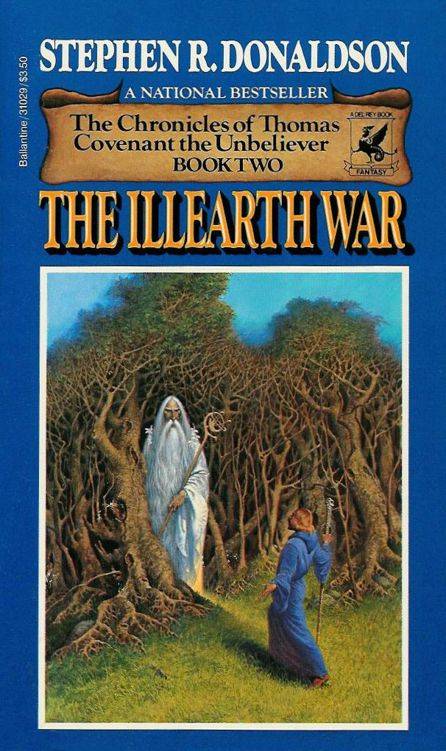
The Chronicles of Thomas Covenant and Unbeliever BOOK THREE
C 1977
V 1.0
**SCANNED BY KEG APR2001**
[ONE] The Danger in Dreams
Thomas Covenant was talking in his sleep. At times he knew what he was doing; the broken pieces of his voice penetrated his stupor dimly, like flickers of innocence. But he could not rouse himself-the weight of his exhaustion was too great. He babbled like millions of people before him, whole or ill, true or false. But in his case there was no one to hear. He would not have been more alone if he had been the last dreamer left alive.
When the shrill demand of the phone cut through him, he woke up wailing.
For a moment after he threw himself upright in bed, he could not distinguish between the phone and his own flat terror; both echoed like torment through the fog in his head. Then the phone rang again. It pulled him sweating out of bed, compelled him to shamble like a derelict into the living room, forced him to pick up the receiver. His numb, disease-cold fingers fumbled over the black plastic, and when he finally gained a grip on it, he held it to the side of his head like a pistol.
He had nothing to say to it, so he waited in blankness for the person at the other end of the line to speak.
A woman’s voice asked uncertainly, “Mr. Covenant? Thomas Covenant?”
“Yes,” he murmured, then stopped, vaguely surprised by all the things he had with that one word admitted to be true.
“Ah, Mr. Covenant,” the voice said. “Megan Roman calling.” When he said nothing, she added with a touch of acerbity, “Your lawyer. Remember?”
But he did not remember; he knew nothing about lawyers. Numb mist confused all the links of his memory. Despite the metallic distortion of the connection, her voice sounded distantly familiar; but he could not identify it.
She went on, “Mr. Covenant, I’ve been your lawyer for two years now. What’s the matter with you? Are you all right?”
The familiarity of her voice disturbed him. He did not want to remember who she was. Dully, he murmured, “It doesn’t have anything to do with me.”
“Are you kidding? I wouldn’t have called if it didn’t have to do with you. I wouldn’t have anything to do with it if it weren’t your business.” Irritation and discomfort scraped together in her tone.
“No.” He did not want to remember. For his own benefit, he strained to articulate, “The Law doesn’t have anything to do with me. She broke it. Anyway, I- It can’t touch me.”
“You better believe it can touch you. And you better listen to me. I don’t know what’s wrong with you, but-“
He interrupted her. He was too close to remembering her voice. “No,” he said again. “It doesn’t bind me. I’m-outside. Separate. It can’t touch me. Law is”-he paused for a moment, groped through the fog for what he wanted to say-“not the opposite of Despite.”
Then in spite of himself he recognized her voice. Through the disembodied inaccuracy of the phone line, he identified her.
Elena.
A sickness of defeat took the resistance out of him.
She was saying, “-what you’re talking about. I’m your lawyer, Megan Roman. And if you think the law can’t touch you, you’d better listen to me. That’s what I’m calling about.”
“Yes,” he said hopelessly.
“Listen, Mr. Covenant.” She gave her irritation a free hand. “I don’t exactly like being your lawyer. Just thinking about you makes me squirm. But I’ve never backed down on a client before, and I don’t mean to start with you. Now pull yourself together and listen to me.”
“Yes.” Elena? he moaned dumbly. Elena? What have I done to you?
“All right. Here’s the situation. That-unfortunate escapade of yours-Saturday night-has brought matters to a head. It- Did you have to go to a nightclub, Mr. Covenant? A nightclub, of all places?”
“I didn’t mean it.” He could think of no other words for his contrition.
“Well, it’s done now. Sheriff Lytton is up in arms. You’ve given him something he can use against you. He spent Sunday evening and this morning talking to a lot of people around here. And the people he talked to talked to other people. The township council met at noon.
“Mr. Covenant, this probably wouldn’t have happened if everyone didn’t remember the last time you came to town. There was a lot of talk then, but it’d calmed down for the most part. Now it’s stirred up again. People want action.
“The council intends to give them action. Our scrupulous local government is going to have your property rezoned. Haven Farm will probably be zoned industrial. Residential use will be prohibited. Once that’s done, you can be forced to move. You’ll probably get a fair price for the Farm-but you won’t find any other place to live in this county.”
“It’s my fault,” he said. “I had the power, and I didn’t know how to use it.” His bones were full to the marrow with old hate and death.
“What? Are you listening to me? Mr. Covenant, you’re my client- for whatever that’s worth. I don’t intend to stand by and let this happen to you. Sick or not, you’ve got the same civil rights as anyone else. And there are laws to protect private citizens from-persecution. We can fight. Now I want”-against the metallic background noise of the phone, he could hear her gathering her courage-“I want you to come to my office. Today. We’ll dig into the situation-arrange to appeal the decision, or file suit against it-something. We’ll discuss all the ramifications, and plan a strategy. All right?”
The sense of deliberate risk in her tone penetrated him for a moment. He said, “I’m a leper. They can’t touch me.”
“They’ll throw you out on your ear! Damn it, Covenant-you don’t seem to understand what’s going on here. You are going to lose your home. It can be fought-but you’re the client, and I can’t fight it without you.”
But her vehemence made his attention retreat. Vague recollections of Elena swirled in him as he said, “That’s not a good answer.” Absently, he removed the receiver from his ear and returned it to its cradle.
For a long time, he stood gazing at the black instrument. Something in its irremediable pitch and shape reminded him that his head hurt.
Something important had happened to him.
As if for the first time, he heard the lawyer saying, Sunday evening and this morning. He turned woodenly and looked at the wall clock. At first he could not bring his eyes into focus on it; it stared back at him as if it were going blind. But at last he made out the time. The afternoon sun outside his windows confirmed it.
He had slept for more than thirty hours.
Elena? he thought. That could not have been Elena on the phone. Elena was dead. His daughter was dead. It was his fault.
His forehead began to throb. The pain rasped his mind like a bright, brutal light. He ducked his head to try to evade it.
Elena had not even existed. She had never existed. He had dreamed the whole thing.
Elena! he moaned. Turning, he wandered weakly back toward his bed.
As he moved, the fog turned crimson in his brain.
When he entered the bedroom, his eyes widened at the sight of his pillow; and he stopped. The pillowcase was stained with black splotches. They looked like rot, some species of fungus gnawing away at the white cleanliness of the linen.
Instinctively, he raised a hand to his forehead. But his numb fingers could tell him nothing. The illness that seemed to fill the whole inside of his skull began laughing. His empty guts squirmed with nausea. Holding his forehead in both hands, he lurched into the bathroom.
In the mirror over the sink, he saw the wound on his forehead.
For an instant, he saw nothing of himself but the wound. It looked like leprosy, like an invisible hand of leprosy clenching the skin of his forehead. Black crusted blood clung to the ragged edges of the cut, mottling his pale flesh like deep gangrene; and blood and fluid seeped through cracks in the heavy scabs. He seemed to feel the infection festering its way straight through his skull into his brain. It hurt his gaze as if it already reeked of disease and ugly death.
Trembling fiercely, he spun the faucets to fill the sink. While water frothed into the basin, he hurried to lather his hands.
But when he noticed his white gold ring hanging loosely on his wedding finger, he stopped. He remembered the hot power which had pulsed through that metal in his dream. He could hear Bannor, the Blood-guard who had kept him alive, saying, Save her! You must!-hear himself reply, I cannot! He could hear Hile Troy’s shout, Leper! You’re too selfish to love anyone but yourself. He winced as he remembered the blow which had laid open his forehead.
Elena had died because of him.
She had never existed.
She had fallen into that crevice, fighting desperately against the specter of mad Kevin Landwaster, whom she had Commanded from his grave. She had fallen and died. The Staff of Law had been lost. He had not so much as lifted his hand to save her.
She had never even existed. He had dreamed her while he lay unconscious after having hit his head on the edge of the coffee table.
Torn between conflicting horrors, he stared at his wound as if it were an outcry against him, a two-edged denunciation. From the mirror it shouted to him that the prophecy of his illness had come to pass.
Moaning, he pushed away, and rushed back toward the phone. With soapy, dripping hands, he fumbled at it, struggled to dial the number of Joan’s parents. She might be staying with them. She had been his wife; he needed to talk to her.
But halfway through the number, he threw down the receiver. In his memory, he could see her standing chaste and therefore merciless before him. She still believed that he had refused to talk to her when she had called him Saturday night. She would not forgive him for the rebuff he had helplessly dealt her.
How could he tell her that he needed to be forgiven for allowing another woman to die in his dreams?
Yet he needed someone-needed someone to whom he could cry out, Help me!
He had gone so far down the road to a leper’s end that he could not pull himself back alone.
But he could not call the doctors at the leprosarium. They would return him to Louisiana. They would treat him and train him and counsel him. They would put him back into life as if his illness were all that mattered, as if wisdom were only skin-deep-as if grief and remorse and horror were nothing but illusions, tricks done with mirrors, irrelevant to chrome and porcelain and clean, white, stiff hospital sheets and fluorescent lights.
They would abandon him to the unreality of his passion.
He found that he was gasping hoarsely, panting as if the air in the room were too rancid for his lungs.
He needed-needed.
Dialing convulsively, he called Information and got the number of the nightclub where he had gone drinking Saturday night.
When he reached that number, the woman who answered the phone told him in a bored voice that Susie Thurston had left the nightclub. Before he could think to ask, the woman told him where the singer’s next engagement was.
He called Information again, then put a long-distance call through to the place where Susie Thurston was now scheduled to perform. The switchboard of this club connected him without question to her dressing room.
As soon as he heard her low, waifish voice, he panted thickly, “Why did you do it? Did he put you up to it? How did he do it? I want to know-”
She interrupted him roughly. “Who are you? I don’t know what the hell you’re talking about. Who do you think you are? I didn’t do nothing to you.”
“Saturday night. You did it to me Saturday night.”
“Buster, I don’t know you from Adam. I didn’t do nothing to you. Just drop dead, will you? Get off my phone.”
“You did it Saturday night. He put you up to it. You called me ‘Berek.’ ” Berek Halfhand-the long-dead hero in his dream. The people in his dream, the people of the Land, had believed him to be Berek Halfhand reborn-believed that because leprosy had claimed the last two fingers of his right hand. “That crazy old beggar told you to call me Berek, and you did it.”
She was silent for a long moment before she said, “Oh, it’s you. You’re that guy-the people at the club said you were a leper.”
“You called me Berek,” Covenant croaked as if he were strangling on the sepulchral air of the house.
“A leper,” she breathed. “Oh, hell! I might’ve kissed you. Buster, you sure had me fooled. You look a hell of a lot like a friend of mine.”
“Berek,” Covenant groaned.
“What-‘Berek’? You heard me wrong. I said, ‘Berrett.’ Berrett Williams is a friend of mine. He and I go ‘way back. I learned a lot from him. But he was three-quarters crocked all the time. Anyway, he was sort of a clown. Coming to hear me without saying a thing about it is the sort of thing he’d do. And you looked-“
“He put you up to it. That old beggar made you do it. He’s trying to do something to me.”
“Buster, you got leprosy of the brain. I don’t know no beggars. I got enough useless old men of my own. Say, maybe you are Berrett Williams. This sounds like one of his jokes. Berrett, damn you, if you’re setting me up for something-“
Nausea clenched in Covenant again. He hung up the phone and hunched over his stomach. But he was too empty to vomit; he had not eaten for forty-eight hours. He gouged the sweat out of his eyes with his numb fingertips, and dialed Information again.
The half-dried soap on his fingers made his eyes sting and blur as he got the number he wanted and put through another long-distance call.
When the crisp military voice said, “Department of Defense,” he blinked at the moisture which filled his eyes like shame, and responded, “Let me talk to Hile Troy.” Troy had been in his dream, too. But the man had insisted that he was real, an inhabitant of the real world, not a figment of Covenant’s nightmare.
“Hile Troy? One moment, sir.” Covenant heard the riffling of pages briefly. Then the voice said, “Sir, I have no listing for anyone by that name.”
“Hile Troy,” Covenant repeated. “He works in one of your-in one of your think tanks. He had an accident. If he isn’t dead, he should be back to work by now.”
The military voice lost some of its crispness. “Sir, if he’s employed here as you say-then he’s security personnel. I couldn’t contact him for you, even if he were listed here.”
“Just get him to the phone,” Covenant moaned. “He’ll talk to me.”
“What is your name, sir?”
“He’ll talk to me.”
“Perhaps he will. I still need to know your name.”
“Oh, hell!” Covenant wiped his eyes on the back of his hand, then said abjectly, “I’m Thomas Covenant.”
“Yes, sir. I’ll connect you to Major Rolle. He may be able to help you.”
The line clicked into silence. In the background, Covenant could hear a running series of metallic snicks like the ticking of a deathwatch. Pressure mounted in him. The wound on his forehead throbbed like a scream. He clasped the receiver to his head, and hugged himself with his free arm, straining for self-control. When the line came to life again, he could hardly keep from howling at it.
“Mr. Covenant?” a bland, insinuating voice said. “I’m Major Rolle. We’re having trouble locating the person you wish to speak to. This is a large department–you understand. Could you tell me more about him?”
“His name is Hile Troy. He works in one of your think tanks. He’s blind.” The words trembled between Covenant’s lips as if he were freezing.
“Blind, you say? Mr. Covenant, you mentioned an accident. Can you tell me what happened to this Hile Troy?”
“Just let me talk to him. Is he there or not?”
The major hesitated, then said, “Mr. Covenant, we have no blind men in this department. Could you give me the source of your information? I’m afraid you’re the victim of-“
Abruptly, Covenant was shouting, raging. “He fell out of a window when his apartment caught fire, and he was killed! He never even existed!”
With a savage heave, he tore the phone cord from its socket, then turned and hurled it at the clock on the living-room wall. The phone struck the clock and bounced to the floor as if it were impervious to injury, but the clock shattered and fell in pieces.
“He’s been dead for days! He never existed!”
In a paroxysm of fury, he lashed out and kicked the coffee table with one numb booted foot. The table flipped over, broke the frame of Joan’s picture as it jolted across the rug. He kicked it again, breaking one of its legs. Then he knocked over the sofa, and leaped past it to the bookcases. One after another, he heaved them to the floor.
In moments, the neat leper’s order of the room had degenerated into dangerous chaos. At once, he rushed back to the bedroom. With stumbling fingers, he tore the penknife out of his pocket, opened it, and used it to shred the bloodstained pillow. Then, while the feathers settled like guilty snow over the bed and bureaus, he thrust the knife back into his pocket and slammed out of the house.
He went down into the woods behind Haven Farm at a run, hurrying toward the secluded hut which held his office. If he could not speak of his distress, perhaps he could write it down. As he flashed along the path, his fingers were already twitching to type out: Help me help help help! But when he reached the hut, he found that it looked as if he had already been there. Its door had been torn from its hinges, and inside the hulks of his typewriters lay battered amid the litter of his files and papers. The ruin was smeared with excrement, and the small rooms stank of urine.
At first, he stared at the wreckage as if he had caught himself in an act of amnesia. He could not remember having done this. But he knew he had not done it; it was vandalism, an attack on him like the burning of his stables days or weeks ago. The unexpected damage stunned him. For an odd instant, he forgot what he had just done to his house. I am not a violent man, he thought dumbly. I’m not.
Then the constricted space of the hut seemed to spring at him from all the walls. A suffocating sensation clamped his chest. For the third time, he ached to vomit, and could not.
Gasping between clenched teeth, he fled into the woods.
He moved aimlessly at first, drove the inanition of his bones as fast as he could deep into the woodland with no aim except flight. But as sunset filled the hills, cluttered the trails with dusk, he bent his steps toward the town. The thought of people drew him like a lure. While he stumbled through the twilit spring evening, odd, irrational surges of hope jabbed his heart. At erratic intervals, he thought that the mere sight of a forthright, unrecriminating face would steady him, bring the extremities of his plight back within his grasp.
He feared to see such a face. The implicit judgment of its health would be beyond his endurance.
Yet he jerked unevenly on through the woods like a moth fluttering in half-voluntary pursuit of immolation. He could not resist the cold siren of people, the allure and pain of his common mortal blood. Help! He winced as each cruel hope struck him. Help me!
But when he neared the town-when he broke out of the woods in back of the scattered old homes which surrounded like a defensive perimeter the business core of the small town-he could not muster the courage to approach any closer. The bright-lit windows and porches and driveways seemed impassable: he would have to brave too much illumination, too much exposure, to reach any door, whether or not it would welcome him. Night was the only cover he had left for his terrible vulnerability.
Whimpering in frustration and need, he tried to force himself forward. He moved from house to house, searching for one, any one, which might offer him some faint possibility of consolation. But the lights refused him. The sheer indecency of thrusting himself upon unwitting people in their homes joined his fear to keep him back. He could not impose on the men and women who lived in sanctuary behind the brightness. He could not carry the weight of any more victims.
In this way-dodging and ducking around the outskirts of the community like a futile ghost, a ghoul impotent to horrify-he passed the houses, and then returned as he had come, made his scattered way back to Haven Farm like a dry leaf, brittle to the breaking point, and apt for fire.
At acute times during the next three days, he wanted to burn his house down, put it to the torch-make it the pyre or charnel of his uncleanness. And in many less savage moods, he ached to simply slit his wrists-open his veins and let the slow misery of his collapse drain away. But he could not muster the resolution for either act. Torn between horrors, he seemed to have lost the power of decision. The little strength of will that remained to him he spent in denying himself food and rest.
He went without food because he had fasted once before, and that hunger had helped to carry him through a forest of self-deceptions to a realization of the appalling thing he had done to Lena, Elena’s mother. Now he wanted to do the same; he wanted to cut through all excuses, justifications, digressions, defenses, and meet his condition on its darkest terms. If he failed to do this, then any conclusion he reached would be betrayed from birth, like Elena, by the inadequacy of his rectitude or comprehension.
But he fought his bone-deep need for rest because he was afraid of what might happen to him if he slept. He had learned that the innocent do not sleep. Guilt begins in dreams.
Neither of these abnegations surpassed him. The nausea lurking constantly in the pit of his stomach helped him to keep from food. And the fever of his plight did not let him go. It held and rubbed him like a harness; he seemed to have the galls of it on his soul. Whenever the penury of his resources threatened him, he gusted out of his house like a lost wind, and scudded through the hills for miles up and down the wooded length of Righters Creek. And when he could not rouse himself with exertion, he lay down across the broken furniture in his living room, so that if he dozed he would be too uncomfortable to rest deeply enough for dreams.
In the process, he did nothing to care for his illness. His VSE-the Visual Surveillance of Extremities on which his struggle against leprosy depended-and other self-protective habits he neglected as if they had lost all meaning for him. He did not take the medication which had at one time arrested the spreading of his disease. His forehead festered; cold numbness gnawed its slow way up the nerves of his hands and feet. He accepted such things, ignored his danger. It was condign; he deserved it.
Nevertheless, he fell into the same fey mood every evening. In the gloom of twilight, his need for people became unendurable; it drew him spitting and gnashing his teeth to the outer darkness beyond the home lights of the town. Night after night he tried to drive himself to the door of a home, any home. But he could not raise his courage high enough to accost the lights. People within a stone’s throw of him remained as unattainable as if they occupied another world. Each night he was thrown back for companionship on the unrelieved aspect of his own weakness-and on the throbbing ache which filled his skull as the infection in his forehead grew.
Elena had died because of him. She was his daughter, and he had loved her. Yet he had trapped her into death.
She had never even existed.
He could find no answer to it.
Then, Thursday night, the pattern of his decline was broken for him. In the process of his futile ghosting, he became aware of sounds on the dark breeze. A tone rose and fell like a voice in oratory, and between its stanzas he heard singing. Disembodied in the darkness, the voices had a tattered, mournful air, like an invitation to a gathering of damned souls-verses and chorus responding in dolor to each other. Elena had been a singer, daughter of a family of singers. Fumbling his way through the benighted outskirts of the town, he followed the reft sorrow of the music.
It led him past the houses, around the town, down the road to the barren field which served as a parade ground whenever the town celebrated a patriotic occasion. A few people were still hurrying toward the field as if they were late, and Covenant avoided them by staying off the road. When he reached the parade ground, he found that a huge tent had been erected in its center. All the sides of the tent were rolled up, so that the light of pressure lanterns shone vividly from under the canvas.
People filled the tent. They were just sitting down on benches after singing, and during the movement, several ushers guided the latecomers to the last empty seats. The benches faced in tight rows toward a wide platform at the front of the tent, where three men sat. They were behind a heavy pulpit, and behind them stood a makeshift altar, hastily hammered together out of pine boards, and bleakly adorned by a few crooked candles and a dull, battered gold cross.
As the people settled themselves on the benches, one of the men on the platform-a short fleshy man dressed in a black suit and a dull white shirt-got to his feet and stepped to the pulpit. In a sonorous, compelling voice, he said, “Let us pray.”
All the people bowed their heads. Covenant was on the verge of turning away in disgust, but the quiet confidence of the man’s tone stayed him. He listened unwillingly as the man folded his hands on the pulpit and prayed gently:
“Dear Jesus, our Lord and Saviour-please look down on the souls that have come together here. Look into their hearts, Lord-see the pain, and the hurt, and the loneliness, and the sorrow-yes, and the sin-and the hunger for You in their hearts. Comfort them, Lord. Help them, heal them. Teach them the peace and the miracle of prayer in Thy true name. Amen.”
Together, the people responded, “Amen.”
The man’s voice tugged at Covenant. He heard something in it that sounded like sincerity, like simple compassion. He could not be sure; he seemed to have learned what little he knew about sincerity in dreams. But he did not move away. Instead, while the people raised their heads from prayer, he moved cautiously forward into the light, went close enough to the tent to read a large sign posted at the side of the road. It said:
The EASTER HEALTH Crusade-
Dr. B. Sam Johnson
revivalist and healer
tonight through Sunday
only.
On the platform, another man approached the pulpit. He wore a clerical collar, and a silver cross hung from his neck. He pushed his heavy glasses up on his nose, and beamed out over the people. “I’m pleased as punch,” he said, “to have Dr. Johnson and Matthew Logan here. They’re known everywhere in the state for their rich ministry to the spiritual needs of people like us. I don’t need to tell you how much we need reviving here-how many of us need to recover that healing faith, especially in this Easter season. Dr. Johnson and Mr. Logan are going to help us return to the matchless Grace of God.”
The short man dressed in black stood up again and said, “Thank you, sir.” The minister hesitated, then left the pulpit as if he had been dismissed-cut off in the opening stages of a fulsome introduction-and Dr. Johnson went on smoothly: “My friends, here’s my dear brother in Christ, Matthew Logan. You’ve heard his wonderful, wonderful singing. Now he’ll read the Divine Word of God for us. Brother Logan.”
As he stepped to the pulpit, Matthew Logan’s powerful frame towered over Dr. Johnson. Though he seemed to have no neck at all, the head resting on his broad shoulders was half a yard above his partner’s. He flipped authoritatively through a massive black Bible on the pulpit, found his place, and bowed his head to read as if in deference to the Word of God.
He began without introduction:
” ‘But if you will not hearken to me, and will not do all these commandments, but break my covenant, I will do this to you: I will appoint over you sudden terror, consumption, and fever that waste the eyes and cause life to pine away. And you shall sow your seed in vain, for your enemies shall eat it; those who hate you shall rule over you, and you shall flee when none pursues you. I will make your heavens like iron and your earth like brass; and your strength shall be spent in vain, for your land shall not yield its increase, and the trees of the land shall not yield their fruit.
” Then if you walk contrary to me, and will not hearken to me, I will bring more plagues upon you, sevenfold as many as your sins. And I will let loose the wild beasts among you, which shall rob you of your children, and destroy your cattle, and make you few in number, so that your ways shall become desolate. I also will walk contrary to you, and I will bring a sword upon you, and shall execute vengeance for the covenant; and if you gather within your cities I will send pestilence among you, and you shall be delivered into the hand of the enemy.’ “
As Matthew Logan rolled out the words, Covenant felt their spell falling on him. The promise of punishment caught at his heart; it snared him as if it had been lying in ambush for his gray, gaunt soul. Stiffly, involuntarily, he moved toward the tent as the curse drew him to itself.
‘And if in spite of this you will not hearken to me, but walk contrary to me, then I will walk contrary to you in fury, and chastise you myself sevenfold for your sins. You shall eat the flesh of your sons, and you shall eat the flesh of your daughters. My soul will abhor you. I will lay your cities waste. I will scatter you among the nations, and I will unsheathe the sword after you; and your land shall be a desolation, and your cities shall be a waste.
‘Then the land shall pay for its sabbaths as long as it lies desolate Covenant ducked under an edge of the canvas and found himself standing beside an usher at the rear of the tent. The usher eyed him distrustfully, but made no move to offer him a seat. High on the platform at the other end, Matthew Logan stood like a savage patriarch leveling retribution at the bent, vulnerable heads below him. The curse gathered a storm in Covenant, and he feared that he would cry out before it ended. But Matthew Logan stopped where he was and flipped through the Bible again. When he found his new place, he read more quietly:
” ‘Whoever, therefore, eats the bread or drinks the cup of the Lord in an unworthy manner will be guilty of profaning the body and blood of the Lord. Anyone who eats and drinks without discerning the body eats and drinks judgment upon himself. That is why many of you are weak and ill, and some have died. But if we judged ourselves truly, we should not be judged. But when we are judged by the Lord, we are chastened so that we may not be condemned along with the world.’ “
Slapping the Bible closed, he returned stolidly to his seat.
At once, Dr. B. Sam Johnson was on his feet. Now he seemed to bristle with energy; he could not wait to begin speaking. His jowls quivered with excitement as he addressed his audience.
“My friends, how marvelous are the Words of God! How quick to touch the heart. How comforting to the sick, the downtrodden, the weak. And how easily they make even the purest of us squirm. Listen, my friends! Listen to the Word of the Apocalypse:
” ‘To the thirsty I will give water without price from the fountain of the water of life. He who conquers shall have this heritage, and I will be his God and he shall be my son. But as for the cowardly, the unbelievers, the polluted, as for murderers, fornicators, sorcerers, idolaters, and all liars, their lot shall be in the lake that burns with fire and brimstone, which is the second death.’
“Marvelous, marvelous Words of God. Here in one short passage we hear the two great messages of the Bible, the Law and the Gospel, the Old Covenant and the New. Brother Logan read to you first from the Old Testament, from the twenty-sixth chapter of Leviticus. Did you hear him, my friends? Did you listen with all the ears of your heart? That is the voice of God, Almighty God. He doesn’t mince words, my friends. He doesn’t beat around the bush. He doesn’t hide things in fine names and fancy language. No! He says, if you sin, if you break My Law, I will terrify you and make you sick. I will make the land barren and attack you with plagues and pestilence. And if you still sin, I will make cannibals and cripples out of you. ‘Then the land shall pay for its sabbaths as long as it lies desolate.’
“And do you know what the Law is, my friends? I can summarize it for you in the Words of the Apocalypse. ‘Thou shalt not be cowardly, or unbelieving, or polluted.’ Never mind murder, fornication, sorcery, idolatry, lies. We’re all good people here. We don’t do things like that. But have you ever been afraid? Have you ever faltered just a bit in your faith? Have you ever failed to keep yourself clean in heart and mind? ‘Then the land shall pay for its sabbaths as long as it lies desolate.’ The Apostle Paul calls a spade a spade. He says, ‘That is why many of you are weak and ill, and some have died.’ But Jesus goes further. He says, ‘Depart from me, you cursed, into the eternal fire prepared for the devil and his angels.’
“Do I hear you protesting? Do I hear some of you saying to yourselves, ‘No one can be that good. I’m human. I can’t be perfect.’ You’re right! Of course, you’re right. But the Law of God doesn’t care for your excuses. If you’re lame, if you’ve got arthritis, if you’re going blind or your heart is failing, if you’re crippled, if you’ve got multiple sclerosis or diabetes or any other of those fancy names for sin, you can be sure that the curse of God is on you. But if you’re healthy, don’t think you’re safe! You’re just lucky that God hasn’t decided to ‘walk contrary to you in fury.’ You can’t be perfect, my friends. And the Law doesn’t care how hard you tried. Instead of telling yourself what a valiant try you made, listen to the Bible. The Old Covenant says to you as plain as day, ‘The leper who has the disease shall wear torn clothes and let the hair of his head hang loose, and he shall cover his upper lip and cry, “Unclean, unclean.” ‘ “
He held his audience in the palm of his hand now. The orotund resonance of his voice swept them all together in one ranked assembly of mortality and weakness. Even Covenant forgot himself, forgot that he was an intruder in this canvas tabernacle; he heard so many personal echoes and gleams in the peroration that he could not resist it. He was willing to believe that he was accursed.
“Ah, my friends,” Dr. Johnson went on smoothly, “it’s a dark day for us when illness strikes, when pain or dismemberment or bereavement afflict us, and we can no longer pretend we’re clean. But I haven’t told you about the Gospel yet. Do you remember Christ saying, ‘He who loses his life for my sake shall find it’ ? Did you hear Paul say, ‘When we are judged by the Lord, we are chastened so that we may not be condemned along with the world’? Did you hear the writer of the Apocalypse say, ‘He who conquers shall have this heritage, and I will be his God and he shall be my son’? There’s another side, my friends. The law is only half of God’s holy message. The other half is chastening, heritage, forgiveness, healing-the Mercy that matches God’s Righteousness. Do I have to remind you that the Son of God healed everyone who asked Him? Even lepers? Do I have to remind you that He hung on a cross erected in the midst of misery and shame to pay the price of our sin for us? Do I have to remind you that the nails tore His hands and feet? That the spear pierced His side? That He was dead for three days? Dead and in hell?
”My friends, He did it for only one reason. He did it to pay for all our cowardly, unbelieving, unclean sabbaths, so that we could be healed. And all you have to do to get healed is to believe it, and accept it, and love Him for it. All you have to do is say with the man whose child was dying, ‘I believe; help my unbelief!’ Five little words, my friends. When they come from the heart, they’re enough to pay for the whole Kingdom of Righteousness.”
As if on cue, Matthew Logan stood up and began singing in soft descant, “Blessed assurance, Jesus is mine.” Against this background, Dr. Johnson folded his hands and said, “My friends, pray with me.”
At once, every head in the audience dropped. Covenant, too, bowed. But the wound on his forehead burned extravagantly in that position. He looked up again as Dr. Johnson said, “Close your eyes, my friends. Shut out your neighbors, your children, your parents, your mate. Shut out every distraction. Look inward, my friends. Look deep inside yourselves, and see the sickness there. Hear the voice of God saying, Thou art weighed in the balance, and found wanting.’ Pray with me in your hearts.
“Dear holy Jesus, Thou art our only hope. Only Thy Divine Mercy can heal the disease which riddles our courage, rots the fiber of our faith, dirties us in Thy sight. Only Thou canst touch the sickness which destroys peace, and cure it. We lay bare our hearts to Thee, Lord. Help us to find the courage for those five difficult, difficult words, ‘I believe; help my unbelief!’ Dear Lord, please give us the courage to be healed.”
Without a break, he raised his arms over the audience and continued, ‘ ‘Do you feel His spirit, my friends? Do you feel it in your hearts? Do you feel the finger of His Righteousness probing the sick spot in your soul and body ? If you do, come forward now, and let me pray for health with you.”
He bowed his head in silent supplication while he waited for the repentant to heed his call. But Covenant was already on his way down the aisle. The usher made a furtive movement to stop him, then backed off as several members of the audience looked up. Covenant stalked feverishly the length of the tent, climbed the rough wooden steps to the platform, and stopped facing Dr. Johnson. His eyes glistered as he said in a raw whisper, “Help me.”
The man was shorter than he had appeared to be from the audience. His black suit was shiny, and his shirt soiled from long use. He had not shaved recently; stiff, grizzled whiskers roughened his jowls and cheeks. His face wore an uncertain aspect-almost an expression of alarm-as Covenant confronted him, but he quickly masked it with blandness, and said in a tone of easy sonority, “Help you, son? Only God can help you. But I will joyfully add my prayers to the cry of any contrite heart.” He placed a hand firmly on Covenant’s shoulder. “Kneel, son, and pray with me. Let’s ask the Lord for help together.”
Covenant wanted to kneel, wanted to submit to the commanding spell of Dr. Johnson’s hand and voice. But his knees were locked with urgency and inanition. The pain in his forehead flamed like acid gnawing at his brain. He felt that if he bent at all he would collapse completely. “Help me,” he whispered again. “I can’t stand it.”
Dr. Johnson’s face became stern at Covenant’s resistance. “Are you repentant, son?” he asked gravely. “Have you found the sick spot of sin in your soul? Do you truly ache for Almighty God’s Divine Mercy?”
“I am sick,” Covenant responded as if he were answering a litany. “I have committed crimes.”
“And do you repent? Can you say those five difficult words with all the honest pain of your heart?”
Covenant’s jaw locked involuntarily. Through clenched teeth, he said as if he were whimpering, “Help my unbelief.”
“Son, that’s not enough. You know that’s not enough.” Dr. Johnson’s sternness changed to righteous judgment. “Do not dare to mock God. He will cast you out forever. Do you believe? Do you believe in God’s own health?”
“I do”-Covenant struggled to move his jaw, but his teeth clung together as if they had been fused by despair-“I do not believe.”
Behind him, Matthew Logan stopped singing his descant. The abrupt silence echoed in Covenant’s ears like ridicule. Abjectly, he breathed, “I’m a leper.”
He could tell by the curious, expectant faces in the first rows of the audience that the people had not heard him, did not recognize him. He was not surprised; he felt that he had been altered past all recognition by his delusions. And even in his long-past days of health he had never been associated with the more religious townspeople. But Dr. Johnson heard. His eyes bulged dangerously in their sockets, and he spoke so softly that his words barely reached Covenant. “I don’t know who put you up to this but you won’t get away with it.”
With hardly a pause, he began speaking for the people in the tent again. “Poor man, you’re delirious. That cut is infected, and it’s given you a bad fever.” His public voice was redolent with sympathy. “I grieve for you, son. But it will take a great power of prayer to clear your mind so that the voice of God can reach you. Brother Logan, would you take this poor sick man aside and pray with him? If God blesses your efforts to lift his fever, he may yet come to repentance.”
Matthew Logan’s massive hands closed like clamps on Covenant’s biceps, The fingers ground into him as if they meant to crush his bones. He found himself propelled forward, almost carried down the steps and along the aisle. Behind him, Dr. Johnson was saying, “My friends, will you pray with me for this poor suffering soul ? Will you sing and pray for his healing with me?”
In a covered whisper, Matthew Logan said near Covenant’s ear, “We haven’t taken the offering yet. If you do anything else to interrupt, I’ll break both your arms.”
“Don’t touch me!” Covenant snarled. The big man’s treatment tapped a resource of rage which had been damned in him for a long time. He tried to struggle against Logan’s grasp. “Get your hands off me.”
Then they reached the end of the aisle and ducked under the canvas out into the night. With an effortless heave, Brother Logan threw Covenant from him. Covenant stumbled and fell on the bare dirt of the parade ground. When he looked up, the big man was standing with fists on hips like a dark colossus between him and the light of the tent.
Covenant climbed painfully to his feet, pulled what little dignity he could find about his shoulders, and moved away.
As he shambled into the darkness, he heard the people singing, “Blessed Assurance.” And a moment later, a pathetic childish voice cried, “Lord, I’m lame! Please heal me!”
Covenant dropped to his knees and retched dryly. Some time passed before he could get up again and flee the cruel song.
He went homeward along the main road, defying the townspeople to hurt him further. But all the businesses were closed, and the street was deserted. He walked like a flicker of darkness under the pale yellow streetlamps, past the high, belittling giant-heads on the columns of the courthouse-made his way unmolested out the end of town toward Haven Farm.
The two miles to the Farm passed like all his hikes-measured out in fragments by the rhythm of his strides, a scudding, mechanical rhythm like the ticking of overstressed clockwork. The mainspring of his movement had been wound too tight; it was turning too fast, rushing to collapse. But a change had taken place in the force which drove him.
He had remembered hate.
He was spinning wild schemes for vengeance in his head when he finally reached the long driveway leading into Haven Farm. There in the cold starlight he saw a heavy sack sitting by his mailbox. A moment passed before he remembered that the sack contained food; the local grocery store delivered to him twice a week rather than face the risk that he might choose to do his shopping in person; and yesterday-Wednesday-had been one of the delivery days. But he had been so occupied with his restless fasting that he had forgotten.
He picked up the sack without stopping to wonder why he bothered, and carried it down the driveway toward his house.
But when he looked into the sack in the bright light of his kitchen, he found he had decided to eat. Vengeance required strength; there was nothing he could do to strike back against his tormentors if he were too weak to hold himself erect. He took a package of buns from the sack.
The wrapping of the buns had been neatly cut on one side, but he ignored the thin slit. He tore off the plastic and threw it aside. The buns were dry and stiff from their exposure to the air. He took one and held it in the palm of his hand, gazed down at it as if it were a skull he had robbed from some old grave. The sight of the bread sickened him. Part of him longed for the clean death of starvation, and he felt that he could not lift his hand, could not complete his decision of retribution.
Savagely, he jerked the bun to his mouth and bit into it.
Something sharp caught between his lower lip and upper gum. Before he could stop biting, it cut him deeply. A keen shard of pain stabbed into his face. Gasping, he snatched back the bun.
It was covered with blood. Blood ran like saliva down his chin.
When he tore open the bun with his hands, he found a tarnished razor blade in it.
At first, he was too astonished to react. The rusty blade seemed beyond comprehension; he could hardly believe the blood that smeared his hands and dropped to the floor from his jaw. Numbly, he let the bun fall from his fingers. Then he turned and made his way into the littered wreckage of his living room.
His eyes were irresistibly drawn to Joan’s picture. It lay faceup under the remains of the coffee table, and the glass of its frame was webbed with cracks. He pushed the table aside, picked up the picture. Joan smiled at him from behind the cracks as if she had been caught in a net of mortality and did not know it.
He began to laugh.
He started softly, but soon scaled upward into manic howling. Water ran from his eyes like tears, but still he laughed, laughed as if he were about to shatter. His bursts spattered blood over his hands and Joan’s picture and the ruined room.
Abruptly, he threw down the picture and ran from it. He did not want Joan to witness his hysteria. Laughing madly, he rushed from the house into the woods, determined even while he lost control of himself to take his final breakdown as far away from Haven Farm as possible.
When he reached Righters Creek, he turned and followed it upstream into the hills, away from the dangerous lure of people as fast as his numb, awkward feet could carry him-laughing desperately all the while.
Sometime during the night, he tripped; and when he found himself on the ground, he leaned against a tree to rest for a moment. At once, he fell asleep, and did not awaken until the morning sun was shining full in his face.
For a time, he did not remember who or where he was. The hot white light of the sun burned everything out of his mind; his eyes were so dazzled that he could not make out his surroundings. But when he heard the thin, wordless cry of fear, he began to chuckle. He was too weak to laugh loudly, but he chuckled as if that were the only thing left in him.
The thin cry repeated itself. Inspired by it, he managed a fuller laugh, and started to struggle to his feet. But the effort weakened him. He had to stop laughing to catch his breath. Then he heard the cry again, a child’s shriek of terror. Supporting himself on the tree, he looked around, peering through his sun blindness at the dim shapes of the woods.
Gradually, he became able to see. He was perched high on a hill in the woods. Most of the branches and bushes were bursting with green spring leaves. A few yards from him, Righters Creek tumbled gaily down the rocky hillside and wandered like a playful silver trail away among the trees. Most of the hill below him was free of brush because of the rockiness of the soil; nothing obscured his downward view.
An odd splotch of color at the bottom of the hill caught his attention. With an effort, he focused his eyes on it. It was cloth, a light blue dress worn by a child-a little girl perhaps four or five years old. She stood half turned toward him, with her back pressed against the black, straight trunk of a tall tree. She seemed to be trying to push herself into the wood, but the indifferent trunk refused to admit her.
She was screaming continuously now, and her cries begged at the anguish in his mind. As she yelled, she stared in unmasked terror at the ground two or three feet in front of her. For a moment, Covenant could not see what she was looking at. But then his ears discerned the low buzzing noise, and he picked out the ominous brown shaking of the rattle.
The timber rattler was coiled less than a yard from the girl’s bare legs. Its head bobbed as if it were searching for the perfect place to strike.
He recognized her terror now. Before the shout had a chance to burst past his blood-caked lips, he pushed himself away from the tree and started running down the hill.
The slope seemed interminably long, and his legs were hardly strong enough to sustain him. At each downward plunge, his muscles gave, and he almost fell to his knees. But the child’s irrefusable fear held him up. He did not look at the snake. He fixed his eyes on her bare shins, concentrated himself on the importance of reaching her before the rattler’s fangs jabbed into her flesh. The rest of her was blurred in his sight, as if she did not exist apart from her peril.
With each shrill cry, she begged him to hurry.
But he was not watching his footing. Before he had covered half the distance, he tripped-pitched headlong down the hill, tumbled and bounced over the rough rocks. For an instant, he protected himself with his arms. But then his head smacked against a broad facet of stone in the hillside.
He seemed to fall into the stone, as if he were burying his face in darkness. The hard surface of it broke over him like a wave; he could feel himself plunging deep into the rock’s granite essence.
No! he cried. No! Not now!
He fought it with every jot of his strength. But it surpassed him. He sank into it as if he were drowning in stone.
[Two] Variol-son
High Lord Mhoram sat in his private chambers deep in Revelstone. The unadorned gut-rock walls around him were warmly lit by small urns of graveling in each corner of the room, and the faint aroma of newly broken earth from the lore-glowing stones wrapped comfortably around him. But still he could feel the preternatural winter which was upon the land. Despite the brave hearth fires set everywhere by the Hirebrands and Gravelingases of Lord’s Keep, a bitter chill seeped noticeably through the mountain granite of the city. High Lord Mhoram felt it. He could sense its effect on the physical mood of the great Giant-wrought Keep. On an almost subliminal level, Revelstone was huddling against the cold.
Already, the first natural turnings of winter toward spring were a full cycle of the moon late. The middle night of spring was only fourteen days away, and still ice clung to the Land.
Outside the wedge-shaped mountain plateau of the Keep, there was not much snow; the air was too cold for snow. It blew at Revelstone on a jagged, uncharacteristic wind out of the east, kicking a thin skiff of snow across the foothills of the plateau, blinding all the windows of the Keep under deep inches of frost and immobilizing with ice the lake at the foot of Furl Falls. Mhoram did not need to smell the Despite which hurled that wind across the Land to know its source.
It came from Ridjeck Thome, Foul’s Creche.
As the High Lord sat in his chambers, with his elbows braced on the stone table and his chin propped on one palm, he was aware of that wind hissing through the background of his thoughts. Ten years ago, he would have said that it was impossible; the natural weather patterns of the Land could not be so wrenched apart. Even five years ago, after he had had time to assess and reassess the loss of the Staff of Law, he would have doubted that the Illearth Stone could make Lord Foul so powerful. But now he knew better, understood more.
High Lord Elena’s battle with dead Kevin Landwaster had taken place seven years ago. The Staff of Law must have been destroyed in that struggle. Without the Staff’s innate support for the natural order of the Earth, one great obstacle was gone from the path of the Despiser’s corrupting power. And the Law of Death had been broken; Elena had summoned Old Lord Kevin from beyond the grave. Mhoram could not begin to measure all the terrible implications of that rupture.
He blinked, and his gold-flecked eyes shifted into focus on the carving which stood on the table two feet from the flat blade of his nose. The bone of the carving gleamed whitely in the light of the fire-stones. It was a marrowmeld sculpture, the last of Elena’s anundivianyajna work. Bannor of the Bloodguard had preserved it, and had given it to Mhoram when they had come together on Gallows Howe in Garroting Deep. It was a finely detailed bust, a sculpting, of a lean, gaunt, impenetrable face, and its lines were tense with prophetic purpose. After Mhoram and the survivors of the Warward had returned to Revelstone from Garroting Deep, Bannor had explained the history of the bone sculpture.
In fact, he had explained it in unaccustomed detail. His habitual Bloodguard reticence had given way almost to prolixity; and the fullness of his description had provided Mhoram with a first hint of the fundamental alteration which had taken place in the Bloodguard. And in turn that description had led circuitously to the great change in Mhoram’s own life. By a curious logic of its own, it had put an end to the High Lord’s power of prevision.
He was no longer seer and oracle to the Council of Lords. Because of what he had learned, he caught no more glimpses of the future in dreams, read no more hints of distant happenings in the dance of the fire. The secret knowledge which he had gained so intuitively from the marrowmeld sculpture had blinded the eyes of his prescience.
It had done other things to him as well. It had afflicted him with more hope and fear than he had ever felt before. And it had partly estranged him from his fellow Lords; in a sense, it had estranged him from all the people of Revelstone. When he walked the halls of the Keep, he could see in the sympathy and pain and doubt and wonder of their glances that they perceived his separateness, his voluntary isolation. But he suffered more from the breach which now obtained between him and the other Lords- Callindrill Faer-mate, Amatin daughter of Matin, Trevor son of Groyle, and Loerya Trevor-mate. In all their work together, in all the intercourse of their daily lives, even in all the mind melding which was the great strength of the new Lords, he was forced to hold that sickening hope and fear apart, away from them. For he had not told them his secret.
He had not told them, though he had no justification for his silence except dread.
Intuitively, by steps which he could hardly articulate, Elena’s marrowmeld sculpture had taught him the secret of the Ritual of Desecration.
He felt that there was enough hope and fear in the knowledge to last him a lifetime.
In the back of his mind, he believed that Bannor had wanted him to have this knowledge and had not been able to utter it directly. The Bloodguard Vow had restricted Bannor in so many ways. But during the single year of his tenure as First Mark, he had expressed more than any Bloodguard before him his solicitude for the survival of the Lords.
High Lord Mhoram winced unconsciously at the memory. The secret he now held had been expensive in more ways than one.
There was hope in the knowledge because it answered the quintessential failure which had plagued the new Lords from the beginning-from the days in which they had accepted the First Ward of Kevin’s Lore from the Giants, and had sworn the Oath of Peace. If it were used, the knowledge promised to unlock the power which had remained sealed in the Wards despite the best efforts of so many generations of Lords and students at the Loresraat. It promised mastery of Kevin’s Lore. It might even show ur-Lord Thomas Covenant how to use the wild magic in his white gold
ring.
But Mhoram had learned that the very thing which made Kevin’s Lore powerful for good also made it powerful for ill. If Kevin son of Loric had not had that particular capacity for power, he would not have been able to Desecrate the Land.
If Mhoram shared his knowledge, any Lord who wished to reinvoke the Ritual would not be forced to rely upon an instinctive distrust of life.
That knowledge violated the Oath of Peace. To his horror, Mhoram had come to perceive that the Oath itself was the essential blindness, the incapacity which had prevented the new Lords from penetrating to the heart of Kevin’s Lore. When the first new Lords, and all the Land with them, had taken the Oath, articulated their highest ideal and deepest commitment by forswearing all violent, destructive passions, all human instincts for murder and ravage and contempt-when they had bound themselves with the Oath, they had unwittingly numbed themselves to the basic vitality of the Old Lords’ power. Therefore High Lord Mhoram feared to share his secret. It was a strength which could only be used if the wielders denied the most basic promise of their lives. It was a weapon which could only be used by a person who had cast down all defenses against despair.
And the temptation to use that weapon would be strong, perhaps irrefusable. Mhoram did not need oracular dreams to foresee the peril which Lord Foul the Despiser was preparing for the defenders of the Land. He could feel it in the frigid winter wind. And he knew that Trothgard was already under attack. The siege of Revelwood was under way even while he sat in his private quarters, staring morosely at a marrowmeld sculpture.
He could taste in his own mouth the desperation which had led High Lord Kevin to Kiril Threndor and the Ritual of Desecration. Power was dreadful and treacherous. When it was not great enough to accomplish its wielder’s desires, it turned against the hands which held it. High Lord Elena’s fate only repeated the lesson of Kevin Landwaster; he had possessed far more power than the new Lords could ever hope for, now that the Staff of Law was gone; and all his might had achieved nothing but his own ineluctable despair and the ruin of the Land. Mhoram feared to share that danger by revealing his secret. He was appalled to think he was in such peril himself.
Yet this withholding of knowledge ran against every grain of his character. He believed intensely that the refusal to share knowledge demeaned both the denier and the denied. By keeping the secret to himself, he prevented Callindrill and Amatin and Trevor and Loerya and every Lorewarden or student of the Staff from finding within themselves the strength to refuse Desecration; he placed himself falsely in the position of a judge who had weighed them and found them wanting. For this reason ten years ago he had argued passionately against the Council’s decision to withhold from Hile Troy the knowledge of Elena’s parentage. That decision had lessened Troy’s control over his own fate. Yet how could he, Mhoram, bear the responsibility of sharing his secret if that sharing led to the Land’s destruction? Better that the evil should be done by the Despiser than by a Lord.
When he heard the abrupt knock at his door, he said, “Enter,” at once. He was expecting a message, and he knew from the sound of the knock who his visitor was. He did not look up from his contemplation of the sculpture as Warmark Quaan strode into the chamber and presented himself at the table.
But Quaan remained silent, and Mhoram sensed that the old Warmark was waiting to meet his gaze. With an inward sigh, the High Lord raised his head. In Quaan’s age- and sun-weathered face, he read that the news was not what they had hoped it would be.
Mhoram did not offer Quaan a seat; he could see that the Warmark preferred to stand. They had sat together often enough in the past. After all the experiences they had shared, they were old comrades-though Quaan, who was twenty years younger than Mhoram, looked twenty years older. And the High Lord frequently found Quaan’s blunt, soldierly candor soothing. Quaan was a follower of the Sword who had no desire to know any secrets of the Staff.
Despite his seventy years, Quaan carried proudly the insignia of his office: the yellow breastplate with its twin black diagonal slashes, the yellow headband, and the ebony sword. His gnarled hands hung at his sides as if they were ready to snatch up weapons at any moment. But his pale eyes were disquieted.
Mhoram met the Warmark’s gaze steadily and said, “Well, my friend?”
“High Lord,” Quaan said brusquely, “the Loresraat has come.”
Mhoram could see that the Warmark had more to say than this. His eyes asked Quaan to continue.
“All the Lorewardens and students have made the journey from Trothgard safely,” Quaan responded. “The libraries of the Loresraat and the Wards have been brought here intact. All the visitors and those made homeless by the march of Satansfist’s army through the Center Plains have come seeking sanctuary. Revelwood is besieged.”
He stopped again, and Mhoram asked quietly, “What word do the Lorewardens bring of that army?”
“It is-vast, High Lord. It assaults the Valley of Two Rivers like a sea. The Giant-Raver Satansfist bears with him the-the same power which we saw in Fleshharrower at the battle of Doriendor Corishev. He easily overcame the river fords of the Rill and Llurallin. Revelwood will soon fall to him.”
The High Lord put a measure of sternness in his voice to counter Quaan’s dismay. “We were forewarned, Warmark. When the Giant-Raver and his horde climbed Landsdrop to the north of the Plains of Ra, the Ramen sent word to us. Therefore the Loresraat has been preserved.”
Quaan braced one hand on his sword and said, “Lord Callindrill has remained in Revelwood.”
Mhoram winced in painful surprise.
“He has remained to defend the tree city. With him are five Howard commanded by Hiltmark Amorine-also Sword-Elder Drinishok and Staff-Elder Asuraka.”
After the first jolt of the news, the High Lord’s gold-flecked irises concentrated dangerously. “Warmark, the Council commanded that Revelwood should be defended only by those of the lillianrill who could not bear to abandon it. The Council commanded that the battle for the Land should take place here”-he slapped the table with his palm-“where we can exact the greatest possible price for our lives.”
“You and I are not at Revelwood,” Quaan replied bluntly. “Who there could command Lord Callindrill to turn aside from his purpose? Amorine could not-you know this. They are bound together by the costs they bore at Doriendor Corishev. Nor could she leave him alone. Nor could she refuse the aid of the Elders.”
His voice was sharp in Hiltmark Amorine’s defense, but he stopped when Mhoram with a distracted gesture waved all questions of anger aside. They remained together in silence for a moment. The High Lord felt an aching anticipation of grief, but he forced it down. His eyes wandered back to the bust on the table. Softly, he said, “Has this word been given to Faer Callindrill-mate?”
“Corimini the Eldest of the Loresraat went to her at once. Callindrill studied with him, and he has known them both for many years. He apologized for not first paying his respects to the High Lord.”
Mhoram shrugged away the need for any apology. His helplessness to reach Callindrill hurt him. He was six days from Revelwood by horse. And he could not call upon the Ranyhyn. The Despiser’s army had effectively cut Revelstone off from the Plains of Ra; any Ranyhyn that tried to answer a summons would almost certainly be slaughtered and eaten. All the High Lord could do was wait-and pray that Callindrill and his companions fled Revelwood before Satansfist encircled them. Two thousand warriors and the Hiltmark of the Warward, two of the leaders of the Lorewardens, one Lord-it was a terrible price to pay for Callindrill’s bravado.
But even as he thought this, Mhoram knew that Callindrill was not acting out of bravado. The Lord simply could not endure the thought that Revelwood might perish. Mhoram privately hoped Satansfist would let the tree stand-use it rather than destroy it. But Callindrill had no such hope. Ever since he had faltered during the battle of Doriendor Corishev, he had seen himself as a man who had disgraced his Lord’s duty, failed to meet the challenge of the Land’s need. He had seen himself as a coward. And now Revelwood, the fairest work of the new Lords, was under attack. Mhoram sighed again, and gently touched the bone of the marrowmeld with his fingers.
In the back of his mind, he was readying his decision.
“Quaan, my friend,” he mused grimly, “what have we accomplished in seven years?”
As if this signaled an end to the formal side of their conversation, Quaan lowered himself into a chair opposite Mhoram, and allowed his square shoulders to sag fractionally. “We have prepared for the siege of Revelstone with all our strength. We have restored the Warward somewhat-the ten Howards which survived have been increased to twenty-five. We have brought the people of the Center Plains here, out of Satansfist’s way. We have stored food, weapons, supplies. The Gray Slayer will require more than a sea of ur-viles and Cavewights to break our hold here.”
“He has more, Quaan.” Mhoram continued to stroke the strangely revealing face of the anundivian yajna bust. “And we have lost the Bloodguard.”
“Through no fault of ours.” Quaan’s pain at the loss made him sound indignant. He had fought side-by-side with the Bloodguard more than any other warrior in the Land. “We could not have known at that time, when the mission to Seareach was given to Korik and the Bloodguard, that the Gray Slayer would attack the Giants with the Illearth Stone. We could not have known that Korik would defeat a Raver and would attempt to bring a piece of the Stone here.”
“We could not have known,” Mhoram echoed hollowly. After all, the end of his oracular dreams was not a great loss. Despite the myriad terrors he had beheld, he had not glimpsed or guessed at Lord Foul’s attack on the Giants in time. “My friend, do you remember what Bannor told us concerning this sculpture?”
“High Lord?”
“He reported that Elena daughter of Lena carved it of Thomas Covenant, Unbeliever and white gold wielder-and that ur-Lord Covenant mistook it for the face of a Bloodguard.” Banner had also reported that Covenant had forced him to tell Elena the name of the Power hidden in the Seventh Ward, so that she could meet the conditions for approaching that Power. But Mhoram was interested for the moment in the resemblance which High Lord Elena had worked into her carving. That had been the starting point, the beginning from which he had traveled to reach his secret knowledge. “She was a true Craftmaster of the bone-sculpting skill. She would not unwittingly have made such confusion possible.”
Quaan shrugged.
Mhoram smiled fondly at the Warmark’s unwillingness to hazard opinions beyond his competence. “My friend,” he said, “I saw the resemblance, but could not decipher it. Ahanna daughter of Hanna aided me. Though she does not know the marrowmeld skill, she has an artist’s eye. She perceived the meaning which Elena made here.
“Quaan, the resemblance is that both ur-Lord Covenant the Unbeliever and Banner of the Bloodguard require absolute answers to their own lives. With the Bloodguard it was their Vow. They demanded of themselves either pure, flawless service forever or no service at all. And the Unbeliever demands-“
“He demands,” Quaan said sourly, “that his world is real and ours is not.”
Another smile eased Mhoram’s somberness, then faded. “This demand for absolute answers is dangerous. Kevin, too, required either victory or destruction.”
The Warmark met Mhoram’s gaze grimly for a moment before he said, “Then do not resummon the Unbeliever. High Lord, he will lay waste the Land to preserve his ‘real’ world.”
Mhoram cocked an eyebrow at Quaan, and his crooked lips tightened. He knew that the Warmark had never trusted Covenant, yet in this time of crisis any doubt was more important, less answerable. But before he could reply, urgent knuckles pounded at his door. The tight voice of a sentry hissed, “High Lord, come swiftly! High Lord!”
Immediately, Mhoram stood and moved toward the door. As he strode, he banished all his reveries, and brought his senses into focus on the ambience of Revelstone, searching it for the cause of the sentry’s distress.
Quaan, reaching the door a step ahead of him, thrust it open. Mhoram hastened out into the bright, round courtyard.
The whole high cavern of the court was clearly illuminated by the pale-yellow light which shone up through the stone floor, but Mhoram did not need to look up to any of the projecting coigns in the cavern walls to see why the sentry had called him. Lord Amatin stood in the center of the floor’s inextinguishable light. She faced him with her back to her own chambers, as if she had been on her way toward him when the distress had come upon her.
In her hands she gripped the lomillialor communication rod which the Loresraat had given to Revelstone seven years ago.
She looked like a dark shadow against the bright floor, and in her hands the High Wood burned flamelessly, like a slit opening into a furnace. Small cold balls of sparks dropped in spurts from the wood. Mhoram understood instantly that she was receiving a message from whomever it was who held the other communication rod, the one at Revelwood.
He snatched up his long, iron-heeled staff from its tripod outside his door and strode across the courtyard to Amatin. He knew from experience that the sending or receiving of lomillialor messages was an exhausting ordeal. Amatin would want his help. She was not physically strong, and knew it; when word of the Despiser’s army had reached the Lords, she had transferred to Callindrill her responsibility for Revelwood-hers because of her passionate love for lore-because she believed she lacked the sheer bodily toughness to endure prolonged strain. Yet hidden within her slight waifish frame and grave eyes was a capacity for knowledge, a devotion to study, which no other Lord could match. The High Lord had often thought that she was better equipped and less likely to uncover his secret than anyone else in the Land.
Now, silhouetted by the bright floor of the courtyard, she looked thin and frail-a mere image cast by the power in her hands. Her whole body trembled, and she held the lomillialor rod at arm’s length as if to keep it as far from herself as possible without releasing it. She started to speak before Mhoram reached her.
“Asuraka,” she gasped. “Asuraka speaks.” Her voice juddered like a branch in a high wind. “Satansfist. Fire. Fire! The tree! Ahh!” As she panted the words, she stared at Mhoram in wide dismay as if through him she could see flames chewing at the trunks of Revelwood.
Mhoram stopped within reach of the High Wood and planted his staff like a command on the floor. Pitching his voice to penetrate her transfixion, he said, “Hold fast, Amatin. I hear.”
She ducked her head, trying to avoid what she saw, and words spattered past her lips as if someone had hurled a heavy boulder into the waters of her soul. “Fire! The bark burns. The wood burns. The Stone! Leaves, roots, fibers are consumed. Callindrill fights. Fights! Screams- the warriors scream. The south hall burns! Ah, my home!”
Grimly, Mhoram clenched his fist around the center of the lomillialor rod. The power of the message stung him, jolted him from head to foot, but he gripped the smooth wood and forced the strength of his will into it. Through it, he reached Amatin, steadied her; and with her support he reversed the flow of power through the High Wood for an instant. Against the flood of Asuraka’s emotion, he hissed toward her, “Flee!”
The Staff-Elder heard. Through Amatin’s lips, she cried back, “Flee? We cannot flee! Revelwood dies under us. We are surrounded. All the outer branches burn. Two trunks are aflame to their tops. Screams! Screams. Lord Callindrill stands in the viancome and fights. The central trunks burn. The net of the viancome burns. Callindrill!”
“Water!” Mhoram dashed his words at Asuraka through the communication rod. “Call the rivers! Flood the valley!”
For a moment, the pressure from Asuraka sagged, as if she had turned away from her rod. Mhoram breathed urgently, “Asuraka! Staff-Elder!” He feared that she had fallen in the fire. When she resumed her message, she felt distant, desolate.
“Lord Callindrill called the rivers-earlier. Satansfist turned the flood aside. He-the Illearth Stone-” A new note of horror came into the weak voice which shuddered between Amatin’s lips. “He resurrected the old death of Kurash Plenethor. Blasted rock and blood and bones and burned earth rose up through the ground. With old waste he walled Revelwood, and turned the water. How is it possible? Is Time broken? With one stroke of the Stone centuries of healing are rent asunder.”
Suddenly, Amatin stiffened in one shrill cry: “Callindrill!”
The next instant, the lomillialor fell silent; the power dropped from it like a stricken bird. Lord Amatin staggered, almost fell to her knees. Mhoram caught her forearm to help her keep her feet.
In the abrupt silence, the courtyard felt as dead and cold as a tomb. The atmosphere flocked with echoes of anguish like the noiseless beating of black wings. Mhoram’s knuckles where he gripped his staff were strained and white.
Then Amatin shuddered, took hold of herself. The High Lord stepped back and made himself aware of the other people in the court. He could feel their presences. Quaan stood a few paces behind him, and several sentries were scattered around the rim of the shining floor. A handful of spectators watched fearfully from the railed coigns in the walls of the cavity. But the High Lord turned from them all to his left, where Corimini the Eldest of the Loresraat stood with Faer Callindrill-mate. The Eldest held each of Faer’s shoulders with an old wrinkled hand. Tears glistened under his heavy eyelids, and his long white beard quivered in grief. But Faer’s bluff face was as blank and pale as bone sculpture.
“Is he dead, then, High Lord?” she asked softly.
“Death reaps the beauty of the world,” replied Mhoram.
“He burned.”
“Satansfist is a Raver. He hates all green growing things. I was a fool to hope that Revelwood might be spared.”
“Burned,” she repeated.
“Yes, Faer.” He could find no words adequate for the ache in his heart. “He fought to preserve Revelwood.”
“High Lord, there was doubt in him-here.” She pointed to her bosom. “He forgot himself.”
Mhoram heard the truth in her voice. But he could not let her bare statement pass. “Perhaps. He did not forget the Land.”
With a low moan, Lord Amatin turned and hastened painfully back to her chambers. But Faer paid no attention to her. Without meeting Mhoram’s intent gaze, she asked, “Is it possible?”
He had no answer for that question. Instead, he replied as if she had repeated Asuraka’s cry. “The Law of Death had been broken. Who can say what is possible now?”
“Revelwood,” groaned Corimini. His voice trembled with age and sorrow. “He died bravely.”
“He forgot himself.” Faer moved out of the Eldest’s hands as if she had no use for his consolation. Turning away from the High Lord, she walked stiffly back to her rooms. After a moment, Corimini followed, blinking uselessly against his tears.
With an effort, Mhoram loosened his grip on his staff, flexed his clawed fingers.
Firmly, deliberately, he made his decision.
His lips were tight and hard as he faced Quaan. “Summon the Council,” he said as if he expected the Warmark to protest. “Invite the Lorewardens, and any of the rhadhamaerl and lillianrill who desire to come. We can no longer delay.”
Quaan did not mistake Mhoram’s tone. He saluted the High Lord crisply, and at once began shouting orders to the sentries.
Mhoram did not wait for the Warmark to finish. Taking his staff in his right hand, he strode off the bright floor and down the hallway which separated the apartments of the Lords from the rest of Revelstone. He nodded to the guards at the far end of the hall, but did not stop to answer their inquiring faces. Everybody he encountered had felt the disturbance of Revelstone’s ambience, and their eyes thronged with anxiety. But he ignored them. They would have their answers soon enough. Sternly, he began to climb up through the levels of Lord’s Keep toward the Close.
Haste mounted around him as word of Asuraka’s message spread through the walls of the city. The usual busyness of life which pulsed in the rock, concerting the rhythms of the Keep’s inhabitants, gave way to an impression of focus, as if Revelstone itself were telling the people what had happened and how to respond. In this same way, the mountain rock had helped to order the lives of its denizens for generations, centuries.
Deep in his aching heart, Mhoram knew that even this rock could come to an end. In all the ages of its existence, it had never been besieged. But Lord Foul was powerful enough now. He could tear these massive walls down, reduce the Land’s last bastion to rubble. And he would begin the attempt soon.
This, at least, Callindrill had understood clearly. The time had come for desperate hazards. And the High Lord was full to bursting with the damage Satansfist had already done in his long march from Ridjeck Thome. He had chosen his own risk.
He hoped to turn the breaking of the Law of Death to the Land’s advantage.
He found himself hurrying, though he knew he would have to wait when he reached the Close. The pressure of decision impelled him. Yet when Trell hailed him from a side passage, he stopped at once, and turned to meet the approach of the big Gravelingas. Trell Atiaran-mate had claims which Mhoram could neither deny nor evade.
Trell was traditionally dressed as a Stonedownor-over his light brown pants he wore a short tunic with his family symbol, a white leaf pattern, woven into its shoulders-and he had the broad, muscular frame which characterized the people of the rock villages; but the Stonedownors were usually short, and Trell was tall. He created an impression of immense physical strength, which was only augmented by his great skill in the rhadhamaerl lore.
He approached the High Lord with his head lowered in an attitude of shyness, but Mhoram knew that it was not embarrassment which caused Trell to avoid meeting the eyes of other people. Another explanation glowered behind the thick intensity of Trell’s red and gray beard and the graveling ruddiness of his features. Involuntarily, Mhoram shivered as if the wind of winter had found its way through Revelstone to his heart.
Like the other rhadhamaerl, Trell had given his whole life to the service of stone. But he had lost his wife and daughter and granddaughter because of Thomas Covenant. The simple sight of Covenant seven years ago had driven him to damage the rock of the Keep; he had gouged his fingers into the granite as if it were nothing more than stiff clay.
He avoided other people’s eyes in an effort to conceal the conflicting hate and hurt which knotted themselves within him.
He usually kept to himself, immersing himself in the stone labors of the Keep. But now he accosted the High Lord with an air of grim purpose.
He said, “You go to the Close, High Lord.” Despite the severity of his mien, his voice held an odd note of supplication.
“Yes,” Mhoram answered.
“Why?”
‘ ‘Trell Atiaran-mate, you know why. You are not deaf to the Land’s need.”
Flatly, Trell said, “Do not.”
Mhoram shook his head gently. “You know that I must make this attempt.”
Trell pushed this statement aside with a jerk of his shoulders, and repeated, “Do not.”
‘ Trell, I am High Lord of the Council of Revelstone. I must do what I can.”
“You will denounce-you will denounce the fall of Elena my daughter’s daughter.”
“Denounce?” Trell’s assertion surprised the High Lord. He cocked an eyebrow and waited for the Gravelingas to explain.
“Yes!” Trell averred. His voice sounded awkward, as if in the long, low, subterranean songs of his rhadhamaerl service he had lost his familiarity with human speech; and he looked as if he were resisting an impulse to shout. ”Atiaran my wife said-she said that it is the responsibility of the living to justify the sacrifices of the dead. Otherwise their deaths have no meaning. You will undo the meaning Elena earned. You must not- approve her death.”
Mhoram heard the truth in Trell’s words. His decision might well imply an affirmation, or at least an acceptance, of Elena’s fall under Melenkurion Skyweir; and that would be bitter bread for Trell’s distress to swallow. Perhaps this explained the inchoate fear which he sensed behind Trell’s speech. But Mhoram’s duty to the Land bound him straitly. So that Trell could not mistake him, he said, “I must make this attempt.” Then he added gently, “High Lord Elena broke the Law of Death. In what way can I approve?”
Trell’s gaze moved around the walls, avoiding the face of the High Lord, and his heavy hands clutched his hips as if to prevent themselves from striking out-as if he did not trust what his hands might do if he failed to hold them down. “Do you love the Land?” he said in a thick voice. “You will destroy it.”
Then he met Mhoram’s gaze, and his sore eyes gleamed with moist fire. “It would have been better if I had”-abruptly, his hands tore loose from his sides, slapped together in front of him, and his shoulders hunched like a strangler’s-“crushed Lena my own daughter at birth.”
“No!” Mhoram affirmed softly. “No.” He yearned to put his arms around Trell, to console the Gravelingas in some way. But he did not know how to untie Trell’s distress; he was unable to loosen his own secret dilemma. “Hold Peace, Trell,” he murmured. “Remember the Oath.” He could think of nothing else to say.
“Peace?” Trell echoed in ridicule or grief. He no longer seemed to see the High Lord. “Atiaran believed in Peace. There is no Peace.” Turning vaguely from Mhoram, he walked away down the side passage from which he had come.
Mhoram stared after him down the passage for a long moment. Duty and caution told him that he should have warriors assigned to watch the Gravelingas. But he could not bear to torment Trell with such an expression of distrust; that judgment might weaken the last clutch of Trell’s self-control. And he, Mhoram, had seen men and women rise to victory from anguish as bad as Trell’s.
Yet the Gravelingas had not looked like a man who could wrest new wholeness out of the ruins of his old life. Mhoram was taking a grave risk by not acting in some way. As he started again toward the Close, the weight of his responsibilities bore heavily on him. He did not feel equal to the multitude of dooms he carried.
The Lords possessed nothing of their own with which to fight the long cruel winter that fettered the Land.
He strode down a long, torchlit corridor, climbed a spiral stairway, and approached one of the Lords’ private entrances to the Close. Outside the door, he paused to gauge the number of people who had already gathered for the Council, and after a moment he heard Lord Amatin coming up the stair behind him. He waited for her. When she reached the landing where he stood, he saw that her eyes were red-rimmed, her forlorn mouth aggravated by tension. He was tempted to speak to her now, but he decided instead to deal with her feelings before the Council. If he were ever to reveal his secret knowledge, he would first have to prepare the ground for it. With a quiet, sympathetic smile, he opened the door for her and followed her into the Close.
From the door, he and Amatin went down the steps to the Lords’ table, which stood below the level of the tiered galleries in the high, round council hall. The hall was lit by four huge, lore-burning lillianrill torches set into the walls above the galleries, and by an open pit of graveling in the base of the Close, below and within the wide C of the table. Stone chairs for the Lords and their special guests waited around the outer edge of the table, facing in toward the open floor and the graveling pit; and at the head of the table was the high-backed seat of the High Lord.
On the floor of the Close beside the graveling pit was a round stone table with a short silver sword stabbed halfway to the hilt in its center. This was the krill of Loric, left where Covenant had driven it seven years ago. In that time, the Lords had found no way to remove it from the stone. They left it in the Close so that anyone who wished to study the krill could do so freely. But nothing had changed except the clear white gem around which the guards and haft of the two-edged blade were forged.
When Mhoram and Callindrill had returned from their plunge into Garroting Deep, they had found the gem lightless, dead. The hot fire which Covenant had set within it had gone out.
It stood near the graveling like an icon of the Lords’ futility, but Mhoram kept his thoughts away from it. He did not need to look around to learn who was already present in the Close; the perfect acoustics of the hall carried every low noise and utterance to his ears. In the first row of the gallery, above and behind the seats of the Lords, sat warriors, Hafts of the Warward, occupying the former places of the Bloodguard. The two Hearthralls, Tohrm the Gravelingas and Borillar the Hirebrand, sat with Warmark Quaan in their formal positions high in the gallery behind the High Lord’s chair. Several Lorewardens had taken seats in tiers above the table; the weary dust of their flight from Revelwood was still on them, but they were too taut with the news of the tree’s fall to miss this Council. And with them were virtually all the lillianrill of Lord’s Keep. The burning of a tree struck at the very hearts of the Hirebrands, and they watched the High Lord’s approach with pain in their eyes.
Mhoram reached his seat but did not sit down immediately. As Lord Amatin moved to her place on the right side of the table, he felt a sharp pang at sight of the stone seat which Callindrill should have filled. And he could sense the remembered presence of the others who had occupied the High Lord’s chair: Variol, Prothall, Osondrea, and Elena among the new Lords, Kevin, Loric, and Damelon of the Old. Their individual greatness and courage humbled him, made him realize how small a figure he was to bear such losses and duties. He stood on the brink of the Land’s doom without Variol’s foresight or Prothall’s ascetic strength or Osondrea’s dour intransigence or Elena’s fire; and he had not power enough to match the frailest Lord in the weakest Council led by Kevin or Loric or Damelon or Berek Heartthew the Lord-Fatherer. Yet none of the remaining Lords could take his place. Amatin lacked physical toughness. Trevor did not believe in his own stature; he felt that he was not the equal of his fellow Lords. And Loerya was torn between her love for the Land and her desire to protect her own family. Mhoram knew that more than once she had almost asked him to release her from her Lordship, so that she could flee with her daughters into the relative sanctuary of the Westron Mountains.
With Callindrill gone, High Lord Mhoram was more alone than he had ever been before.
He had to force himself to pull out his chair and sit down.
He waited for Trevor and Loerya in a private reverie, gathering his fortitude. Finally, the main doors of the Close opened opposite him, and the two Lords started down the broad steps, accompanying Eldest Corimini. He moved with slow difficulty, as if the end of Revelwood had exhausted the last elasticity of his thews, leaving him at the mercy of his age; and Trevor and Loerya supported him gently on either side. They helped him to a chair down the table from Amatin, then walked around and took their places on the High Lord’s left.
When they were seated, the Close grew quiet. All talking stopped, and after a brief shuffle of feet and positions, silence filled the warm yellow light of the torches and graveling. Mhoram could hear nothing but the low susurration of hushed breathing. Slowly, he looked around the table and the galleries. Every eye in the chamber was on him. Stiffening himself, he placed his staff flat on the table before him, and stood up.
“Friends and servants of the Land,” he said steadily, “be welcome to the Council of Lords. I am Mhoram son of Variol, High Lord by the choice of the Council. There are dire matters upon us, and we must take action against them. But first we must welcome the Lorewardens of the Loresraat. Corimini, Eldest of the Loresraat, be at home in Lord’s Keep with all your people. You have brought the great school of lore safely to Revelstone. How may we honor you?”
Corimini rose infirmly to his feet as if to meet the High Lord’s salutation, but the diffusion of his gaze showed that his mind was elsewhere. “Faer,” he began in a tremulous old voice, “Faer begs me to apologize for the absence of Callindrill her husband. He will be unable to attend the Council.” Dislocation gathered in his tone while he spoke, and his voice trailed off as if he had forgotten what he meant to say. Slowly, his thoughts slipped out of contact with his situation. As he stood before the Council, the power of the lore which had preserved him for so long from the effects of age seemed to fail within him. After a moment, he sat down, murmuring aimlessly to himself, wandering in his mind like a man striving to comprehend a language he no longer knew. At last he found the word, “Revelwood.” He repeated it several times, searching to understand it. Softly he began to weep.
Tears burned the backs of Mhoram’s eyes. With a quick gesture he sent two of the Lorewardens to Corimini’s aid. They lifted him from his seat and bore him between them up the stairs toward the high wooden doors. “Take him to the Healers,” Mhoram said thickly. “Find Peace for him. He has served the Land with courage and devotion and wisdom for more years than any other now living.”
The Lords came to their feet, and at once all the people in the Close stood. Together, they touched their right hands to their hearts, then extended the palms toward Corimini in a traditional salute. “Hail, Corimini,” they said, “Eldest of the Loresraat. Be at Peace.”
The two Lorewardens took Corimini from the Close, and the doors shut behind them. Sadly, the people in the galleries reseated themselves. The Lords looked toward Mhoram with mourning in their eyes, and Loerya said stiffly, “This is an ill omen.”
Mhoram gripped himself with a stern hand. “All omens are ill in these times. Despite is abroad in the Land. For that reason we are Lords. The Land would not require us if there were no harm at work against it.”
Without meeting Mhoram’s gaze, Amatin replied, “If that is our purpose, then we do not serve it.” Her anger and pain combined to give her a tone of defiance. She held her palms flat on the table and watched them as if she were trying to push them through the stone. “Only Callindrill of all the Lords lifted his hand in Revelwood’s defense. He burned in my place.”
‘ ‘No!” the High Lord snapped at once. He had hoped to deal with the issues before the Council on other terms, but now that Amatin had spoken, he could not back away. “No, Lord Amatin. You cannot take upon your shoulders responsibility for the death of Callindrill Faer-mate. He died in his own place, by his own choice. When you believed that you were no longer the Lord best suited to watch over Revelwood, you expressed your belief to the Council. The Council accepted your belief and asked Lord Callindrill to take that burden upon himself.
“At the same time, the Council decided that the defenders of the Land should not spend themselves in a costly and bootless battle for Revel-wood.” As he spoke, the tightness around his eyes expressed how hard, how poignantly hard, that decision had been to make. “The home of the Loresraat was not made for war, and could not be well defended. The Council decided for the sake of the Land that we must save our strength, put it to its best use here. Callindrill chose”-the authority of Mhoram’s tone faltered for an instant-“Lord Callindrill Faer-mate chose otherwise. There is no blame for you in this.”
He saw the protest in her eyes and hastened to answer her. He did not want to hear her thought uttered aloud. “Further, I tell you that there is no blame for us in the wisdom or folly, victory or defeat, of the way we have elected to defend the Land. We are not the Creators of the Earth. Its final end is not on our heads. We are creations, like the Land itself. We are accountable for nothing but the purity of our service. When we have given our best wisdom and our utterest strength to the defense of the Land, then no voice can raise accusation against us. Life or death, good or ill-victory or destruction-we are not required to solve these riddles. Let the Creator answer for the doom of his creation.”
Amatin stared at him hotly, and he could feel her probing the estranged, secret place in his heart. Speaking barely above a whisper, she said, “Do you blame Callindrill then? There is no ‘best wisdom’ in his death.”
The misdirection of her effort to understand him pained the High Lord, but he answered her openly. “You are not deaf to me, Lord Amatin, I loved Callindrill Faer-mate like a brother. I have no wisdom or strength or willingness to blame him.”
“You are the High Lord. What does your wisdom teach you?”
“I am the High Lord,” Mhoram affirmed simply. “I have no time for blame.”
Abruptly, Loerya joined the probing. “And if there is no Creator? Or if the creation is untended?”
“Then who is there to reproach us? We provide the meaning of our own lives. If we serve the Land purely to the furthest limit of our abilities, what more can we ask of ourselves?”
Trevor answered, “Victory, High Lord. If we fail, the Land itself reproaches us. It will be made waste. We are its last preservers.”
The force of this thrust smote Mhoram. He found that he still lacked the courage to retort nakedly, Better failure than desecration. Instead, he turned the thrust with a wry smile and said, “The last, Lord Trevor? No. The Haruchai yet live within their mountain fastness. In their way, they know the name of the Earthpower more surely than any Lord. Ramen and Ranyhyn yet live. Many people of the South and North Plains yet live. Many of the Unfettered yet live. Caerroil Wildwood, Forestal of Garroting Deep, has not passed away. And somewhere beyond the Sunbirth Sea is the homeland of the Giants-yes, and of the Elohim and Bhrathair, of whom the Giants sang. They will resist Lord Foul’s hold upon the Earth.”
“But the Land, High Lord! The Land will be lost! The despiser will wrack it from end to end.”
At once, Mhoram breathed intensely, “By the Seven! Not while one flicker of love or faith remains alive!”
His eyes burned into Trevor’s until the Lord’s protest receded. Then he turned to Loerya. But in her he could see the discomfortable fear for her daughters at work, and he refrained from touching her torn feelings. Instead, he looked toward Amatin and was relieved to see that much of her anger had fallen away. She regarded him with an expression of hope. She had found something in him that she needed. Softly, she said, “High Lord, you have discovered a way in which we may act against this doom.”
The High Lord tightened his hold upon himself. “There is a way.” Raising his head, he addressed all the people in the Close. “My friends, Satansfist Raver has burned Revelwood. Trothgard is now in his hands. Soon he will begin to march upon us. Scant days remain before the siege of Revelstone begins. We can no longer delay.” The gold in his eyes flared as he said, “We must attempt to summon the Unbeliever.”
At this, a stark silence filled the Close. Mhoram could feel waves of surprise and excitement and dread pouring down on him from the galleries. Warmark Quaan’s passionate objection struck across his shoulders. But he waited in the silence until Lord Loerya found her voice to say, “That is impossible. The Staff of Law has been lost. We have no means for such a summoning.” The soft timbre of her voice barely covered its hard core.
Still Mhoram waited, looking toward the other Lords for answers to Loerya’s claim. After a long moment, Trevor said hesitantly, “But the Law of Death has been broken.”
“And if the Staff has been destroyed,” Amatin added quickly, “then the Earthpower which it held and focused has been released upon the Land. Perhaps it is accessible to us.”
“And we must make the attempt,” said Mhoram. “For good or ill, the Unbeliever is inextricably linked to the Land’s doom. If he is not here, he cannot defend the Land.”
“Or destroy it!” Quaan rasped.
Before Mhoram could respond, Hearthrall Borillar was on his feet. He said in a rush, “The Unbeliever will save the Land.”
Quaan growled, “This is odd confidence, Hearthrall.”
“He will save,” Borillar said as if he were surprised at his own temerity. Seven years ago, when he had met Covenant, he had been the youngest Hirebrand ever to take the office of Hearthrall. He had been acutely aware of his inexperience, and he was still deferential-a fact which amused his friend and fellow Hearthrall, Tohrm. “When I met the Unbeliever, I was young and timid-afraid.” Tohrm grinned impishly at the implication that Borillar was no longer young and timid. “Ur-Lord Covenant spoke kindly to me.”
He sat down again, blushing in embarrassment. But no one except Tohrm smiled, and Tohrm’s smile was always irrepressible. It expressed only amused fondness, not mockery. The pitch of Borillar’s conviction seemed to reproach the doubts in the Close. When Lord Loerya spoke again, her tone had changed. With a searching look at the young Hearthrall, she said, “How shall we make this attempt?”
Mhoram gravely nodded his thanks to Borillar, then turned back to the Lords. “I will essay the summoning. If my strength fails, aid me.” The Lords nodded mutely. With a final look around the Close, he sat down, bowed his head, and opened his mind to the melding of the Lords.
He did so, knowing that he would have to hold back part of himself, prevent Trevor and Loerya and Amatin from seeing into his secret. He was taking a great risk. He needed the consolation, the sharing of strength and support, which a complete mind melding could give; yet any private weakness might expose the knowledge he withheld. And in the melding his fellow Lords could see that he did withhold something. Therefore it was an expensive rite. Each meld drained him because he could only protect his secret by giving fortitude rather than receiving it. But he believed in the meld. Of all the lore of the new Lords, only this belonged solely to them; the rest had come to them through the Wards of Kevin Landwaster. And when it was practiced purely, melding brought the health and heart of any Lord to the aid of all the others.
As long as the High Lord possessed any pulse of life or thew of strength, he could not refuse to share them.
At last, the contact was broken. For a moment, Mhoram felt that he was hardly strong enough to stand; the needs of the other Lords, and their concern for him, remained on his shoulders like an unnatural burden. But he understood himself well enough to know that in some ways he did not have the ability to surrender. Instead, he had an instinct for absolute exertions which frightened him whenever he thought of the Ritual of Desecration. After a momentary rest, he rose to his feet and took up his staff. Bearing it like a standard, he walked around the table to the stairs and started down toward the open floor around the graveling pit.
As Mhoram reached the floor, Tohrm came down out of the gallery to join him. The Gravelingas’s eyes were bright with humor, and he grinned as he said, “You will need far sight to behold the Unbeliever.” Then he winked as if this were a jest. “The gulf between worlds is dark, and darkness withers the heart. I will provide more light.”
The High Lord smiled his thanks, and the Hearthrall stepped briskly to one side of the graveling pit. He bent toward the fire-stones, and at once seemed to forget the other people in the Close. Without another look at his audience, he softly began to sing.
In a low rocky language known only to those who shared the rhadhamaerl lore, he hymned an invocation to the fire-stones, encouraging them, stoking them, calling to life their latent power. And the red-gold glow of the graveling reflected like a response from his face. After a moment, Mhoram could see the brightness growing. The reddish hue faded from the gold; the gold turned purer, whiter, hotter; and the new-earth aroma of the graveling rose up like incense in the Close.
In silence, the three Lords stood, and the rest of the people joined them in a mute expression of respect for the rhadhamaerl and the Earthpower. Before them, the radiance of the pit mounted until Tohrm himself was pale in the light.
With a slow, stately movement, High Lord Mhoram lifted his staff, held it in both hands level with his forehead.
The summoning song of the Unbeliever began to run in his mind as he focused his thoughts on the power of his staff. One by one, he eliminated the people in the Close, and then the Close itself, from his awareness. He poured himself into the straight, smooth wood of his staff until he was conscious of nothing but the song and the light-and the illimitable implications of the Earthpower beating like ichor in the immense mountain-stone around him. Then he gathered as many strands of the pulse as he could hold together in the hands of his staff, and rode them outward through the warp and weft of Revelstone’s existence. And as he rode, he sang to himself:
There is wild magic graven in every rock,
contained for white gold to unleash or control-
gold, rare metal, not born of the Land,
nor ruled, limited, subdued
by the Law with which the Land was created-
but keystone rather, pivot, crux
for the anarchy out of which Time was made.
The strands carried him out through the malevolent wind, so that his spirit shivered against gusts of spite; but his consciousness passed beyond them swiftly, passed beyond all air and wood and water and stone until he seemed to be spinning through the quintessential fabric of which actuality was made. For an interval without dimension in time and space, he lost track of himself. He felt that he was floating beyond the limits of creation. But the song and the light held him, steadied him. Soon his thoughts pointed like a compass to the lodestone of the white gold.
Then he caught a glimpse of Thomas Covenant’s ring. It was unmistakable; the Unbeliever’s presence covered the chaste circlet like an aura, bound it, sealed up its power. And the aura itself ached with anguish.
High Lord Mhoram reached toward that presence and began to sing:
Be true, Unbeliever- Answer the call. Life is the Giver: Death ends all. The promise is truth, And banes disperse With promise kept: But soul’s deep curse On broken faith And faithless thrall, For doom of darkness Covers all.
Be true, Unbeliever- Answer the call. Be true.
He caught hold of Covenant with his song and started back toward the Close.
The efficacy of the song took much of the burden from him, left him free to return swiftly to himself, As he opened his eyes to the dazzling light, he almost fell to his knees. Sudden exhaustion washed over him; he felt severely attenuated, as if his soul had been stretched to cover too great a distance. For a time, he stood strengthless, even forgetting to sing. But the other Lords had taken up the song for him, and in the place of his power their staffs vitalized the summoning.
When his eyes regained their sight, he beheld Thomas Covenant, Unbeliever and white gold wielder, standing half substantial in the light before him.
But the apparition came no closer, did not incarnate itself. Covenant remained on the verge of physical presence; he refused to cross over. In a voice that barely existed, he cried, “Not now! Let me go!”
The sight of the Unbeliever’s suffering shocked Mhoram. Covenant was starving, he desperately needed rest, he had a deep and seriously untended wound on his forehead. His whole body was bruised and battered as if he had been stoned, and one side of his mouth was caked with ugly blood. But as bad as his physical injuries were, they paled beside his psychic distress. Appalled resistance oozed from him like the sweat of pain, and a fierce fire of will held him unincarnate. As he fought the completion of his summoning, he reminded Mhoram forcibly of dukkha, the poor Waynhim upon which Lord Foul had practiced so many torments with the Illearth Stone. He resisted as if the Lords were coercing him into a vat of acid and virulent horror.
“Covenant!” Mhoram groaned. “Oh, Covenant.” In his fatigue, he feared that he would not be able to hold back his weeping. “You are in hell. Your world is a hell.”
Covenant flinched. The High Lord’s voice seemed to buffet him physically. But an instant later he demanded again, “Send me back! She needs me!”
“We need you also,” murmured Mhoram. He felt frail, sinewless, as if he lacked the thews and ligaments to keep himself erect. He understood now why he had been able to summon Covenant without the Staff of Law, and that understanding was like a hole of grief knocked in the side of his being. He seemed to feel himself spilling away.
“She needs me!” Covenant repeated. The effort of speech made blood trickle from his mouth. “Mhoram, can’t you hear me?”
That appeal touched something in Mhoram. He was the High Lord; he could not, must not, fall short of the demands placed upon him. He forced himself to meet Covenant’s feverish gaze.
“I hear you, Unbeliever,” he said. His voice became stronger as he spoke. “I am Mhoram son of Variol, High Lord by the choice of the Council. We need you also. I have summoned you to help us face the Land’s last need. The prophecy which Lord Foul the Despiser gave you to pronounce upon the Land has come to pass. If we fall, he will have the command of life and death in his hand, and the universe will be a hell forever. Ur-Lord Covenant, help us! It is I, Mhoram son of Variol, who beseech you.”
The words struck Covenant in flurries. He staggered and quailed under the sound of Mhoram’s voice. But his aghast resistance did not falter. When he regained his balance, he shouted again, “She needs me, I tell you! That rattlesnake is going to bite her! If you take me now, I can’t help her,”
In the back of his mind, Mhoram marveled that Covenant could so grimly deny the summoning without employing the power of his ring. Yet that capacity for refusal accorded with Mhoram’s secret knowledge. Hope and fear struggled in the High Lord, and he had difficulty keeping his voice steady.
“Covenant-my friend-please hear me. Hear the Land’s need in my voice. We cannot hold you. You have the white gold-you have the power to refuse us. The Law of Death does not bind you. Please hear me. I will not require much time. After I have spoken, if you still choose to depart-I will recant the summoning. I will-I will tell you how to make use of your white gold to deny us.”
Again, Covenant recoiled from the assault of sound. But when he had recovered, he did not repeat his demand. Instead, he said harshly, “Talk fast. This is my only chance-the only chance to get out of a delusion is at the beginning. I’ve got to help her.”
High Lord Mhoram clenched himself, mustered all his love and fear for the Land, put it into his voice. ”Ur-Lord, seven years have passed since we stood together on Gallows Howe. In that time we have recovered from some of our losses. But since-since the Staff of Law was lost-the Despiser has been much more free. He has built a new army as vast as the sea, and has marched against us. Already he has destroyed Revelwood. Satansfist Raver has burned Revelwood and slain Lord Callindrill. In a very few days, the siege of Lord’s Keep will begin.
“But that does not complete the tale of our trouble. Seven years ago, we might have held Revelstone against any foe for seasons together. Even without the Staff of Law, we might have defended ourselves well. But- my friend, hear me-we have lost the Bloodguard.”
Covenant cowered as if he were being pounded by a rockfall, but Mhoram did not stop. “When Korik of the Bloodguard led his mission to the Giants of Seareach, great evils claimed the lives of the Lords Hyrim and Shetra. Without them-” Mhoram hesitated. He remembered Covenant’s friendship with the Giant, Saltheart Foamfollower. He could not bear to torment Covenant by telling him of the Giants’ bloody fate. “Without them to advise him, Korik and two comrades captured a fragment of the Illearth Stone. He did not recognize his danger. The three Bloodguard bore the fragment with them, thinking to carry it to Lord’s Keep.
“But the Illearth Stone is a terrible wrong in the Land. The three Bloodguard were not forewarned-and the Stone enslaved them. Under its power, they bore their fragment to Foul’s Creche. They believed that they would fight the Despiser. But he made them his own.” Again, Mhoram forbore to tell the whole story. He could not say to Covenant that the Bloodguard Vow had been subtly betrayed by the breaking of the Law of Death-or that the fine metal of the Bloodguard rectitude had been crucially tarnished when Covenant had forced Banner to reveal the name of the Power of Command. “Then he”-Mhoram still winced whenever he remembered what had happened-“he sent the three to attack Revelstone. Korik, Sill, and Doar marched here with green fire in their eyes and Corruption in their hearts. They killed many farmers and warriors before we comprehended what had been done to them.
“Then First Mark Banner and Terrel and Runnik of the Bloodguard went to do battle with the three. They slew Korik and Sill and Doar their comrades, and brought their bodies to the Keep. In that way, we found”- Mhoram swallowed thickly-“we found that Lord Foul had cut off the last two fingers from the right hand of each of the three.”
Covenant cried out in pain, but Mhoram drove his point home hoarsely. “He damaged each Bloodguard to resemble you.”
“Stop!” Covenant groaned. “Stop. I can’t stand it.”
Still the High Lord continued. “When First Mark Banner saw how Korik and his comrades had been corrupted despite their Vow, he and all the Bloodguard abandoned their service. They returned to the mountain home of the Haruchai. He said that they had been conquered by Corruption, and could no longer serve any Vow.
“My friend, without them-without the Staff of Law-without any immense army or dour-handed allies-we will surely fall. Only the wild magic can now come between us and Lord Foul’s hunger.”
As Mhoram finished, Covenant’s eyes looked as bleak as a wilder-land. The heat of his fever seemed to make any tears impossible. His resistance sagged briefly, and for an instant he almost allowed his translation into the Close to be completed. But then he raised his head to look at other memories. His refusal stiffened; he moved back until he almost vanished in the bright graveling light. “Mhoram, I can’t,” he said as distantly as if he were choking. “I can’t. The snake- That little girl is all alone. I’m responsible for her. There’s no one to help the child but me.”
From high in the opposite gallery, Mhoram felt a surge of anger as Quaan’s old indignation at Covenant flared into speech. “By the Seven!” he barked. “He speaks of responsibility.” Quaan had watched himself become old and helpless to save the Land, while Covenant neither aged nor acted, He spoke with a warrior’s sense of death, a warrior’s sense of the value in sacrificing a few lives to save many. “Covenant, you are responsible for us!”
The Unbeliever suffered under Quaan’s voice as he did under Mhoram’s, but he did not turn to face the Warmark. He met Mhoram’s gaze painfully and answered, “Yes, I know. I know. I am-responsible.
But she needs me. There’s no one else. She’s part of my world, my real world. You’re-not so real now. I can’t give you anything now.” His face twisted frantically, and his resistance mounted until it poured from him like agony. “Mhoram, if I don’t get back to her she is going to die.”
The desolate passion of Covenant’s appeal wrung Mhoram. Unconsciously, he gnawed his lips, trying to control with physical pain the strain of his conflicting compassions. His whole life, all his long commitments, seemed rent within him. His love for the Land urged him to deny the Unbeliever, to struggle now as if he were wrestling for possession of Covenant’s soul. But from the same wellspring of his self arose an opposite urge, a refusal to derogate Covenant’s sovereignty, Covenant’s right to choose his own fate. For a time, the High Lord hesitated, trapped in the contradiction. Then slowly he lifted his head and spoke to the people in the Close as well as to Thomas Covenant.
“No one may be compelled to fight the Despiser. He is resisted willingly, or not at all. Unbeliever, I release you. You turn from us to save life in your own world. We will not be undone by such motives. And if darkness should fall upon us, still the beauty of the Land endures. If we are a dream-and you the dreamer-then the Land is imperishable, for you will not forget.
“Be not afraid, ur-Lord Thomas Covenant. Go in Peace.”
He felt a pressure of protest from Lord Loerya and some of the other spectators, but he overruled them with a commanding gesture. One by one, the Lords withdrew the power of their staffs while Tohrm lowered the graveling fire. Covenant began to fade as if he were dissolving in the abyss beyond the arch of Time.
Then High Lord Mhoram recollected his promise to reveal the secret of the wild magic. He did not know whether or not Covenant could still hear him, but he whispered after the fading form, “You are the white gold.”
A moment later, he knew that the Unbeliever was gone. All sense of resistance and power had left the air, and the light of the graveling had declined to a more normal level. For the first time since the summoning began, Mhoram saw the shapes and faces of the people around him. But the sight did not last. Tears blinded him, and he leaned weakly on his staff as if only its stern wood could uphold him.
He was full of grief over the strange ease with which he had summoned the Unbeliever. Without the Staff of Law, he should not have been able to call Covenant alone; yet he had succeeded. He knew why. Covenant had been so vulnerable to the summons because he was dying.
Through his sorrow, he heard Trevor say, “High Lord-the krill-the gem of the krill came to life. It burned as it did when the Unbeliever first placed it within the table.”
Mhoram blinked back his tears. Leaning heavily on his staff, he moved to the table. In its center, Loric’s krill stood like a dead cross-as opaque and fireless as if it had lost all possibility of light. A rage of grief came over Mhoram. With one hand, he grasped the hilt of the silver sword.
A fleeting blue gleam flickered across its gem, then vanished.
“It has no life now,” he said dully.
Then he left the Close and went to the sacred enclosure to sing for Covenant and Callindrill and the Land.
[THREE] The Rescue
A cold wind blew through Covenant’s soul as he struggled up out of the rock. It chilled him as if the marrow of his bones had been laid bare to an exhalation of cruel ice-cruel and sardonic, tinged with that faint yet bottomless green travail which was the antithesis of green things growing. But slowly it left him, slid away into another dimension. He became more conscious of the stone. Its granite impenetrability thickened around him; he began to feel that he was suffocating.
He flailed his arms and legs, tried to reach toward the surface. But for a time he could not even be sure that his limbs were moving. Then a series of jolts began to hurt his joints. He sensed through his elbows and knees that he was thrashing against something hard.
He was pounding his arms and legs at the hillside. Behind the muffled thuds and slaps he made, he could hear running water. The sun shone objectively somewhere beyond him. He jerked up his head.
At first, he could not orient himself. A stream splashed vividly across his sight; he felt that he was peering at it from above, that the slope down which it ran was canted impossibly under him. But at last he realized that he was not looking downward. He lay horizontally across the slope. The hill rose above him on the right, dropped away on the left.
He turned his head to search for the girl and the snake.
His eyes refused to focus. Something pale gleamed in front of his face, prevented him from seeing down the hill.
A thin, childish voice near him said, “Mister? Are you okay, mister? You fell down,”
He was trying to see too far away. With an effort, he screwed his gaze closer, and at last found himself staring from a distance of a few inches at a bare shin. In the sunlight, it gleamed as pure and pale as if it had been anointed with chrism. But already it showed a slight swelling. And in the center of the swelling were two small red marks like paired pinpricks.
“Mister?” the child said again. “Are you okay? The snake bit me. My leg hurts.”
The frigid winter he had left behind seemed to leap at him from the depths of his mind. He began to shiver. But he forced himself to disregard the cold, bent all his attention toward those two red fang marks. Without taking his eyes off them, he climbed into a sitting position. His bruises groaned at him, and his forehead throbbed sickly, but he ignored all the pain, discounted it as if it had nothing to do with him. His trembling hands drew the little girl toward him.
Snakebite, he thought numbly. How do you treat snakebite?
“All right,” he said, then stopped. His voice shook unreassuringly, and his throat felt too dry to be controlled. He did not seem to know any comforting words. He swallowed hoarsely and hugged the child’s thin bones to his chest. “All right. You’re going to be all right. I’m here. I’ll help you.”
He sounded grotesque to himself-ghoulish and useless. The cut in his lip and gum interfered with his articulation. But he ignored that, too. He could not afford the energy to worry about such things. A haze of fever parched his thoughts, and he needed all his strength to fight it, recollect the treatment for snakebite.
He stared at the fang marks until he remembered. Stop the circulation, he said to himself as if he were stupid. Cut. Get out the poison.
Jerking himself into movement, he fumbled for his penknife.
When he got it out, he dropped it on the ground beside him, and hunted through the debris which littered his brain for something which he could use as a tourniquet. His belt would not do, he had no way to fasten it tightly enough. The child’s dress had no belt. Her shoelaces did not look long enough.
“My leg hurts,” she said plaintively. “I want my mommy.”