Book Preview
Agatha Christie:
An
Introduction
JOHN CURRAN
Who is
known as the Queen of Crime, the Mistress of Mystery, the Duchess of Death? Who
is the world’s most translated writer? Who is the biggest-selling writer in the
world, with only Shakespeare and the Bible selling more copies? Who wrote the
longest-running stage play—almost sixty years—in the history of the theater? The
answer: Agatha Christie.
In a career spanning over fifty years, Agatha
Christie transformed detective fiction both on the page and, later, on the
stage. Through the creation of a gallery of immortal characters—Hercule Poirot,
Miss Marple, Tommy and Tuppence Beresford—she sold more books in more parts of
the globe than any crime writer before or since. Almost forty years after her
death, her entire output is still available in bookstores and seen in theaters
around the world. How did she do it? A look at her life may provide some clues.
. . .
Life
The youngest of three children of an
American father and English mother, Agatha Miller was born in Torquay, England,
on September 15, 1890. Her family home, Ashfield, was a large, comfortable house
and her childhood was a very happy one. Although she never went to school, the
young Agatha devoured books, many of which—The Three
Musketeers, Vanity Fair, Bleak House—are mentioned in her Autobiography and can be seen to this day on the
shelves of her last home, Greenway House.
Her father died unexpectedly when Agatha was eleven
and it was subsequently discovered that his investments, the only source of
income for the family, were not as gilt-edged as previously supposed. Some
economies were necessary, but the young Agatha continued to enjoy a carefree
existence, participating in full in the social life of turn-of-the-century
Torquay, attending concerts and dances and amateur dramatics, roller-skating on
the pier; and eventually travelling to Paris to study music. Luckily for the
world of crime fiction, she was too nervous to perform professionally. She
retained a love of music, especially the operas of Wagner, throughout her life.
A trip to Egypt with her mother, in 1910, provided her with the background for
her still-unpublished novel Snow upon the Desert.
(Twenty years later, in Death on the Nile, novelist
Salome Otterbourne describes her novel, Snow on the
Desert’s Face: Powerful—suggestive. Snow—on the
desert—melted in the first flaming breath of passion!)
Although she received more than one offer of
marriage, Agatha eventually settled on Archie Christie, a dashing member of the
Royal Flying Corps. They married on Christmas Eve 1914 and, after a very brief
honeymoon at The Grand Hotel in Torquay, Archie returned to his flying duties in
World War I. Agatha also volunteered and, after a brief stint as a nurse, moved
to the dispensary of the local hospital, eventually becoming a qualified
dispenser. This gave her a professional knowledge of poisons, which she was to
put to good use in her literary career.
As she explains in her Autobiography, during this time she read Sherlock Holmes and The Mystery of the Yellow Room by Gaston Leroux (later
to achieve immortality as the author of The Phantom of the
Opera) and Anna Katherine Green’s The
Leavenworth Case. In the course of a conversation with her sister
Madge, she accepted a challenge to write her own detective story. Further
encouraged by her mother, Agatha worked on her novel, eventually taking herself
off to a hotel on Dartmoor for an undisturbed period of intense writing.
Although she began The Mysterious Affair at Styles
in 1916, it was not published until the end of 1920 in the United States and in
early 1921 in the United Kingdom. By then, she was the mother of her only child,
Rosalind, born in 1919. Although already working on her third novel (The Secret Adversary, her second novel, had been
nearly finished before The Mysterious Affair at
Styles was published), Agatha enjoyed homemaking in post-WWI
London.
In 1921, Archie’s boss, Major Belcher, asked him to
participate in a business trip to South Africa, Australia, New Zealand, Canada,
and the United States, Belcher also arranged for Agatha to join the party and
the trio set off on January 20, 1922. This exotic once-in-a-lifetime adventure
cemented Agatha’s love of travel; her letters and photos from every stage of the
trip confirm this; it also provided her the background for her fourth novel,
The Man in the Brown Suit, much of which was
written during the long sea journeys involved in such a trip. The couple arrived
home in November 1922 and shortly afterward set up home in Sunningdale,
Berkshire, in a house they called Styles, in honor of the success of Agatha’s
first novel. The dream of happy wife and mother and successful author was not to
last.
The first blow was the death, in 1926, of Agatha’s
beloved mother, and the consequent dismantling of Agatha’s idyllic childhood
home. Worse was to follow when, shortly after, Archie asked for a divorce in
order to marry his sometime golf partner, Nancy Neele. Within a short time, two
of the people Agatha most adored in the world had deserted her, and this
combination of emotional shocks precipitated her famous disappearance in
December 1926. Although for the rest of her life she never discussed this, there
seems little doubt that a breakdown of some sort, coupled with a desire for some
time to herself, was the sole motivation behind the bizarre episode, although
the newspapers of the time and books and documentaries ever since would lead us
to believe otherwise. Agatha was identified in a hotel in Harrogate ten days
after leaving home; she immediately retired to Abney Hall, the home of her
sister Madge and brother-in-law James Watts, to recover from the ordeal. Her
lifelong aversion to the press, and publicity of almost any kind, probably stems
from this unhappy experience.
Agatha produced an episodic novel, The Big Four, in 1927, with the help of Campbell
Christie, her brother-in-law. She used these previously published short-story
adventures featuring Hercule Poirot to keep her publishers Collins and her
public happy until a new Poirot case, The Mystery of the
Blue Train, appeared in 1928. Agatha wrote most of this novel while
in the Canary Islands, with Rosalind and her faithful secretary, Carlo, during
1927.
In 1930, Collins inaugurated the Crime Club; Agatha
Christie would be a prolific contributor to this imprint for the rest of her
life. The first Christie title to feature the now-famous hooded gunman logo on
its cover was also Miss Marple’s first book-length case, The Murder at the Vicarage. Thus began Agatha Christie’s golden age,
in terms of both productivity and ingenuity. For almost the next twenty years
she published two novels a year, at least; 1934 saw the publication of five.
Most of her classic titles appeared during this period, including Lord Edgware Dies, The A.B.C.
Murders, Murder on the Orient Express, Death on the Nile, Hercule Poirot’s
Christmas, And Then There Were None, The Body in the Library, The Labors of
Hercules, and Crooked House. Dominating
the world of detective fiction with enviable ease, she became a favorite not
only of magazine editors, but critics, as well as her insatiable public.
In 1930, Agatha married archaeologist Max Mallowan,
a man fourteen years her junior, whom she had met while visiting her friends the
Woolleys on a dig in southeastern Iraq. Although on the face of it an unlikely
alliance, they remained happily married for the next fifty years; for most of
that time Agatha accompanied Max every year on his digs, where she lived in a
tent, happily cleaning, cataloguing, and photographing the finds. Always one to
put an experience to good literary use, she adopted the background for some of
her best books—Murder in Mesopotamia (1936), Death on the Nile (1937), and Appointment with Death (1938)—as well as the memoir Come Tell Me How You Live. To produce her novels while
on a dig, all she needed was a typewriter and a steady table.
Agatha bought Winterbrook House in Wallingford,
Oxfordshire, in 1934; this she always considered to be Max’s house. In 1938, she
bought Greenway House, a Georgian mansion on thirty acres of woodland garden
with stunning views over the river Dart which lay just outside her birthplace,
Torquay. She had known of this house since childhood and, when it came on the
market she viewed it and fell under its spell. It became her holiday home for
the rest of her life. Here she entertained family and friends, played tennis and
swam in the river, enjoyed afternoon tea on the lawn and sumptuous dinners in
the dining room, played the piano in the drawing room, and read her
work-in-progress to her family to get their reactions. The US Navy requisitioned
the house in 1942, and she was forced to store the furniture and abandon
Greenway for the remainder of the war. When she regained possession, life
resumed its contented pattern: enjoying long, lazy weeks in the summer, with
shorter breaks throughout the year; entertaining her friends and family; her
gardener winning prizes at the flower show; her butler serving the delicious
produce from her garden; and making occasional forays to London to enjoy the
theater and opera.
In 1956, in recognition of her unique contribution
to literature and drama, Agatha Christie received a C.B.E. (Commander of the
British Empire) from Queen Elizabeth. In 1961, she was declared by UNESCO the
world’s most translated writer. She published her eightieth title, Passenger to Frankfurt, in 1970. The following year she
was created a Dame of the British Empire. The stage adaption of her short story,
“Three Blind Mice,” called The Mousetrap, which
opened in 1952, continued to break every known theatrical record. Through all
this, Agatha Christie continued to produce her annual novel to the delight of
millions of readers the world over. In 1974, the phenomenally successful film
version of one of her greatest titles, Murder on the Orient
Express, was released to worldwide acclaim. Agatha’s last public
appearance was its London premiere that November.
The following year, Sir William Collins, correctly
assuming that the now-frail Dame Agatha would be unable to provide a new book,
persuaded her to release Curtain: Poirot’s Last
Case, which had been written thirty-five years earlier during her time in
London during the Blitz. It had been stored ever since in a bank vault. Heralded
by a front-page obituary in the New York Times,
Hercule Poirot, to the chagrin of his legions of fans, had died, but not before
solving his most ingenious and shocking case. It was set in Styles Court, the
scene of his first triumph over fifty years earlier. Three months later, on
January 12, 1976, his creator joined her most famous character; and the world
mourned.
In the course of a fifty-year career Agatha
Christie created many memorable characters, but the most popular were the
following.
Hercule Poirot
When she created Hercule Poirot in 1916,
Agatha Christie made only one serious mistake— she made him a retired member of
the Belgian police force. This meant that when he died almost sixty years later
in Curtain: Poirot’s Last Case (1975), even a
conservative estimate must have put his age at 120. Little did she realize, when
she wrote in chapter two of The Mysterious Affair at
Styles, “As I came out again, I cannoned into a little man who was
just entering. I drew aside and apologised, when suddenly with a loud
exclamation, he clasped me in his arms and kissed me warmly. ‘Mon ami Hastings!’
he cried. ‘It is indeed mon ami Hastings,’ ” that Hercule Poirot would be with
her for the rest of her life. He would become one of the most famous Belgians in
history, and the second most famous detective (after Sherlock Holmes) in the
world; he would appear in thirty-three novels and over fifty short stories and
spawn almost one hundred movies and TV films; or that he would appear on stamps
in Nicaragua and Dominica. Captain Hastings, Poirot’s faithful partner in crime
for many of his early cases, narrated their first adventure together, then met
his wife in the course of The Murder on the Links,
eventually departing to live in Argentina after Dumb
Witness (1937), and returning only for Curtain.
Poirot owes his nationality to the presence of
Belgian refugees in Torquay during World War I. Christie also endowed him with
an overweening vanity and a neurotic precision, as well as magnificent
moustaches and his famous little grey cells. If she could have known at the time
how he would come to dominate her life, she might well have amended some of
these characteristics. But he, and she, embarked on a career of singular success
with little idea that almost a century later the investigations of the little
Belgian would still be read in every language in the world.
While he waited for his first full-length case to
follow The Mysterious Affair at Styles, Poirot
solved a series of short investigations in The
Sketch magazine throughout 1923 and much of 1924. In 1926, he
appeared in what was to become his most famous (some might say infamous) case,
The Murder of Roger Ackroyd (1926). In many ways
a typical detective story of the time—small village, wealthy landowner found
dead in his study, a mysterious butler, a house full of suspects, an incompetent
police investigation, all explained satisfactorily in the last chapter—this
novel transformed the careers of Christie and Poirot beyond recognition.
Considered by many to be the most brilliant detective novel ever written and
decried by others as a shameless cheat, The Murder of Roger
Ackroyd has divided opinion ever since its first appearance in May
1926. Its stunning last-chapter revelation was a unique and daring masterstroke
which shot Christie straight into the upper echelon of crime writing, where she
remained for the rest of her life.
For the next fifty years, Poirot solved cases
throughout England, in France in The Murder on the
Links (1923), in Yugoslavia in Murder on the
Orient Express (1934), in Iraq in Murder in
Mesopotamia (1936), in Egypt in Death on the
Nile (1937), and, in the course of The Labors of
Hercules (1947), in Ireland, Switzerland, Italy, and Austria. The
little Belgian is the most famous export of that country and, thanks to a
brilliant television portrayal by David Suchet, is now firmly fixed in the
public consciousness and affection for all time.
Miss Marple
Jane Marple made an inauspicious debut in
the short story “The Tuesday Night Club,” published in December 1927. There, she
is described as dressed completely in black and having “faded blue eyes,
benignant and kindly” and she is knitting “something white and soft and fleecy.”
Despite being overlooked by the armchair detectives gathered together in her
house in St. Mary Mead to discuss unsolved mysteries, she is shown to be the
most acute and observant of them all. Her unorthodox style of detection is based
on her village parallels, small and seemingly insignificant events familiar to
her from a lifetime of village living, which she adopts as a basis for
comparison when faced with more sinister events.
Although her detective career is less extensive
than Poirot, covering twelve novels and twenty short stories, Miss Marple’s
status as the most famous female detective in literature is assured. There was a
twelve-year gap, from 1930 to 1942, between her first and second book-length
investigations, The Murder at the Vicarage and The Body in the Library. Her greatest case, A Murder Is Announced, was Agatha Christie’s fiftieth
title and the occasion of a celebratory party at the Savoy Hotel in London in
June 1950. Miss Marple travelled to the West Indies for her only foreign case,
A Caribbean Mystery, in 1964, and to London to
solve a murder At Bertram’s Hotel (1965).
Unlike Poirot, the last glimpse we have of the
elderly sleuth is of her alive and well, sitting on the terrace of Torquay’s
Imperial Hotel at the conclusion of Sleeping Murder,
explaining, for the last time, the intricacies of murder.
Tommy and Tuppence
Tommy and Tuppence Beresford are the only
Christie characters to age gradually, as they did between their first appearance
in 1922, in Christie’s second published novel, to their last adventure in 1973.
Beginning as bright young things in the aftermath of World War I, they track
down The Secret Adversary (1922) before marrying and
opening a detective agency in the short story collection Partners in Crime (1929), in which they investigate crimes in the
manner of famous detectives such as Sherlock Holmes and Father Brown. Their
final investigation, “The Man Who Was No. 16,” is, in a nice example of
self-parody, solved in the style of that famous Belgian sleuth, Monsieur Hercule
Poirot!
By the time of the WWII thriller, N or M? (1941), Tommy and Tuppence are the parents of
twins (and also adopt a baby at the end of that novel), and as By the Pricking of My Thumbs (1968) opens they are a
middle-aged couple reminiscing about their adventurous youth and investigating a
sinister retirement home. Finally, we meet them as a retired couple moving into
a new house with a mysterious past in Postern of Fate
(1973), the last novel Christie wrote.
Stand-alone titles
Although she achieved her greatest fame as
the creator of Hercule Poirot and Miss Marple, some of Agatha Christie’s best
books are to be found among her stand-alone titles. These included traditional
whodunits, domestic and international thrillers, and a few unclassifiable items.
Through her life she experimented with the crime novel and, as Ellery Queen once
wrote of her, “the only thing you can expect from Agatha Christie is the
unexpected.”
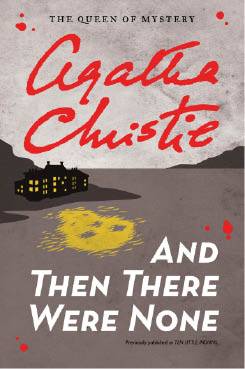
Without doubt her most famous title, and the
bestselling crime novel of all time, is And Then There Were
None (1939). Part detective story and part thriller, this novel first
appeared in print in the Saturday Evening Post
beginning at the end of May 1939. It received rapturous reviews on both sides of
the Atlantic when it was published in book form at the end of that year. The
much-copied plot concerns the fate of ten characters invited to an island off
the coast of southern England, where, over the course of a weekend, they are all
systematically killed in line with the macabre nursery rhyme that hangs in each
of their bedrooms. The Christie twist is that the killer is one of the ten. It
has been brought to the screen countless times, the best version being the
famous 1945 Rene Clair film.
Years before the historical murder mystery became
popular, Christie published Death Comes as the End
(1945), a domestic murder mystery set in Egypt in 2000 B.C. This
fascinating novel of mass murder in a family consumed with greed and jealousy,
living on the banks of the Nile, was written at the suggestion of an
archaeologist friend of her husband Max Mallowan. In 1949, she published Crooked House, very much a typical Christie—large
family living in a rambling house with a poisoner at work—until the last
chapter, which propounded such a shocking solution that her publishers asked her
to change it; she refused and it remains one the Christie classics. Two of her
strongest and most unexpected titles appeared in the last chapter of her writing
life: The Pale Horse (1961) concerns a
murder-to-order venture with suggestions of black magic, while Endless Night (1967), with its stunning surprise in
the last chapter, is often considered her last great novel.
Thrillers, both international—The Man in the Brown Suit (1924), They Came to
Baghdad (1951), Destination Unknown
(1954), Passenger to Frankfurt (1970)—and
domestic—The Secret of Chimneys (1925), The Seven Dials Mystery (1929), The Boomerang Clue (1934)—appeared periodically throughout her
writing life and Christie considered these a holiday from the clues-and-alibis
plotting of her detective fiction. With an emphasis on physical rather than
cerebral activity, these thrillers all show the Christie magic at work. Stolen
jewels, missing state papers, unidentified spies, and criminal masterminds
jostle for attention in plots involving organized anarchy and international
terrorism. Almost all of these titles feature young women—Lady Eileen (Bundle)
Brent, Lady Frances (Frankie) Derwent, Anne Beddingfeld, Victoria Jones—who are
in the mold of Tuppence Beresford: brave, resourceful, enterprising, and
incurably inquisitive.
Dotted throughout her classic period Christie also
wrote, with enviable ease, non-Poirot and non-Marple whodunits. The Sittaford Mystery (1931) begins with a séance
accurately foretelling a murder; Murder Is Easy
(1939) is regular Christie territory—a country village with a suspiciously high
number of unexplained deaths; Sparkling Cyanide
(1945) features subtle characterization with the personal reminiscences of the
suspects involved in a poisoning drama at a fashionable nightclub. One of her
most intriguing titles is Towards Zero (1944), where
we are introduced to a collection of characters months before the approaching
zero hour of the inevitable murder. Ordeal by
Innocence (1958) is both a deeply felt exploration of the
consequences of a possible miscarriage of justice and a clever whodunit.
Christie also wrote a number of short stories that
achieved fame in their own right, including “Witness for the Prosecution.” First
published in 1925 under the title “Traitor Hands,” almost thirty years later it
became not just Christie’s best stage play, but also one of the best courtroom
dramas ever. “Philomel Cottage,” also a short story from the 1920s, became the
stage play and film Love from a Stranger. And, of
course, before its incarnation as a play, The
Mousetrap had been a short story, “Three Blind Mice.”
Christie the Dramatist
Agatha Christie is still the only crime
novelist to achieve equal fame as a crime dramatist. The first stage play based
on her writing was Alibi, an adaptation, but not by
the author herself, of The Murder of Roger Ackroyd,
which opened in London in 1928. That year she also adapted her 1925 novel, The Secret of Chimneys, as a three-act play but failed
to have it staged. She then wrote an original script, Black
Coffee (1930), in which Poirot is summoned to find a missing document
vital to the country’s security, but finds himself investigating a murder at the
home of Sir Claud Amory. A further adaptation of Peril at
End House followed in 1940, but Christie was disappointed with
adaptations of her stories by other hands. So she adapted her own novel And Then There Were None in 1943 and it had a
successful run of almost a year in London’s West End, despite the destruction of
its theatrical home during the height of the Blitz, and a transfer to
another.
Spurred on by this success, she adapted Appointment with Death and Murder
on the Nile in 1945 and 1946. Miss Marple made her stage debut in
1949 in Murder at the Vicarage. The 1950s was
Christie’s golden age of theater. Beginning with The Hollow
(1951), and followed by Witness for the Prosecution (1953), Spider’s Web (1954), Towards Zero
(1956), Verdict (1958), and The Unexpected Guest
(1958), this impressive roster of dramas
contributed to her unique theatrical success. To this day, she is the only
female playwright to have had three plays running simultaneously in the West
End.
In 1952, the most famous stage play in the world,
The Mousetrap, began its inexorable advance to
the status of national institution. Originally written as a radio play to
celebrate the eightieth birthday of Queen Mary, it was subsequently adapted as a
novella and, finally, as the stage play that is now older than most of the UK
population. This theatrical landmark celebrates its sixtieth birthday in
2012.
In 1962, another experiment, Rule of Three, debuted on the London stage. Although not well
received by the critics, it remains fascinating to fans as each of the three
one-act plays, totally different in style and plot, display aspects of Christie
not hitherto seen on the stage. The Rats is a
claustrophobic will-they-get-away-with-it? play; Afternoon
at the Seaside is a very funny sketch involving missing jewelry with
a surprise revelation in the last moments; and The
Patient is an ingenious whodunit with an artfully concealed central
clue. As late as 1972, Christie’s love of the theater is evident in Fiddlers Five, or, as it later became, Fiddlers Three. Although it did not receive a West End
production and, compared to her earlier theatrical hits, is, despite its many
clever ideas, disappointing, it is clear that her love of playwriting remained
with Christie until the end of her life.
Other Works
Interspersed with her detective fiction,
Christie also experimented with noncrime material, showing an aspect of her
imagination not obvious from her crime fiction alone. In 1924, she published
Road of Dreams, a poetry collection, and six
years later published Giant’s Bread, the first of
six Mary Westmacott novels to appear over the next thirty years. Best described
as bittersweet love stories, these titles show glimpses of the real Agatha
Christie and mirror many situations in her own life. Giant’s Bread centers on the composer Vernon Deyre and reveals
Christie’s lifelong love of music; two years later, Unfinished Portrait contains, consciously or otherwise, many
elements from Christie’s own life, including a marriage, idyllic at the start
but later ruined by infidelity, culminating in divorce; an unhappy wife who
takes up writing; and a subsequent mother/daughter relationship. A similar theme
is also explored, even more devastatingly, in the 1952 novel, A Daughter’s a Daughter. In her
Autobiography, Christie describes how she wrote
Absent in the Spring (1934) over a single weekend; in it, Joan
Scudamore, trapped by bad weather in a remote area of Turkey, spends four days
examining her life and conscience before resolving to transform herself. The
Westmacott pseudonym remained a secret for many years and Christie was always
very pleased that the books were accepted for publication and reviewed on their
merits alone, not because they were written by a famous crime writer. The final
Westmacott, The Burden (1956), explores the love
between two sisters.
In 1946, she published Come
Tell Me How You Live, a rambling memoir of day-to-day life on an
archaeological dig written to answer the innumerable questions of friends and
acquaintances. Although her publishers would have preferred a whodunit, her love
of this life shines through every page of the book. In 1937, she wrote Akhnaton, a play based on the life of the doomed
Egyptian king. Although it has never received a professional performance, the
script was published in 1973 and proved to be a well-researched and poignant
play; although essentially a noncrime title, it does feature a poisoning and the
unmasking of a killer in the final scene. Star Over
Bethlehem (1965) is, as the name suggests, a religious-themed
collection of very short stories and poems.
Finally, the year after her death, An
Autobiography was published. Christie had worked on
this for over fifteen years, beginning in Baghdad in 1950 where, she explains in
the foreword, she was suddenly overtaken by the urge to write down the story of
her life. After her death, it fell to her daughter and an editor at Collins to
reduce the vast amount of material to a manageable size, and the book was
published in October 1977 to international acclaim. As easily readable as all of
her writing, An Autobiography is a fascinating look
at the woman who wrote the world’s bestselling books, but there is little in the
way of solid information about the creation of any particular title. She does
give an account of the creation of Hercule Poirot and a less detailed one for
Miss Marple, but the genesis of most of her books remains as mysteriously
elusive as the books themselves.
The Legacy
Almost forty years after her death, Agatha
Christie’s name is still synonymous with the very best detective fiction. She
refined an already existing template, and for over a half-century, she expanded
and experimented with it to produce a body of work that continues to transcend
every known border of age, sex, race, background, and level of education. Her
entire output is still available in every language and she is read avidly from
Melbourne to Moscow, from Iceland to India. She is enjoyed by teenagers and
pensioners; she is studied by academics and linguists and social historians. Her
work provides a regular source for film and TV adapters, for computer game
developers, for animators, and graphic-novel artists. Quite simply, in the field
of detective fiction no other writer ever did it as often, as well, or for as
long. Agatha Christie remains unique and, thus far, immortal.
John Curran is the
Agatha, Anthony, and Macavity award-winning author of Agatha
Christie’s Secret Notebooks and Agatha Christie:
Murder in the Making. A recognized expert on the life and
works of Agatha Christie, he is a frequent speaker and contributor to
programs about her. He lives in Dublin, where he is writing a doctoral
thesis on Christie.
Read the full book by downloading it below.