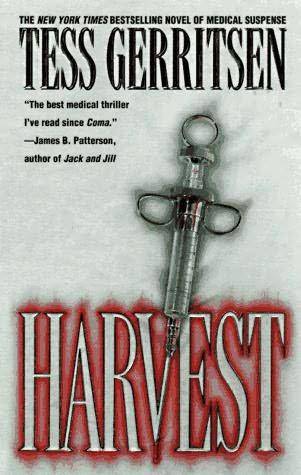
Gerritsen draws on her years of experience as a doctor to deliver a harrowing and brilliantly crafted novel of suspense. At Bayside Hospital, Dr. Abby DiMatteo’s career is in serious jeopardy when it is discovered that she helped divert a donor heart to a dying teenager. When a new heart for the intended recipient, a wealthy woman, suddenly appears, Abby questions its origin. Now every move she makes creates a furious backlash, and nothing can prepare her for the grisly final reckoning.
Copyright 1996 Tess Gerritsen
The right of Tess Gerritsen to be identified as the Author of the Work has been asserted by her in accordance with the Copyright, Designs and Patents Act 1988.
First published in Great Britain in 1996 by HEADLINE BOOK PUBLISHING
10987654321
All rights reserved. No part of this publication may be reproduced, stored in a retrieval system, or transmitted, in any form or by any means without the prior written permission of the publisher, nor be otherwise circulated in any form of binding or cover other than that in which it is published and without a similar condition being imposed on the subsequent purchaser.
All characters in this publication are fictitious and any resemblance to real persons, living or dead, is purely coincidental.
British Library Cataloguing in Publication Data
Gerritsen, Tess
Harvest
1. American fiction – 20th century I. Title 823.5’4 [F]
ISBN 0-7472-1670-3
Typeset by CBS, Felixstowe, Suffolk
Printed and bound in Great Britain by Mackays of Chatham PLC, Chatham, Kent
HEADLINE BOOK PUBLISHING A division of Hodder Headline PLC 338 Euston Road London NWl 3BH
HARVEST
CHAPTER ONE
He was small for his age, smaller than the other boys who panhandled in the underpass at Arbats-Kaya, but at eleven years old he had already done it all. He had been smoking cigarettes for four years, stealing for three and a half, and turning tricks for two.
This last vocation Yakov did not much care for, but it was something Uncle Misha insisted upon. How else were they to buy bread and cigarettes?Yakov, being the smallest and blondes of Uncle Misha’s boys, bore the brunt of the trade. The customers always favoured the young ones, the fair ones. They did not seem to care about Yakov’s missing left hand; indeed, most did not even notice his withered stump. They were too enchanted by his smallness, his blondness, his unflinching blue eyes.
Yakov longed to grow out of the trade, to earn his keep by picking pockets like the bigger boys. Every morning when he woke up in Misha’s flat, and every evening before he fell asleep, he would reach up with his one good hand and grasp the head bar of his cot. He’d stretch and stretch, hoping to add another fraction of a centimetre to his height. A useless exercise, Uncle Misha advised him. Yakov was small because he came from stunted stock. The woman who’d abandoned him in Moscow seven years ago had been stunted too. Yakov could scarcely remember the woman, nor could he remember much of anything else from his life before the city. He knew only what Uncle Misha told him, and he believed only half of it. At the tender age of eleven, Yakov was both diminutive and wise.
So it was with his natural skepticism that he now regarded the man and woman talking business with Uncle Misha over the dining table.
The couple had come to the flat in a large black car with dark windows. The man, named Gregor, wore a suit and tie and shoes of real leather. The woman Nadiya was a blonde dressed in a skirt and jacket of fine wool and she carried a hard-shelled valise. She was not Russian – that much was immediately evident to all four boys in the flat. She was American, perhaps, or English. She spoke in fluent but accented Russian.
While the two men conducted business over vodka, the woman’s gaze wandered about the tiny flat, taking in the old army cots shoved up against the wall, the piles of dirty bedclothes, and the four boys huddled together in anxious silence. She had light grey eyes, pretty eyes, and she studied the boys each in turn. First she looked at Pyotr, the oldest at fifteen. Then she looked at Stepan, thirteen, and Aleksei, ten.
And finally, she looked atYakov.
Yakov was accustomed to such scrutiny by adults, and he gazed back calmly. What he was not accustomed to was being so quickly passed over. Usually the adults ignored the other boys. This time it was gangly, pimply-faced Pyotr who garnered the woman’s attention.
Nadiya said to Misha: “You are doing the right thing, Mikhail Isayevich. These children have no future here. We offer them such a chance!” She smiled at the boys.
Stepan, the dullard, grinned back like an idiot in love.
“You understand, they speak no English,” said Uncle Misha. “Only a word, here and there.”
“Children pick it up quickly. For them, it is effortless.”
“They will need time to learn. The language, the food–‘
“Our agency is quite familiar with transitional needs. We work with so many Russian children. Orphans, like these. They will stay, for a while, in a special school to give them time to adjust.”
“And if they cannot?”
Nadiya paused. “Every so often, there are exceptions. The ones with emotional difficulties.” Her gaze swept the four boys. “Is there one in particular who concerns you?”
Yakov knew that he was the one with the difficulties of which they spoke. The one who seldom laughed and never cried, the one Uncle Misha called his ‘little stone boy’.Yakov did not know why he never cried. The other boys, when hurt, would shed fat and sloppy tears. Yakov would simply turn his mind blank, the way the television screen turned blank late at night after the stations shut off. No transmission, no images, just that comforting white fuzz. Uncle Misha said, “They are all good boys. Excellent boys.” Yakov looked at the other three boys. Pyotr had a jutting brow and shoulders perpetually hunched forward like a gorilla’s. Stepan had odd ears, small and wrinkled, between which floated a walnut for a brain. Aleksei was sucking his thumb.
And I, thought Yakov, looking down at his stump of a forearm, I have only one hand. Why do they say we are excellent?Yet that was precisely what Uncle Misha kept insisting. And the woman kept nodding. These were good boys, healthy boys.
“Even their teeth are good!” pointed out Misha. “Not rotten at all. And look how tall my Pyotr is.”
“That one there looks undernourished.” Gregor pointed toYakov.
“And what happened to his hand?”
“He was born without it.”
“The radiation?”
“It does not affect him otherwise. It’s just the missing hand.”
“It should pose no problem,” said Nadiya. She rose from the chair. “We must leave. It’s time.”
“So soon?”
“We have a schedule to keep.”
“But – their clothes–‘
“The agency will provide-clothes. Better than what they’re wearing now.”
“Is it to happen so quickly? We have no time to say goodbye?”
A ripple of irritation passed through the woman’s eyes. “A moment. We don’t want to miss our connections.”
Uncle Misha looked at his boys, his four boys, related to him not by blood, nor even by love, but by mutual dependence. Mutual need. He hugged each of the boys in turn.when he came toYakov, he held on a little longer, a little tighter. Uncle Misha smelled of onions and cigarettes, familiar smells. Good smells. But Yakov’s instinct was to recoil from the closeness. He disliked being held or touched, by anyone.
“Remember your uncle,” Misha whispered. “When you are rich in America. Remember how I watched over you.”
“I don’t want to go to America,” saidYakov. “It’s for the best. For all of you.”
“I want to stay with you, Uncle! I want to stay here.”
“You have to go.”
“Why?”
“Because I have decided.” Uncle Misha grasped his shoulders and gave him a hard shake. “I have decided.”
Yakov looked at the other boys, who were grinning at each other. And he thought:They are happy about this. Why am I the only one with doubts?
The woman tookYakov by the hand. “I’ll bring them to the car. Gregor can finish up here with the papers.”
“Uncle?” called Yakov.
But Misha had already turned away and was staring out the window.
Nadiya shepherded the four boys into the hallway and down the stairs. It was three flights to the street. All those clomping shoes, all that noisy boy energy, seemed to ricochet loudly through the empty stairwell.
They were already on the ground floor when Aleksei suddenly halted. “Wait! I forgot Shu-Shu!” he cried and went tearing back up the stairs.
“Come back here!” called Nadiya. “You can’t go up there!”
“I can’t leave him!” yelled Aleksei. “Come back here now!”
Aleksei just kept thudding away up the steps. The woman was about to chase after him when Pyotr said, “He won’t leave without Shu-Shu.”
“Who the devil is Shu-Shu?” she snapped.
“His stuffed dog. He’s had it forever.”
She glanced up the stairwell toward the fourth floor, and in that instant Yakov saw, in her eyes, something he did not understand. Apprehension.
She stood as though poised between pursuit and abandonment of Aleksei. When the boy came running back down the stairs with the tattered Shu-Shu clutched in his arms, the woman seemed to melt in relief against the banister.
“Got him!” crowed Aleksei, embracing the stuffed animal. “Now we go,” the woman said, ushering them outside.
The four boys piled into the back seat of the car. It was cramped, andYakov had to sit halfway on Pyotr’s lap.
“Can’t you put your bony ass somewhere else?” grumbled Pyotr. “Where shall I put it? In your face?” Pyotr shoved him. He shoved back.
“Stop it!” ordered the woman from the front seat. “Behave yourselves.”
“But there’s not enough room back here,” complained Pyotr.
“Then make room. And hush!” The woman glanced up at the building, towards the fourth floor. Towards Misha’s flat. “Why are we waiting?” asked Aleksei. “Gregor. He’s signing the papers.”
“How long will it take?”
The woman sat back and stared straight ahead. “Not long.”
A close call, thought Gregor as the boy Aleksei left the flat for the second time and slammed the door behind him. Had the little bastard popped in a moment later, there would be hell to pay. What was that stupid Nadiya doing, letting the brat back upstairs? He had been against using Nadiya from the start. But Reuben had insisted on a woman. People would trust a woman.
The boy’s footsteps receded down the stairwell, a loud clompclomp followed by the thud of the building door.
Gregor turned to the pimp.
Misha was standing at the window, staring down at the street, at the car where his four boys sat. He pressed his hand to the glass, his fat fingers splayed in farewell. When he turned to face Gregor, his eyes were actually misted with tears.
But his first words were about the money. “Is it in the valise?”
“Yes,” said Gregor. “All of it?”
“Twenty thousand American dollars. Five thousand per child. You did agree to the price.”
“Yes.” Misha sighed and ran a hand over his face. A face whose furrows showed only too well the effect of too much vodka, too many cigarettes. “They will be adopted by proper families?”
“Nadiya will see to it. She loves children, you know. It’s why she chose this work.”
Misha managed a weak smile. “Perhaps she could find me an American family.”
Gregor had to get him away from the window. He pointed to the valise, which was resting on an end table. “Go ahead. Check it if you wish.”
Misha went to the valise and unsnapped the catch. Inside were stacks of American bills, bound together in neat bundles. Twenty thousand dollars, enough for all the vodka a man would need to rot his liver. How cheap it is these days to buy a man’s soul, thought Gregor. On the streets of this new Russia, one could barter for anything. A crate of Israeli oranges, an American television, the pleasure of a woman’s body. Opportunity everywhere, for those with the talent to mine it.
Misha stood staring down at that money, his money, but not with a look of triumph. Rather, it-was a look of disgust. He closed the valise and stood with head bowed, hands resting on the hard black plastic.
Gregor stepped up behind Misha’s balding head, raised the barrel of a silenced automatic, and fired two bullets into the man’s brain.
Blood and grey matter spattered the far wall. Misha collapsed face-down, toppling the end table as he fell. The valise thudded onto the rug beside him.
Gregor snatched up the valise before the pooling blood could reach it. There were clumps of human tissue on the side. He went into the bathroom, used toilet paper to wipe off the splatters from the plastic, and flushed away the tissue. When he walked back into the room where Misha lay, the pool of blood had already crept across the floor and was soaking into another rug.
Gregor glanced around the room to assure himself that his work here was done and that no evidence remained. He was tempted to take the bottle of vodka with him, but decided against it. Explanations would be required as to why he had Misha’s precious bottle, and Gregor had no patience for the questions of children. That was Nadiya’s department.
He left the flat and went downstairs.
Nadiya and her charges were waiting in the car. She looked at him as he slid behind the wheel, the questions plain in her eyes. “You have the papers all signed?” she asked. “Yes. All of them.”
Nadiya sat back, exhaling an audible sigh of relief. She has no nerves for this, thought Gregor as he started the car. No matter what Reuben said, the woman was a liability.
There were sounds of scuffling from the back seat. Gregor glanced in the rearview mirror and saw that the boys were shoving each other back and forth. All except the smallest one, Yakov, who was staring straight ahead. In the mirror their gazes met, and Gregor had the eerie sensation that the eyes of an adult were staring out of that child’s face.
Then the boy turned and punched his neighbour in the shoulder. Suddenly the back seat was a tangle of squirming bodies and flailing limbs.
“Behave yourselves!” said Nadiya. “Can’t you keep quiet?We have a long drive to Riga.”
The boys calmed down. For a moment there was silence in the back seat. Then, in the rearview mirror, Gregor saw the little one, the one with the adult eyes, jab an elbow at his neighbour.
That made Gregor smile. No reason to worry, he thought. They were, after all, merely children.
CHAPTER TWO
It was midnight, and Karen Terrio was fighting to keep her eyes open. Fighting to stay on the road.
She had been driving for the better part of two days now, had left right after Aunt Dorothy’s funeral, and she hadn’t stopped except to pull over for a quick nap or a hamburger and coffee. Lots of coffee. Her aunt’s funeral had receded to a two-day-old blur of memories. Wilting gladioli. Nameless cousins. Stale finger sandwiches. Obligations, so damn many obligations.
Now all she wanted was to go home.
She knew she should pull off again, should try to catch another quick nap before pressing onward, but she was so close, only a hundred miles from Boston. At the last Dunkin Donuts, she’d tanked up on three more cups of coffee. That had helped, a little; it had given her just enough of a buzz to get her from Springfield to Sturbridge. Now the caffeine was starting to wear off, and even though she thought she was awake, every so often her head would dip in a sharp bob, and she knew she’d fallen asleep, if only for a second.
A Burger King sign beckoned from the darkness ahead. She pulled off the highway.
Inside she ordered coffee and a blueberry muffin and sat down at a table. At this hour of night, there were only a few patrons in the dining room, all of them wearing the same pasty masks of exhaustion. Highway ghosts, thought Karen. The same tired souls who seemed to haunt every highway rest stop. It was eerily quiet in that dining room, everyone focused on trying to stay awake and get back on the road.
At the next table sat a depressed-looking woman with two small children, both of them quietly chewing on cookies. Those children, so well behaved, so blond, made Karen think of her own daughters. It was their birthday tomorrow. Tonight, asleep in their beds, she thought, they are only a day away from being thirteen. A day further from their childhood.
When you wake up, she thought, I’ll be home.
She refilled her coffee cup, snapped on a plastic cover, and walked out to her car.
Her head felt clear now. She could make it. An hour, fifty miles, and she’d be walking in her front door. She started the engine and pulled out of the parking lot. A hundred miles, she thought. Only a hundred miles.
Twenty miles away, parked behind a 7-11,Vince Lawry and Chuck Servis finished off the last six pack. They’d been going at it for four straight hours, just a little friendly competition to see who could toss back the most Buds without puking it all up again. Chuck was ahead by one. They’d lost track of the total; they’d have to figure it out in the morning when they tallied up the beer cans mounded in the back seat.
But Chuck was definitely ahead, and he was gloating about it, which pissed Vince off, because Chuck was better at every fucking thing. And this wasn’t a fair contest. Vince could’ve gone another round, but the Bud had run out, and now Chuck was wearing that eat-shit grin of his, even though he knew it wasn’t a fair contest.
Vince shoved open the car door and climbed out of the driver’s seat.
“Where you going?” asked Chuck.
“T’get some more.”
“You can’t handle no more.”
“Fuck you,” said Vince, and stumbled across the parking lot towards the 7-11’s front door.
Chuck laughed. “You can’t even walk!” he yelled out the window. Asshole, thought Vince. What the fuck, he could walk. See, he was walking fine. He’d just stroll into the 7-11 and pick up two more sixes. Maybe three.Yeah, he could do three, easy. His stomach was iron, and except for having to piss every few minutes, he didn’t feel the effects at all.
He tripped going in the door – goddamn high threshold, they could get sued for that – but he picked himself right up. He got three six packs from the cooler and swaggered over to the cash register. He plunked down a twenty-dollar bill.
The clerk looked at the money and shook his head. “Can’t take it,” he said.
“What do you mean, can’t take it?”
“Can’t sell beer to an intoxicated customer.”
“Are you saying I’m drunk?”
“That’s right.”
“Look, it’s money, isn’t it?You don’t want my fucking money?”
“I don’t wanna get sued. You just put the beer back, son, OK? Better yet, why don’t you buy a cup of coffee or something? A hot dog.”
“I don’t want a fucking hot dog.”
“Then just walk on out, boy. Go on.”
Vince shoved one of the six packs across the countertop. It slid off the edge and crashed to the floor. He was about to launch another six pack off the counter when the clerk pulled out a gun.
Vince stood staring at it, his body poised in mid-shove.
“Go on, get the hell out,” said the clerk.
“OK?Vince stepped back, both hands raised in submission. “OK, I hear you.”
He tripped on the damn threshold again as he went out the door.
“So where is it?” asked Chuck as Vince climbed back in the car. “They’re outta beer.”
“They can’t be out of beer.”
“They’re fucking out, OK?Vince started the car and goosed the accelerator. They squealed out of the lot.
“Where we going now?” asked Chuck.
“Find another store.” He squinted ahead at the darkness. “Where’s the onramp? Gotta be around here somewhere.”
“Man, give it up. No way you’ll go another round without puking.” “Where’s the fucking onramp?”
“I think you passed it.”
“No, there it is.” Vince veered left, tyres squealing over the pavement.
“Hey,” said Chuck. “Hey, I don’t think–‘
“Got twenty fucking bucks left to blow. They’ll take it. Someone’ll take it.”
“Vince, you’re going the wrong way!”
“What?”
Chuck yelled, “You’re going the wrong way!”
Vince gave his head a shake and tried to focus on the road. But the lights were too bright and they were shining right in his eyes. They seemed to be getting brighter.
“Pull right!” screamed Chuck. “It’s a car! Pull right!” Vince veered right. So did the lights.
He heard a shriek, unfamiliar, unearthly.
Not Chuck’s, but his own.
Dr. Abby DiMatteo was tired, more tired than she’d ever been in her life. She had been awake for thirty straight hours, if one didn’t count her ten-minute nap in the X-ray lounge, and she knew her exhaustion showed. While washing her hands in the SICU sink, she had glimpsed herself in the mirror and had been dismayed by the smudges of fatigue under her dark eyes, by the disarray of her hair, which now hung in a tangled black mane. It was already 10 a.m., and she had not yet showered or even brushed her teeth. Breakfast had been a hardboiled egg and a cup of sweet coffee, handed to her an hour ago by a thoughtful surgical ICU nurse. Abby would be lucky to find time for lunch, luckier still to get out of the hospital by five and home by six. Just to sink into a chair right now would be luxury.
But one did not sit during Monday morning attending rounds. Certainly not when the attending was Dr. ColinWettig, Chairman of Bayside Hospital’s Surgical Residency Programme. A retired Army general, Dr. Wetrig had a reputation for crisp and merciless questions. Abby was terrified of the General. So were all the other surgical residents.
Eleven residents now stood in the SICU, forming a semicircle of white coats and green scrub suits. Their gazes were all trained on the residency chairman. They knew that any one of them could be ambushed with a question. To be caught without an answer was to be subjected to a prolonged session of personalized humiliation.
The group had already rounded on four post-op patients, had discussed treatment plans and prognoses. Now they stood assembled beside SICU Bed 11. Abby’s new admission. It was her turn to present the case.
Though she held a clipboard in her arms, she did not refer to her notes. She presented the case by memory, her gaze focused on the General’s unsmiling face.
“The patient is a thirty-four-year-old Caucasian female, admitted at one this morning via the trauma service after a high-speed head-on collision on Route 90. She was intubated and stabilized in the field, then airlifted here. On arrival to the ER, she had evidence of multiple trauma. There were compound and depressed skull fractures, fractures of the left clavicle and humerus, and severe facial lacerations. On my initial exam, I found her to be a well nourished white female, medium build. She was unresponsive to all stimuli with the exception of some questionable extensor posturing–‘
“Questionable?” asked Dr. Wetfig. “What does that mean? Did she or did she not have extensor posturing?”
Abby felt her heart hammering. Shit, he was already on her case. She swallowed and explained, “Sometimes the patient’s limbs would extend on painful stimuli. Sometimes they wouldn’t.”
“How do you interpret that? Using the Glasgow Coma Scale for motor response?”
“Well. Since a nil response is rated a one, and extensor posturing is a two, I suppose the patient could be considered a… one and a half.”
There was a ripple of uneasy laughter among the circle of residents.
“There is no such score as a one and a half,” said Dr. Wettig.
“I’m aware of that,” said Abby. “But this patient doesn’t fit neatly into–‘
“Just continue with your exam,” he cut in.
Abby paused and glanced around at the circle of faces. Had she screwed up already? She couldn’t be sure. She took a breath and continued. “Vital signs were blood pressure of ninety over sixty and pulse of a hundred. She was already intubated. She had no spontaneous respirations. Her rate was fully supported by mechanical ventilation at twenty-five breaths per minute.”
“Why was a rate of twenty-five selected?”
“To keep her hyperventilated.”
“Why?”
“To lower her blood carbon dioxide. That would minimize brain edema.”
“Go on.”
“Head exam, as I mentioned, revealed both depressed and compound skull fractures of the left parietal and temporal bones. Severe swelling and lacerations of the face made it difficult to evaluate facial fractures. Her pupils were midposition and unreactive. Her nose and throat–‘ “Oculocephalic
“reflexes?”
“I didn’t test them.”
“You didn’t?”
“No, sir. I didn’t want to manipulate the neck. I was concerned about possible spinal dislocation.”
She saw, by his slight nod, that her answer had been acceptable.
She described the physical findings. The normal breath sounds. The unremarkable heart. The benign abdomen. Dr. Wettig did not interrupt. By the time she’d finished describing the neurologic findings, she was feeling more self-assured. Almost cocky. And why shouldn’t she? She knew what the hell she’d been doing.
“So what was your impression?” asked Dr. Wettig. “Before you saw any x-ray results?”
“Based on the midposition and unreactive pupils,” said Abby, “I felt there was probable midbrain compression. Most likely from an acute subdural or epidural haematoma.” She paused, and added with a quiet note of confidence, “The CT scan confirmed it. A large left-sided subdural with severe midline shift. Neurosurgery was called in. They performed an emergency evacuation of the clot.”
“So you’re saying your initial impression was absolutely correct, Dr. DiMatteo?”
Abby nodded.
“Let’s take a look at how things are this morning,” said Dr. Wettig, moving to the bedside. He shone a penlight into the patient’s eyes. “Pupils unresponsive,” he said. He pressed a knuckle, hard, against the breastbone. She remained flaccid, unmoving. “No response to pain. Extensor or otherwise.”
All the other residents had edged forward, but Abby remained at the foot of the bed, her gaze focused on the patient’s bandaged head. WhileWettig continued his exam, tapping on tendons with a rubber hammer, flexing elbows and knees, Abby felt her attention drift away on a tide of fatigue. She kept staring at the woman’s head, recently shorn of hair. The hair had been a thick brown, she remembered, clotted with blood and glass. There had been glass ground into the clothes as well. In the ER, Abby had helped cut away the blouse. It was a blue and white silk with a Donna Karan label. That last detail was what seemed to linger inAbby’s memory. Not the blood nor the broken bones nor the shattered face. It was that label. Donna Karan. A brand she herself had once purchased. She thought of how, sometime, somewhere, this woman must once have stood in a shop, flipping through blouses, listening to the hangers squeak as they slid across the rack…
Dr. Wetrig straightened and looked at the SICU nurse. “When was the haematoma drained?”
“She came out of Recovery about 4 a.m.”
“Six hours ago?”
“Yes, that would make it six hours.”
Wetrig turned to Abby. “Then why has nothing changed?” Abby stirred from her daze and saw that everyone was watching her. She looked down at the patient. Watched the chest rise and fall, rise and fall with every wheeze of the ventilator bellows.
“There… may be some post-op swelling,” she said, and glanced at the monitor. “The intracranial pressure is slightly elevated at twenty millimetres.”
“Do you think that’s high enough to cause pupillary changes?”
“No. But–‘
“Did you examine her immediately post-op?”
“No, sir. Her care was transferred to Neurosurgery service. I spoke to their resident after surgery, and he told me–‘
“I’m not asking the neurosurgery resident. I’m asking you, Dr. DiMatteo. You diagnosed a subdural haematoma. It’s been evacuated. So why are her pupils still midposition and unreactive six hours post-op?”
Abby hesitated. The General watched her. So did everyone else. The humiliating silence was punctuated only by the whoosh of the ventilator.
Dr. Wettig glanced imperiously at the circle of residents. “Is there anyone here who can help Dr. DiMatteo answer the question?”
Abby’s spine straightened. ‘! “I can answer the question myself,” she said.
Dr. Wettig turned to her, his eyebrow raised. “Yes?”
“The… pupillary changes – the extensor posturing of the limbs – they were high midbrain signs. Last night I assumed it was because of the subdural haematoma, pressing downwards on the midbrain. But since the patient hasn’t improved, I… I guess that indicates I was mistaken.”
“You guess?”
She let out a breath. “I was mistaken.”
“What’s your diagnosis now?”
“A midbrain haemorrhage. It could be due to shearing forces. Or residual damage from the subdural haematoma. The changes might not show up yet on CT scan.”
Dr. Wettig regarded her for a moment, his expression unreadable. Then he returned to the other residents. “A midbrain haemorrhage is a reasonable assumption. With a combined Glasgow Coma Scale of three…” He glanced at Abby ‘… and a half,” he amended, ‘the prognosis is nil. The patient has no spontaneous respirations, no spontaneous movements, and she appears to have lost all brainstem reflexes. At the moment, I have no suggestions other than life support. And consideration of organ harvest.” He gave Abby a curt nod. Then he moved on to the next patient.
One of the other residents gave Abby’s arm a squeeze. “Hey, DiMatteo,” he whispered. “Flying colours.”
Wearily Abby nodded. “Thanks.”
Chief surgical resident Dr. Vivian Chao was a legend among the other residents at Bayside Hospital. As the story went, two days into her very first rotation as an intern, her fellow intern suffered a psychotic break and had to be carted off, sobbing uncontrollably, to the loony ward. Vivian was forced to pick up the slack. For twenty-nine straight days, she was the one and only orthopaedic resident on duty, around the clock. She moved her belongings into the call room and promptly lost five pounds on an unrelenting diet of cafeteria food. For twenty-nine straight days, she did not step out of the hospital front doors. On the thirtieth day her rotation ended, and she walked out to her car, only to discover that it had been towed away a week before. The parking lot attendant had assumed it was abandoned.
Four days into the next rotation, vascular surgery, Vivian’s fellow intern was struck by a city bus and hospitalized with a broken pelvis. Again, someone had to take up the slack.
Vivian Chao moved right back into the hospital call room.
In the eyes of the other residents, she had thus achieved honorary manhood, a lofty status which was later acknowledged at the yearly awards dinner when she was presented with a boxed pair of steel balls.
When Abby first heard the Vivian Chao stories, she’d had a hard time reconciling that steel-balls reputation with what she saw: a laconic Chinese woman who was so petite she had to stand on a footstool to operate. ThoughVivian seldom spoke during attending rounds, she could always be found standing fearlessly at the very front of the group, wearing an expression of cool dispassion.
It was with her usual air of detachment that Vivian approached Abby in the SICU that afternoon. By then Abby was moving through a sea of exhaustion, every step a struggle, every decision an act of pure will. She didn’t even notice Vivian was standing beside her until the other woman said, “I hear you admitted an AB positive head trauma.”
Abby looked up from the chart where she’d been recording patient progress notes. “Yes. Last night.”
“Is the patient still alive?”
Abby glanced towards Bed 1 l’s cubicle. “It depends what you mean by alive.”
“Heart and lungs in good shape?”
“They’re functioning.”
“How old?”
“She’s thirty-four. Why?”
“I’ve been following a medical patient on the teaching service. Endstage congestive failure. Blood type AB positive. He’s been waiting for a new heart?Vivian went over to the chart rack. “Which bed?”
“Eleven.”
Vivian pulled the chart out of the rack and flipped open the metal cover. Her face belied no emotion as she scanned the pages.
“She’s not my patient any more,” said Abby. “I transferred her to Neurosurgery. They drained a subdural hematoma.”
Vivian just kept reading the chart.
“She’s only ten hours post-op,” said Abby. “It seems a little early to be talking harvest.”
“No neurologic changes so far, I see.”
“No. But there’s a chance…”
“With a Glasgow Scale of three? I don’t think so.”Vivian slid the chart back in the rack and crossed to Bed 11.
Abby followed her.
From the cubicle doorway she stood and watched as Vivian briskly performed a physical exam. It was the same way Vivian performed in the OR, wasting no time or effort. During Abby’s first year – the year of her internship – she had often observed Vivian in surgery, and she had admired those small, swift hands, had watched in awe as those delicate fingers spun perfect knots. Abby felt clumsy by comparison. She invested hours of practice and yards and yards of thread, learning to tie surgical knots on the handles of her bureau drawers. Though she could manage the mechanics competently enough, she knew she would never have Vivian Chao’s magical hands.
Now, as she watched Vivian examine Karen Terrio, Abby found the efficiency of those hands profoundly chilling.
“No response to painful stimuli,” Vivian observed.
“It’s still early.”
“Maybe. Maybe not.” Vivian pulled a reflex hammer from her pocket and began tapping on tendons. “She/ AB positive?”
“Yes.”
“A stroke of luck.”
“I don’t see how you can call it that.”
“My patient in MICU is AB positive. He’s been waiting a year for a heart. This is the best match that’s come up for him.”
Abby looked at Karen Terrio and she remembered, once again, the blue and white blouse. She wondered what the woman had been thinking as she’d buttoned it up that last time. Mundane thoughts, perhaps. Certainly not mortal thoughts. Not thoughts of a hospital bed or IV tubes or machines pumping air into her lungs.
“I’d like to go ahead with the lymphocyte crossmatch. Make sure they’re compatible,” said Vivian. “And we might as well start HLA typing for the other organs. The EEG’s been done, hasn’t it?”
“She’s not on my service; said Abby. “And anyway, I think this is premature. No one’s even talked to the husband about it.”
“Someone’s going to have to.”
“She has kids. They’ll need time for this to sink in.”
“The organs don’t have a lot of time.”
“I know I know it’s got to be done. But, as I said, she’s only ten hours post-op.”
Vivian went to the sink and washed her hands. “You aren’t really expecting a miracle, are you?”
A SICU nurse appeared at the cubicle door. “The husband’s back with the kids. They’re waiting to visit. Will you be much longer?”
“I’m finished,” saidVivian. She tossed the crumpled paper towel into the trash can and walked out.
“Can I send them in?” the nurse asked Abby.
Abby looked at KarenTerrio. In that instant she saw, with painful clarity, what a child would see gazing at that bed. “Wait,” said Abby. “Not yet.” She went to the bed and quickly smoothed out the blankets. She wet a paper towel in the sink and wiped away the flecks of dried mucus from the woman’s cheek. She transferred the bag of urine around to the side of the bed, where it would not be so visible. Then, stepping back, she took one last look at KarenTerrio. And she realized that nothing she could do, nothing anyone could do, would lessen the pain of what was to come for those children.
She sighed and nodded to the nurse. “They can come in now.”
By four-thirty that afternoon, Abby could barely concentrate on what she was writing, could barely keep her eyes focused. She had been on duty thirty-three and a half hours. Her afternoon rounds were completed. It was, at last, time to go home.
But as she closed the last chart, she found her gaze drawn, once again, to Bed 11. She stepped into the cubicle. There she lingered at the foot of the bed, gazing numbly at Karen Terrio. Trying to think of something else, anything else, that could be done.
She didn’t hear the footsteps approaching from behind.
Only when a voice said: “Hello gorgeous,” did Abby turn and see brown-haired, blue-eyed Dr. Mark Hodell smiling at her. It was a smile meant only for Abby, a smile she’d sorely missed seeing today. On most days, Abby and Mark managed to share a quick lunch together or, at the very least, exchange a wave in passing. Today, though, they had missed seeing each other entirely, and the sight of him now gave her a quiet rush of joy. He bent to kiss her. Then, stepping back, he eyed her uncombed hair and wrinkled scrub suit. “Must’ve been a bad night,” he murmured sympathetically.
“How much sleep did you get?”
‘! don’t know. Half an hour.”
“I heard rumours you batted a thousand with the General this morning.”
She shrugged. “Let’s just say he didn’t use me to wipe the floor.”
“That qualifies as a triumph.”
She smiled. Then her gaze shifted back to Bed 11 and her smile faded. Karen Terrio was lost in all that equipment. The ventilator, the infusion pumps. The suction tubes and monitors for EKG and blood pressure and intracranial pressure. A gadget to measure every bodily function. In this new age of technology, why bother to feel for a pulse, to lay hands on a chest? What use were doctors when machines could do all the work?
“I admitted her last night,” said Abby. “Thirty-four years old. A husband and two kids. Twin girls. They were here. I saw them just a little while ago. It’s +strange, Mark, how they wouldn’t touch her. They stood looking. Just looking at her. But they wouldn’t touch her. I kept thinking, you have to. You have to touch her now because it could be your last chance. The last chance you’ll ever have. But they wouldn’t. And ! think, someday, they’re going to wish…” She shook her head. Quickly she ran her hand across her eyes. “I hear the other guy was driving the wrong way, drunk. You know what pisses me off, Mark?And it really pisses me off. He’ll survive. Right now he’s sitting upstairs in the orthopaedic ward, whining about a few fucking broken bones.” Abby took another deep breath and with the sigh that followed, all her anger seemed to dissipate. “Jesus, I’m supposed to save lives. And here I am wishing that guy was smeared all over the highway.” She turned from the bed. “It must be time to go home.”
Mark ran his hand down her back, a gesture of both comfort and possession. “Come on,” he said. “I’ll walk you out.”
They left the SICU and stepped onto the elevator. As the doors slid shut, she felt herself wobble and melt against him. At once he took her into the warm and familiar circle of his arms. It was a place where she felt safe, where she’d always felt safe.
A year ago, Mark Hodell had seemed a far from reassuring presence. Abby had been an intern. Mark had been a thoracic surgery attending – not just any attending physician, but a key surgeon on the Bayside cardiac transplant team. They’d met in the OR over a trauma case. The patient, a ten-year-old boy, had been rushed in by ambulance with an arrow protruding from his chest -the result of a sibling argument combined with a bad choice in birthday presents. Mark had already been scrubbed and gowned when Abby entered the OR. It was only her first week as an intern, and she’d been nervous, intimidated by the thought of assisting the distinguished Dr. Hodell. She’d stepped up to the table. Shyly she’d glanced at the man standing across from her. What she saw, above his mask, was a broad, intelligent forehead and a pair of beautiful blue eyes. Very direct. Very inquisitive.
Together they operated. The kid survived.
A month later, Mark asked Abby for a date. She turned him down twice. Not because she didn’t want to go out with him, but because she didn’t think she should go out with him.
A month went by. He asked her out again. This time temptation won out. She accepted.
Five and a half months ago, Abby moved into Mark’s Cambridge home. It hadn’t been easy at first, learning to live with a forty-one-year-old bachelor who’d never before shared his life – or his home – with a woman. But now, as she felt Mark holding her, supporting her, she could not imagine living with, or loving, anyone else.
“Poor baby,” he murmured, his breath warm in her hair. “Brutal, isn’t it?”
“I’m not cut out for this. What the hell do I think I’m doing here?”
“You’re doing what you always dreamed about. That’s what you told me.”
“I don’t even remember what the dream was any more. I keep losing sight of it.”
“I believe it had something to do with saving lives?”
“Right. And here I am wishing that drunk in the other car was dead.” She shook her head in self-disgust.
“Abby, you’re going through the worst of it now. You’ve got two more days on Trauma. You just have to survive two more days.”
“Big deal. Then I start Thoracic–‘
“A piece of cake in comparison. Trauma’s always been the killer. Tough it out like everyone else.”
She burrowed deeper into his arms. “If I switched to Psychiatry, would you lose all respect for me?”
“All respect. No doubt about it.”
“You’re such a jerk.”
Laughing, he kissed the top of her head. “Many people think it, but you’re the only one allowed to say it.”
They stepped off on the first floor and walked out of the hospital. It was autumn already, but Boston was sweltering in the sixth day of a late-September heat wave. As they crossed the parking lot, she could feel her last reserves of strength wilting away. By the time they reached her car, she was scarcely able to drag her feet across the pavement. This is what it does to us, she thought. It’s the fire we walk through to become surgeons. The long days, the mental and emotional abuse, the hours of pushing onward while bits and pieces of our lives peel away from us. She knew it was simply a winnowing process, ruthless and necessary. Mark had survived it; so would she.
He gave her another hug, another kiss. “Sure you’re safe driving home?” he asked.
“I’ll just put the car on automatic pilot.”
“I’ll be home in an hour. Shall I pick up a pizza?” Yawning, she slid behind the wheel. “None for me.”
“Don’t you want supper?”
She started the engine. “All I want tonight,” she sighed, ‘is a bed.”
CHAPTER THREE
In the night it came to her like the gentlest of whispers or the brush of fairy wings across her face: I am dying. That realization did not frighten Nina Voss. For weeks, through the changing shifts of three private duty nurses, through the daily visits of Dr. Morissey with his ever-higher doses of furosemide, Nina had maintained her serenity. And why should she not be serene? Her life had been rich with blessings. She had known love, and joy, and wonder. In her forty-six years she had seen sunrise over the temples of Karnak, had wandered the twilight ruins of Delphi and climbed the foothills of Nepal. And she had known the peace of mind that comes only with the acceptance of one’s place in God’s universe. She was left with only two regrets in her life. One was that she had never held a child of her own.
The other was that Victor would be alone.
All night her husband had maintained his vigil at her bedside, had held her hand through the long hours of laboured breaths and coughing, through the changing of the oxygen tanks and the visits of Dr. Morissey. even in her sleep she had felt Victor’s presence. Sometime near dawn, through the haze of her dreams, she heard him say: She is so young. So very young. Couldn’t something else, anything else, be done?
Something! Anything!That was Victor. He did not believe in the inevitable.
But Nina did.
She opened her eyes and saw that night had finally passed, and that sunlight was shining through her bedroom window. Beyond that window was a sweeping view of her beloved Rhode Island Sound. In the days before her illness, before the cardiomyopathy had drained her strength, dawn would usually find Nina awake and dressed. She would step out onto their bedroom balcony and watch the sun rise. Even on mornings when fog cloaked the Sound, when the water seemed little more than a silvery tremor in the mist, she would stand and feel the earth tilting, the day spilling towards her. As it did today.
So many dawns have I known. I thank you, Lord, for every one of them.
“Good morning, darling,” whispered Victor.
Nina focused on her husband’s face, smiling down at her. Some who looked at Victor Voss saw the face of authority. Some saw genius or ruthlessness. But this morning, as Nina gazed at her husband, she saw only the love. And the weariness.
She reached out for his hand. He took it and pressed it to his lips. “You must get some sleep, Victor,” she said.
“I’m not tired.”
“But I can see you are.”
“No I’m not.” He kissed her hand again, his lips warm against her chilled skin. They looked at each other for a moment. Oxygen hissed softly through the tubes in her nostrils. From the open window came the sound of ocean waves sluicing across the rocks.
She closed her eyes. “Remember the time…” Her voice faded as she paused to catch her breath.
“Which time?” he prompted gently.
“The day I… broke my leg…” She smiled.
It was the week they’d met, in Gstaad. He told her later that he’d first spotted her schussing down a double black diamond, had pursued her down the mountain, back up in the lift, and down the mountain again. That was twenty-five years ago.
Since then they had been together every day of their lives.
‘! knew,” she whispered. “In that hospital… when you stayed by my bed. ! knew.”
“Knew what, darling?”
“That you were the only one for me.” She opened her eyes and smiled at him again. Only then did she see the tear trickle down his lined cheek. Oh, but Victor did not cry! She had never seen him cry, not once in their twenty-five years together. She had always thought of Victor as the strong one, the brave one. Now, as she looked at his face, she realized how very wrong she had been.
“Victor,” she said and clasped his hand in hers. “You mustn’t be afraid.”
Quickly, almost angrily, he mopped his hand across his face. “I won’t let this happen. I won’t lose you.”
“You never will.”
“No. That’s not enough! I want you here on this earth. With me. With me.”
“Victor, if there’s one thing… one thing I know…” She took a deep breath, a gasp for air. “It’s that this time… we have here… is a very small part… of our existence.”
She felt him stiffen with impatience, felt him withdraw. He rose from the chair and paced to the window where he stood gazing out at the Sound. She felt the warmth of his hand fade from her skin. Felt the chill return.
“I’ll take care of this, Nina,” he said.
“There are things… in this life… we cannot change.”
“I’ve already taken steps.”
“But Victor…”
He turned and looked at her. His shoulders, framed by the window, seemed to blot out the light of dawn. “It will all be taken care of, darling,” he said. “Don’t you worry about a thing.”
It was one of those warm and perfect evenings, the sun just setting, ice cubes clinking in glasses, perfumed ladies floating past in silk and voile. It seemed to Abby, standing in the walled garden of Dr. Bill Archer, that the air itself was magical. Clematis and roses arched across a latticed pergola. Drifts of flowers swept broad strokes of colour across the expanse of lawn. The garden was the pride and joy of Marilee Archer, whose loud contralto could be heard booming out botanical names as she shepherded the other doctors’ wives from flowerbed to flowerbed.
Archer, standing on the patio with highball in hand, laughed. “Marilee knows more goddamn Latin than I do.”
‘! took three years of it in college,” said Mark. “All I remember is what I learned in medical school.”
They were gathered next to the brick barbecue, Bill Archer, Mark, the General, and two surgical residents. Abby was the only woman in that circle. It was something she’d never grown accustomed to, being the lone female in a group. She might lose sight of it for a moment or two, but then she would glance around a room where surgeons were gathered, and she’d experience that familiar flash of discomfort with the realization that she was surrounded by men.
Tonight there were wives at Archer’s house party, of course, but they seemed to move in a parallel universe, seldom intersecting with that of their husbands. Abby, standing with the surgeons, would occasionally hear far-off snippets from the wives’ conversations. Talk of damask roses, of trips to Paris and meals savoured. She would feel pulled both ways, as though she stood straddling the divide between men and women, belonging to neither universe, yet drawn to both.
It was Mark who anchored her in this circle of men. He and Bill Archer, also a thoracic surgeon, were close colleagues. Archer, chief of the cardiac transplant team, had been one of the doctors who’d recruited Mark to Bayside seven years ago. It wasn’t surprising the two men got along so well. Both of them were hard-driving, athletic, and fiercely competitive. In the OR they worked together as a team, but out of the hospital, their friendly rivalry extended from the ski slopes of Vermont to the waters of Massachusetts Bay. Both men kept their J-35 sailboats moored at Marblehead marina, and so far this season, the racing score stood at six to five, Archer’s Red Eye versus Mark’s Gimme Shelter. Mark planned to even the score this weekend. He’d already recruited Rob Lessing, the other second-year resident, as crew.
What was it about men and boats? wondered Abby. This was gizmo talk, men and their sailing machines, high-tech conversation fuelled by testosterone. In this circle, centre stage belonged to the men with greying hair. To Archer, with his silver-threaded mane. To Colin Wettig, already a distinguished grey. And to Mark who, at forty-one, was just starting to turn silver at the temples.
As the conversation veered towards hull maintenance and keel design and the outrageous price of spinnakers, Abby’s attention drifted. That’s when she noticed two late arrivals: Dr. Aaron Levi and his wife Elaine. Aaron, the transplant team cardiologist, was a painfully shy man. Already he had retreated with his drink to a far corner of the lawn, where he stood stoop-shouldered and silent. Elaine was glancing around in search of a conversational beachhead.
This was Abby’s chance to flee the boat talk. She slipped away from Mark and went to join the Levis.
“Mrs Levi? It’s so nice to see you again.”
Elaine returned a smile of recognition. “It’s… Abby, isn’t it?” “Yes, Abby DiMatteo. I think we met at the residents’ picnic.”
“Oh yes, that’s right. There are so many residents, I have trouble keeping you all straight. But I do remember you.”
Abby laughed. “With only three women in the surgery programme, we do stick out.”
“It’s a lot better than the old days, when there were no women at all. Which rotation are you on now?”
“I start thoracic surgery tomorrow.”
“Then you’ll be working with Aaron.”
“If I’m lucky enough to scrub on any transplants.”
“You’re bound to. The team’s been so busy lately. They’re even getting referrals from Massachusetts General, which tickles Aaron pink.” Elaine leaned towards Abby. “They turned him down for a fellowship years ago. Now they’re sending him patients.”
“The only thing Mass Gen has over Bayside is their Harvard mystique,” said Abby. “You know Vivian Chao, don’t you? Our Chief Resident?”
“Of course.”
“She graduated top ten at Harvard Med. But when it came time to apply for residency, Bayside was her number one choice.” Elaine turned to her husband. “Aaron, did you hear that?” Reluctantly he looked up from his drink. “Hear what?”
“Vivian Chao picked Bayside over Mass Gen. Really, Aaron, you’re already at the top here. Why would you want to leave?”
“Leave?” Abby looked at Aaron, but the cardiologist was glaring at his wife. Their sudden silence was what puzzled Abby most. From across the lawn came the sound of laughter, the echoing drifts of conversation, but in this corner of the garden, nothing was said.
Aaron cleared his throat. “It’s just something I’ve toyed with,” he said. “You know. Getting away from the city. Moving to a small town. Everyone daydreams about small towns, but no one really wants to move there.”
“I don’t,” said Elaine.
“I grew up in a small town,” said Abby. “Belfast, Maine. I couldn’t wait to get out.”
“That’s how I imagine it would be,” said Elaine. “Everyone clawing to get to civilization.”
“Well, it wasn’t that bad.”
“But you’re not going back. Are you?”
Abby hesitated. “My parents are dead. And both my sisters have moved out of state. So I don’t have any reason to go back. But I have a lot of reasons to stay here.”
“It was just a fantasy,” said Aaron, and he took a deep gulp of his drink. “I wasn’t really thinking about it.”
In the odd silence that followed, Abby heard her name called. She turned and saw Mark waving to her.
“Excuse me,” she said, and crossed the lawn to join him. “Archer’s giving the tour of his inner sanctum,” said Mark. “What inner sanctum?”
“Come on. You’ll see.” He took her hand and led her across the terrace and into the house. They climbed the staircase to the second floor. Only once before had Abby been upstairs in the Archer house, and that was to view the oil paintings hung in the gallery.
Tonight was the first time she’d been invited into the room at the end of the hall.
Archer was already waiting inside. In a grouping of leather chairs were seated Drs Frank Zwick and Raj Mohandas. But Abby scarcely noticed the people: it was the room itself that commanded her attention.
She was standing in a museum of antique medical instruments. In display cases were exhibited a variety of tools both fascinating and frightening. Scalpels and bloodletting basins. Leech jars. Obstetrical forceps with jaws that could crush an infant’s skull. Over the fireplace hung an oil painting: the battle between Death and the Physician over the life of a young woman. A Brandenburg Concerto was playing on the stereo.
Archer turned down the volume, and the room suddenly seemed very quiet, with only the whisper of music in the background. “Isn’t Aaron coming?” asked Archer.
“He knows about it. He’ll be on his way up,” said Mark.
“Good.” Archer smiled at Abby. “What do you think of my little collection?”
She studied the contents of a display case. “This is fascinating. I can’t even tell you what some of these things are.”
Archer pointed to an odd contraption of gears and pulleys. “That device over there is interesting. It was meant to generate a weak electrical current, which was applied to various parts of the body. Said to be helpful for anything from female troubles to diabetes. Funny, isn’t it?The nonsense medical science would have us believe.”
Abby stopped before the oil painting and gazed at the black-robed image of Death. Doctor as hero, Doctor as conqueror, she thought. And of course the object of rescue is a woman. A beautiful woman.
The door opened.
“Here he is,” said Mark. “We wondered if you’d forgotten about it, Aaron.”
Aaron came into the room. He said nothing, only nodded as he sat down in a chair.
“Can I refill your drink, Abby?” said Archer, gesturing to her glass. “I’m fine.”
“Just a splash of brandy? Mark’s driving, right?”
Abby smiled. “All right. Thanks.”
Archer touched up Abby’s drink and handed it back to her. The room had fallen strangely quiet, as though everyone was waiting for this formality to be completed. It struck her then: she was the only resident in the room. Bill Archer threw this sort of party every few months, to welcome another batch of house staff to the thoracic and trauma rotations. At this moment, there were six other surgical residents circulating downstairs in the garden. But here, in Archer’s private retreat, there was only the transplant team.
And Abby.
She sat down on the couch next to Mark and sipped her drink. Already she was feeling the brandy’s heat, and the warmth of this special attention. As an intern, she’d viewed these five men with awe, had felt privileged just to assist in the same OR with Archer and Mohandas. Though her relationship with Mark had brought her into their social circle, she never forgot who these men were. Nor did she forget the power they held over her career.
Archer sat down across from her. “I’ve been hearing some good things about you, Abby. From the General. Before he left tonight, he paid you some wonderful compliments.”
“Dr. Wettig did?” Abby couldn’t help a surprised laugh. “To be honest, I’m never quite sure what he thinks about my performance.”
“Well, that’s just the General’s way. Spreading a little insecurity around in the world.”
The other men laughed. Abby did too.
“I do respect Colin’s judgment,” said Archer. “And I know he thinks you’re one of the best Level-Two residents in the programme. I’ve worked with you, so I know he’s right.”
Abby shifted uneasily on the couch. Mark reached for her hand and gave it a squeeze. That gesture was not missed by Archer, who smiled.
“Obviously, Mark thinks you’re pretty special. And that’s part of the reason we thought we should have this discussion. I know it may seem a little premature. But we’re long-range planners, Abby.
We think it never hurts to scout out the territory in advance.”
“I’m afraid I don’t quite follow you,” said Abby.
Archer reached for the brandy decanter and poured himself a scant refill. “Our transplant team’s interested in only the best. The best credentials, the best performance. We’re always looking over the residents for fellowship material. Oh, we have a selfish motive, of course. We’re grooming people for the team.” He paused. “And we were wondering if you might have an interest in transplant surgery.”
Abby flashed Mark a startled look. He nodded.
“It’s not something you have to decide anytime soon,” said Archer. “But we want you to think about it. We have the next few years to get to know each other. By then, you may not even want a fellowship. It may turn out transplant surgery’s not something you’re even vaguely interested in.”
“But it is.” She leaned forward, her face flushing with enthusiasm. “I guess I’m just… surprised by this. And flattered. There are so many good residents in the programme. Vivian Chao, for instance.”
“Yes, Vivian is good.”
“I think she’ll be looking for a fellowship next year.”
Mohandas said, “There’s no question that Dr. Chao’s surgical technique is outstanding. I can think of several residents with excellent technique. But you have heard the saying? One can teach a monkey how to operate.The trick is teaching him when to operate.”
“I think what Raj is trying to say is, we’re looking for good clinical judgment,” said Archer. “And a sense of teamwork. We see you as someone who works well with a team. Not at cross-purposes. That’s something we insist on, Abby, teamwork. When you’re sweating it out in the OR, all sorts of things can go wrong. Equipment fails. Scalpels slip. The heart gets lost in transit. We have to be able to pull together, come hell or high water. And we do.”
“We help each other out, too,” said Frank Zwick. “Both in the OR and outside of it.”
“Absolutely,” said Archer. He glanced at Aaron. “Wouldn’t you agree?”
Aaron cleared his throat. “Yes, we help each other out. It’s one of the benefits of joining this team.”
“One of the many benefits,” added Mohandas.
For a moment no one spoke. The Brandenburg Concerto played softly in the background. Archer said, “I like this part,” and turned up the volume. As the sound of violins spilled from the speakers, Abby found herself gazing, once again, at Death versus the Physician. The battle for a patient’s life, a patient’s soul.
“You mentioned there were… other benefits,” said Abby.
“For example,” offered Mohandas, ‘when I completed my surgery residency, I had a number of student loans to pay off. So that was part of my recruitment package. Bayside helped me pay off my loans.”
“Now that’s something we can talk about, Abby,” said Archer. “Ways we can make this attractive to you.Young surgeons nowadays, they come out of residency at thirty years old. Most of them are already married with maybe a kid or two. And they owe – what? A hundred thousand dollars in loans. They don’t even own a house yet! It’ll take ’em ten years just to get out of debt. By then they’re forty, and worried about college for their kids!” He shook his head. “I don’t know why anyone goes into medicine these days. Certainly not to make money.”
“If anything,” agreed Abby, ‘it’s a hardship.”
“It doesn’t have to be. That’s where Bayside can help. Mark mentioned to us that you were on financial aid all the way through medical school.”
“A combination of scholarships and loans. Mostly loans.”
“Ouch. That sounds painful.”
Abby nodded ruefully. “I’m just beginning to feel the pain.”
“College loans as well?”
“Yes. My family had… financial problems,” Abby admitted. “You make it sound like something to be ashamed of.”
“It was more a case of… bad luck. My younger brother was hospitalized for a number of months and we weren’t insured. But then, in the town where I grew up, a lot of people weren’t insured.”
“Which only confirms how hard you must have worked to beat the odds. Everyone here knows what that’s like. Raj here was an immigrant, didn’t speak English until he was ten. Me, I’m the first in my family to go to college. Believe me, there are no goddamn Boston Brahmins in this room. No rich daddies or handy little trust funds. We know about beating the odds because we’ve all done it. That’s the kind of drive we’re looking for in this team.”
The music swelled to its finale. The last chord of trumpets and strings faded away. Archer shut off the stereo and looked at Abby.
“Anyway. It’s something for you to think about,” he said. “We’re not making any firm offers, of course. It’s more like talking about a, uh…” Archer grinned at Mark. “First date.”
“I understand,” said Abby.
“One thing you should know. You’re the only resident we’ve approached. The only one we’re really considering. It would be wise if you didn’t mention this to the rest of the house staff. We don’t want to stir up any jealousy.”
“Of course not.”
“Good.” Archer looked around the room. “I think we’re all in agreement about this. Right, gentlemen?”
There was a general nodding of heads.
“We have consensus,” said Archer. And, smiling, he reached once again for the brandy decanter. “This is what I call a real team.”
“So what do you think?” Mark asked as they drove home.
Abby threw back her head and shouted deliriously. “I’m floating! God, what a night!”
“You’re happy about it, huh?”
“Are you kidding? I’m terrified.”
“Terrified? Of what?”
“That I’ll screw up. And blow it all.”
He laughed and gave her knee a squeeze. “Hey, we’ve worked with all the other residents, OIL> We know we’re recruiting the best.”
“And just how much of this was your influence, Dr. Hodell?”
“Oh, I put in my two cents’ worth. The others just happened to be in complete agreement.”
“Right.”
“It’s true. Believe me, Abby, you’re our number one choice. And I think you’d find it a terrific arrangement, too.”
She sat back, smiling. Imagining. Until tonight, she’d had only a fuzzy notion of where she’d be working in three and a half years. Toiling in an HMO, most likely. Private practice was in its dying days; she saw no future in it, at least, not in the city of Boston. And Boston was where she wanted to stay. Where Mark was.
“I want this so badly,” she said. “I just hope I don’t disappoint you all.”
“Not a chance. The team knows what it wants. We’re all together on this.”
She fell silent for a moment. “Even Aaron Levi?” she asked. “Aaron? Why wouldn’t he be?”
“I don’t know. I was talking to his wife tonight. Elaine. I got the feeling Aaron isn’t very happy. Did you know he was thinking of leaving?”
“What?” Mark glanced at her in surprise.
“Something about moving to a small town.”
He laughed. “It’ll never happen. Elaine’s a Boston girl.”
“It wasn’t Elaine. It was Aaron who was thinking about it.”
For a while Mark drove without saying a word. “You must have misunderstood,” he said at last.
She shrugged. “Maybe I did.”
“Light, please,” said Abby.
A nurse reached up and adjusted the overhead lamp, focusing the beam on the patient’s chest. The operative site had been drawn on the skin in black marker, two tiny x’s connected by a line tracing along the top of the fifth rib. It was a small chest, a small woman. Mary Allen, eighty-four years old and a widow, had been admitted to Bayside a week ago complaining of weight loss and severe headaches. A routine chest x-ray had turned up an alarming find: multiple nodules in both lungs. For six days she’d been probed, scanned, and x-rayed. She’d had a bronchoscope down her throat, needles punched through her chest wall, and still the diagnosis was unclear.
Today they’d know the answer.
Dr. Wetfig picked up the scalpel and stood with blade poised over the incision site. Abby waited for him to make the cut. He didn’t. Instead he looked at Abby, his eyes a hard, metallic blue over the mask.
“How many open lung biopsies have you assisted on, DiMatteo?” he asked.
“Five, I think.”
“You’re familiar with this patient’s history? Her chest films?”
“Yes, sir.”
Wetfig held out the scalpel. “This one’s yours, Doctor.”
Abby looked in surprise at the scalpel, glittering in his hand. The General seldom relinquished the blade, even to his upper level residents.
She took the scalpel, felt the weight of stainless steel settle comfortably in her grasp. With steady hands, she made her incision, stretching the skin taut as she sliced a line along the rib’s upper edge. The patient was thin, almost wasted; there was scant subcutaneous fat to obscure the landmarks. Another, slightly deeper incision parted the intercostal muscles.
She was now in the pleural cavity.
She slipped a finger through the incision and could feel the surface of the lung. Soft, spongy. “Everything all right?” she asked the anaesthesiologist.
“Doing fine.”
“OK, retract,” said Abby.
The ribs were spread apart, widening the incision. The ventilator pumped another burst of air, and a small segment of lung tissue ballooned out of the incision. Abby clamped it, still inflated. Again she glanced at the anaesthesiologist. “OK?”
“No problem.”
Abby focused her attention on the exposed segment of lung tissue. It took only a glance to locate one of the nodules. She ran her fingers across it. “Feels pretty solid,” she said. “Not good.”
“No surprise,” said Wettig. “She looked like a chemotherapy special on x-ray. We’re just confirming cell type.”
“The headache? Brain metastases?”
Wetfig nodded. “This one’s aggressive. Eight months ago she had a normal chest x-ray. Now she’s a cancer farm.”
“She’s eighty-four,” said one of the nurses. “At least she had a long life.”
But what kind of life? wondered Abby as she resected the wedge of lung containing the nodule. Yesterday, she had met Mary Allen for the first time. She had found the woman sitting very quiet and still in her hospital room. The shades had been drawn, the bed cast in semidarkness. It was the headaches, Mary said. The sun hurts my eyes. Only when I sleep does the pain go away. So many different kinds of pain… .
Please, doctor, couldn’t I have a stronger sleeping pill?
Abby completed the resection and sutured the cut edge of lung. Wetfig offered no comment. He merely watched her work, his gaze as chilly as ever. The silence was compliment enough; she’d learned long ago that just to escape the General’s criticism was a triumph.
At last, the chest closed, the drain tube in place, Abby stripped off her bloodied gloves and deposited them in the bin labelled: contaminated.
“Now comes the hard part,” she said, as the nurses wheeled the patient out of the OR. “Telling her the bad news.”
“She knows,” said Wettig. “They always do.”
They followed the squeak of the gurney wheels to Recovery. Four post-op patients in various states of consciousness occupied the currained stalls. Mary Allen, in the last stall, was just beginning to stir. She moved her foot. Moaned. Tried to pull her hand free of the restraint.
With her stethoscope, Abby took a quick listen to the patient’s lungs, then said: “Give her five milligrammes of morphine, IV.”
The nurse injected an IV bolus of morphine sulphate. Just enough to dull the pain, yet allow a gentle return to consciousness. Mary’s groaning ceased. The tracing on the heart monitor remained steady and regular.
“Post-op orders, Dr. Wettig?” the nurse asked.
There was a moment’s silence. Abby glanced at Wetfig, who said, “Dr. DiMatteo’s in charge here.” And he left the room.
The nurses looked at each other. Wetfig always wrote his own post-op orders. This was another vote of confidence for Abby.
She took the chart to the desk and began to write: Transfer to 5 East, Thoracic Surgery Service. Diagnosis: Post-op open lung biopsy for multiple pulmonary nodules. Condition: stable. She wrote steadily: orders for diet, meds, activity. She reached the line for code status. Automatically she wrote: Full code.
She looked across the desk at Mary Allen, lying motionless on the gurney. Thought about what it would be like to be eighty-four years old and fiddled with cancer, the days numbered, each one filled with pain. Would the patient choose a kinder, swifter death? Abby didn’t know.
“Dr. DiMatteo?” It was a voice over the intercom.
“Yes?” said Abby.
“You had a call from 4 East about ten minutes ago. They want you to come by.”
“Neurosurg? Did they say why?”
“Something about a patient named Terrio. They want you to talk to the husband.”
“Karen Terrio’s not my patient any longer.”
“I’m just passing the message along, Doctor.”
“OK, thanks.”
Sighing, Abby rose to her feet and went to Mary Allen’s gurney for one last check of the cardiac monitor, the vital signs. The pulse was running a little fast, and the patient was moving, groaning again. Still in pain.
Abby looked at the nurse. “Another two milligrammes of morphine,” she said.
The blip on the EKG monitor traced a slow and steady rhythm.
“Her heart’s so strong,” murmured JoeTerrio. “It doesn’t want to give up. She doesn’t want to give up.”
He sat at his wife’s bedside, his hand clasping hers, his gaze fixed on that green line squiggling across the oscilloscope. He looked bewildered by all the gadgetty in the room. The tubes, the monitors, the suction pump. Bewildered and afraid. He focused every ounce of attention on the EKG monitor, as though, if he could somehow master the secrets of that mysterious box, he could master everything else. He could understand why and how he had come to be sitting at the bedside of the woman he loved, the woman whose heart refused to stop beating.
It was 3 p.m., sixty-two hours since a drunk driver had slammed into KarenTerrio’s car. She was thirty-four years old, HIV negative, cancer free, infection free. She was also brain dead. In short, she was a living supermarket of healthy donor organs. Heart and lungs. Kidneys. Pancreas. Liver. Bone. Corneas. Skin. With one terrible harvest, half a dozen different lives could be saved or changed for the better.
Abby pulled up a stool and sat down across from him. She was the only doctor who’d actually spent much time talking with Joe, so she was the one the nurses had called to speak to him now. To convince him to sign the papers and allow his wife to die. She sat quietly with him for a moment. Karen Terrio’s body stretched between them, her chest rising and falling at a preselected twenty breaths per minute.
“You’re right, Joe,” said Abby. “Her heart is strong. It could keep going for some time. But not forever. Eventually the body knows. The body understands.”
Joe looked across at her, his eyes red-rimmed with tears and sleeplessness. “Understands?”
“That the brain is dead. That there’s no reason for the heart to keep beating.”
“How would it know?”
“We need our brains. Not just to think and feel, but also to give the rest of our body a purpose. When that purpose is gone, the heart, the lungs, they start to fail.” Abby looked at the ventilator. “The machine is breathing for her.”
“I know.” Joe rubbed his face with his hands. “I know, I know. I know . . .”
Abby said nothing, Joe was rocking back and forth in his chair now, his hands in his hair, his throat squeezing out little grunts and whimpers, the closest thing to sobs a man could allow himself. When he raised his head again, clumps of his hair stood up damp and stiff with tears.
He looked up at the monitor again. The one spot in the room he seemed to feel was safe to stare at. “It all seems too soon.”
“It isn’t. There’s only a certain amount of time before the organs start to go bad. Then they can’t be used. And no one is helped by that, Joe.”
He looked at her, across the body of his wife. “Did you bring the papers?”
“I have them.”
He scarcely looked at the forms. He merely signed his name at the bottom and handed the papers back. An ICU nurse and Abby witnessed the signature. Copies of the form would go into Karen Terrio’s record, to the New England Organ Bank, and Bayside’s Transplant Co-ordinator files. Then the organs would be harvested.
Long after KarenTerrio was buried, bits and pieces of her would go on living. The heart that she’d once felt thudding in her chest when she’d played as a five-year-old, married as a twenty-year-old, and strained at childbirth as a twenty-one-year-old, would go on beating in the chest of a stranger. It was as close as one could come to immortality.
But it was scarcely much comfort to Joseph Terrio, who continued his silent vigil at the bedside of his wife.
Abby found Vivian Chao undressing in the OR locker room. Vivian had just emerged from four hours of emergency surgery, yet not a single blot of sweat stained the discarded scrub clothes lying on the bench beside her.
Abby said, “We have consent for the harvest.”
“The papers are signed?” asked Vivian. “Yes.”
“Good. I’ll order the lymphocyte crossmatch.” Vivian reached for a fresh scrub top. She was dressed only in her bra and underwear, and every rib seemed to stand out on her frail, flat chest. Honorary manhood, thought Abby, is a state of mind, not body. “How are her vitals?” asked Vivian.
“They’re holding steady.”
“Have to keep her blood pressure up. Kidneys perfused. It’s not every day a nice pair of AB positive kidneys comes along.” Vivian pulled on a pair of drawstring trousers and tucked in her shirt. Every movement she made was precise. Elegant.
“Will you be scrubbing in on the harvest?” asked Abby.
“If my patient gets the heart, I will. The harvest is the easy part. It’s reattaching the plumbing that gets interesting.” Vivian closed the locker door and snapped the padlock shut. “You have a minute?
I’ll introduce you to Josh.”
“Josh?”
“My patient on the teaching service. He’s up in MICU.”
They left the locker room and headed down the hall towards the elevator. Vivian made up for her short legs by her quick, almost fierce stride. “You can’t judge the success of a heart transplant until you’ve seen the before and the after,” said Vivian. “So I’m going to show you the before. Maybe it’ll make things easier for you.” ‘what do you mean?”
“Your woman has a heart but no brain. My boy has a brain and practically no heart.”The elevator door opened. Vivian stepped in. “Once you get past the tragedy, it all makes sense.”
They rode the elevator in silence.
Of course it makes sense, thoughtAbby. It makes perfect sense. Vivian sees it clearly. But I can’t seem to get past the image of two little girls standing by their mother’s bed. Afraid to touch her… Vivian led the way to the Medical ICU. Joshua O”Day was asleep in Bed 4.
“He’s sleeping a lot these days,” whispered the nurse, a sweet faced blonde with Hannah Love, RN, on her nametag.
“Change in meds?” asked Vivian.
“I think it’s depression.” Hannah shook her head and sighed. “I’ve been his nurse for weeks. Ever since he was admitted. He’s such a terrific kid, you know? Really nice. A little goofy. But lately, all he does is sleep. Or stare at his trophies.” She nodded at the bedside stand, where a display of various awards and ribbons had been lovingly arranged. One ribbon went all the way back to the third grade – an honourable mention for a Cub Scout Pinewood Derby. Abby knew about pinewood derbies. Like Joshua O”Day, her brother had been a Cub Scout.
Abby moved to the bedside. The boy looked much younger than she had expected. Seventeen, according to the birthdate on Hannah Love’s clipboard. He could have passed for fourteen. A thicket of plastic tubes surrounded his bed, IV’s and arterial and Swan-Ganz lines. The last was used to monitor pressures in the right atrium and pulmonary artery. On the screen overhead, Abby could read the right atrial pressure. It was high. The boy’s heart was too weak to pump effectively, and blood had backed up in his venous system. Even without the monitor, she could have reached that conclusion by a glance at his neck veins. They were bulging.
“You’re looking at Redding High School’s baseball star from two years ago,” said Vivian. “I’m not into the game so I don’t really know how to judge his batting average. But his dad seems pretty proud of it.”
“Oh, his dad/s proud,” said Hannah. “He was in here the other day with a ball and mitt. I had to kick him out when they started a game of catch.” Hannah laughed. “The dad’s as crazy as the kid!”
“How long has he been sick?” asked Abby.
“He hasn’t been to school in a year,” said Vivian. “The virus hit him about two years ago. CoxsackieVirus B. Within six months, he was in congestive heart failure. He’s been in the ICU for a month now, just waiting for a heart.” Vivian paused. And smiled. “Right, Josh?”
The boy’s eyes were open. He seemed to be looking at them as though through layers of gauze. He blinked a few times, then smiled at Vivian. “Hey, Dr. Chao.”
“I see some new ribbons on display,” said Vivian.
“Oh. Those.” Josh rolled his eyes. “I don’t know where my Mom digs those up. She keeps everything, you know. She even has this plastic bag with all my baby teeth. I think it’s pretty gross.”
“Josh, I brought someone along to meet you. This is Dr. DiMatteo, one of our surgical residents.”
“Hello, Josh,” said Abby.
It seemed to take the boy a moment to fully refocus his gaze. He didn’t say anything.
“Is it OK for Dr. DiMatteo to examine you?” asked Vivian. “Why?”
“When you get your new heart, you’ll be like that crazy Road Runner on TV. We won’t be able to tie you down long enough for an exam.”
Josh smiled. “You’re so full of it.”
Abby moved to the bedside. Already, Josh had pulled up his gown and bared his chest. It was white and haitiess, not a teenager’s chest but a boy’s. She lay her hand over his heart and felt it fluttering like bird’s wings against the cage of ribs. She lay her stethoscope against it and listened to the heartbeat, the whole time aware of the boy’s gaze, wary and untrusting. She had seen such looks from children who have been too long in paediatric wards, children who’ve learned that every new pair of hands brings a new variety of pain. When she finally straightened and slipped her stethoscope back in her pocket, she saw the look of relief in the boy’s face. “Is that all?” he said.
“That’s all.” Abby smoothed down his hospital gown. “So. Who’s your favourite team, Josh?”
“Who else?”
“Ah. Red Sox.”
“My dad taped all their games for me. We used to go to the park together, my dad and me. When I get home, I’m going to watch ‘era all. All those tapes. Three straight days of baseball…” He took a deep breath of oxygen-infused air and looked up at the ceiling.
Softly he said, “I want to go home, Dr. Chao.”
“I know,” said Vivian.
“I want to see my room again. I miss my room.” He swallowed, but he couldn’t hold back the sob. “I want to see my room. That’s all. I just want to see my room.”
At once Hannah moved to his side. She gathered the boy into her arms and held him, rocked him. He was fighting not to cry, his fists clenched, his face buried in her hair. “It’s OK,” murmured Hannah. “Baby, you just go ahead and cry. I’m right here with you. I’m going to stay right here, Josh. As long as you need me. It’s OK.” Hannah’s gaze met Abby’s over the boy’s shoulder. The tears on the nurse’s face weren’t Josh’s, but her own.
In silence, Abby and Vivian left the room.
At the MICU nurses’ station, Abby watched as Vivian signed in duplicate the order for the lymphocyte crossmatch between Josh O”Day’s and Karen Terrio’s blood.
“How soon can he go to surgery?” asked Abby.
“We could be scrubbed and ready to cut by tomorrow morning. The sooner the better. The kid’s had three episodes of V. tach in just the last day. With a heart rhythm that unstable, he doesn’t have much time.” Vivian swivelled around to face Abby. “I’d really like that boy to see another Red Sox game. Wouldn’t you?”
Vivian’s expression was as calm and unreadable as ever. She might be soft as slush inside, thought Abby, but Vivian would never show it.
“Dr. Chao?” said the ward clerk.
“Yes?”
“I just called SICU about that lymphocyte crossmatch. They said they’re already running a match against Karen Terrio.”
“Great. For once my intern’s on the ball.”
“But Dr. Chao, the crossmatch isn’t with Josh O”Day.”
Vivian turned and looked at the clerk. “What?”
“SICU says they’re running it on someone else. Some private patient named Nina Voss.”
“But Josh is critical! He’s at the top of the list.”
“All they said was the heart’s going to that other patient.” Vivian shot to her feet. In three quick steps she was at the telephone, punching in a number. A moment later, Abby heard her say:
“This is Dr. Chao. I want to know who ordered that lymphocyte crossmatch on Karen Terrio.” She listened. Then, frowning, she hung up.
“Did you get the name?” asked Abby.
“Yes.”
“Who ordered it?”
“Mark Hodell.”
CHAPTER FOUR
Abby and Mark had made reservations that night for Casablanca’s, a restaurant just down the road from their Cambridge house. Though it was meant to be a celebration, to mark the six month anniversary of their moving in together, the mood at their table was anything but cheerful.
“All I want to know,” said Abby, ‘is who the hell is Nina Voss?”
‘! told you, I don’t know,” said Mark. “Now can we drop the subject?”
“The boy’s critical. He’s coding practically twice a day. He’s been on the recipient list for a year. Now an AB positive heart finally becomes available, and you’re bypassing the registry system? Giving the heart to some private patient who’s still living at home?”
“We’re not giving it away, OK? It was a clinical decision.”
“Whose decision was it?”
“Aaron Levi’s. He called me this afternoon. Told me that Nina Voss was being admitted tomorrow. He asked me to order the screening labs on the donor.”
“That’s all he told you?”
“Essentially.” Mark reached for the bottle of wine and refilled his glass, sloshing burgundy onto the tablecloth. “Now can we change the subject?”
She watched him sip the wine. He wasn’t looking at her, wasn’t meeting her gaze.
“Who is this patient?” she asked. “How old is she?”
‘! don’t want to talk about it.”
“You’re the one taking her to surgery. You must know how old she is.”
“Forty-six.”
“From out of state?”
“Boston.”
“I heard she was flying in from Rhode Island. That’s what the nurses told me.”
“She and her husband live in Newport during the summer.”
“Who’s her husband?”
“Some guy named Victor Voss. That’s all I know about him, his name.”
She paused. “How did Voss get his money?”
“Did I say anything about money?”
“A summer home in Newport? Give me a break, Mark.”
He still wouldn’t look at her, still wouldn’t lift his gaze from that glass of wine. So many times before, she’d look across a table at him and see all the things that had first attracted her. The direct gaze. The forty-one years of laugh lines. The quick smile. But tonight, he wasn’t even looking at her.
She said, “I didn’t realize it was so easy to buy a heart.”
“You’re jumping to conclusions.”
“Two patients need a heart. One is a poor, uninsured kid on the teaching service. The other has a summer home in Newport. So which one gets the prize? It’s pretty obvious.”
He reached again for the wine bottle and poured himself another glass – his third. For a man who prided himself on his temperate lifestyle, he was drinking like a lush. “Look,” he said. “I spend all day in the hospital. The last thing I feel like doing is talking about it. So let’s just drop the subject.”
They both fell silent. The subject of Karen Terrio’s heart was like a blanket snuffing out the sparks of any other conversation. Maybe we’ve already said everything there is to say to each other, she thought. Maybe they’d reached that dismal phase of a relationship when their life stories had been told and the time had come to dredge up new material. We’ve been together only six months, and already the silences have started.
She said: “That boy makes me think of Pete. Pete was a Red Sox fan .”
“Who?”
“My brother.”
Mark said nothing. He sat with shoulders hunched in obvious discomfort. He’d never been at ease with the subject of Pete. But then, death was not a comfortable subject for doctors. Every day we play a game of tag with that word, she thought. We say ‘expired’ or ‘could not resuscitate’ or ‘terminal event’. But we seldom use that word: died.
“He was crazy about the Red Sox,” she said. “He had all these baseball cards. He’d save his lunch money to buy them. And then he’d spend a fortune on little plastic covers to keep them safe. A five-cent cover for a one-cent piece of cardboard. I guess that’s the logic of a ten-year-old for you.”
Mark took a sip of wine. He sat wrapped in his discomfort, insulated against her attempts at conversation.
The celebration dinner was a bust. They ate with scarcely another word between them.
Back in the house they shared in Cambridge, Mark retreated behind his stack of surgical journals. That was the way he always reacted to their disagreements – withdrawal. Damn it, she didn’t mind a good, healthy fight. The DiMatteo family, with its three headstrong daughters and little Pete, had weathered more than its share of adolescent conflicts and sibling rivalries, but their love for each other had never been in doubt.
It was silence she couldn’t stand.
In frustration she went into the kitchen and scrubbed the sink. I’m turning into my mother, she thought in disgust. I get angry and what do I do? I clean the kitchen. She wiped the stove top, then dismantled the burners and scrubbed those as well. She had the whole damn kitchen sparkling by the time she heard Mark finally head upstairs to the bedroom.
She followed him.
In darkness they lay side by side, not touching. His silence had rubbed off on her and she could think of no way to break through it without seeming like the needy one, the weak one. But she couldn’t stand it any longer.
“I hate it when you do this,” she said.
“Please, Abby. I’m tired.”
“So am I.We’re both tired. It seems like we’re always tired. But I can’t go to sleep this way. And neither can you.”
“All right. What do you want me to say?”
“Anything! I just want you to keep talking to me.”
“I don’t see the point of talking things to death.”
“There are things I need to talk about.”
“Fine. I’m listening.”
“But you’re doing it through a wall. I feel like I’m in confession. Talking through a grate to some guy I can’t see.” She sighed and stared up at the darkness. She had the sudden, dizzying sensation that she was floating free, unattached. Unconnected. “The boy’s in MICU,” she said. “He’s only seventeen.”
Mark said nothing.
“He reminds me so much of my brother. Pete was a lot younger. But there’s this sort of fake courage that all boys have. That Pete had.”
“It’s not my decision alone,” he said. “There are others involved. The whole transplant team. Aaron Levi, Bill Archer. Even Jeremiah Parr.”
“Why the hospital president?”
“Parr wants our statistics to look good. And all the research shows that outpatients are more likely to survive a transplant.”
“Without a transplant, Josh O”Day’s not going to survive at all.”
“I know it’s a tragedy. But that’s life.”
She lay very still, stunned by his matter-of-fact tone.
He reached out to touch her hand. She pulled away.
“You could change their minds,” she said. “You could talk them into—‘
“It’s too late. The team’s decided.”
“What/s this team, anyway? God?”
There was a long silence. Quietly, Mark said: “Be careful what you say, Abby.”
“You mean about the holy team?”
“The other night, at Archer’s, we all meant what we said. In fact, Archer told me later that you’re the best fellowship material he’s seen in three years. But Archer’s careful about which people he recruits, and I don’t blame him. We need people who’ll work with us. Not against us.”
“Even if I don’t agree with the rest of you?”
“It’s part of being on a team, Abby. We all have our points of view. But we make the decisions together. And we stick by them.” He reached out again to touch her hand. This time she didn’t pull away. Neither did she return his squeeze. “Come on, Abby,” he said softly. “There are residents out there who’d kill for a transplant fellowship at Bayside. Here you’re practically handed one on a platter. It is what you want, isn’t it?”
“Of course it’s what I want. It scares me how much I want it. The crazy thing is, I never knew I did, not until Archer raised the possibility…” She took a deep breath, released it in a long sigh. “I hate the way I keep wanting more. Always wanting more. There’s something that keeps pulling me and pulling me. First it was getting into college, then med school. Then a surgery residency. And now, it’s this fellowship. It’s moved so far from where I started. When I just wanted to be a doctor…”
“It’s not enough any more. Is it?”
“No. I wish it was. But it isn’t.”
“Then don’t blow it, Abby. Please. For both our sakes.”
“You make it sound as if you’re the one with everything to lose.”
“I’m the one who suggested your name. I told them you’re the best choice they could make.” He looked at her. “I still think so.”
For a moment they lay without talking, only their hands in contact. Then he reached over and caressed her hip. Not a real embrace, but an attempt at one.
It was enough. She let him take her into his arms.
The simultaneous squeal of half a dozen pocket pagers was followed by the curt announcement over the hospital speaker system: Code Blue, MICU. Code Blue, MICU.
Abby joined the other surgical residents in a dash for the stairway. By the time she’d jogged into the MICU, a crowd of medical personnel was already thronging the area. A glance told her there were more than enough people here to deal with a Code Blue. Most of the residents were starting to drift out of the room. Abby, too, would have left.
Had she not seen that the code was in Bed 4. Joshua O”Day’s cubicle.
She pushed into the knot of white coats and scrub suits. At their centre lay Joshua O”Day, his frail body fully exposed to the glare of overhead lights. Hannah Love was administering chest compressions, her blonde hair whipping forward with every thrust. Another nurse was frantically rummaging through the crash cart drawers, pulling out drug vials and syringes and passing them to the medical residents. Abby glanced up at the cardiac monitor screen.
Ventricular fibrillation. The pattern of a dying heart.
“Seven and a half ET tube!” a voice yelled.
Only then did Abby notice Vivian Chao crouched behind Joshua’s head. Vivian already had the laryngoscope ready.
The crash cart nurse ripped the plastic cover off an ET tube and passed it to Vivian.
“Keep bagging him!”Vivian ordered.
The respiratory tech, holding an anaesthesia mask to Josh’s face, continued squeezing the balloon-like reservoir a few times, manually pumping oxygen into the boy’s lungs.
“OK,” said Vivian. “Let’s intubate.”
The tech pulled the mask away. Within seconds, Vivian had the ET tube in place, the oxygen connected.
“Lidocaine’s in,” said a nurse.
The medical resident glanced up at the monitor. “Shit. Still in V. fib. Let’s have the paddles again. 200 joules.” A nurse handed him the defibrillator paddles. He slapped them onto the chest. The placement was already marked by conductive gel pads: one paddle near the sternum, the other outside the nipple. “Everyone back.”
The burst of electricity shot through Joshua O”Day’s body, jolting every muscle into a simultaneous spasm. He gave a grotesque jerk and then lay still.
Everyone’s gaze shot to the monitor screen.
“Still in V. fib,” someone said. “Bretylium, 2502 Hannah automatically resumed chest compressions. She was flushed, sweating, her expression numb with fear. “I can take over,” Abby offered. Nodding, Hannah stepped aside.
Abby climbed onto the footstool and positioned her hands on Joshua’s chest, her palm on the lower third of the sternum. His chest felt thin and brittle, as though it would crack under a few vigorous thrusts; she was almost afraid to lean against it.
She began to pump. It was a task that required no mental exertion. Just that repetitive motion of lean forward, release, lean forward, release. The alpha rhythm of CPR. She was a participant in the chaos yet she was apart from it, her mind pulling back, withdrawing. She could not bring herself to look at the boy’s face, to watch as Vivian taped the ET tube in place. She could only focus on his chest, on that point of contact between his sternum and her clasped hands. Sternums were anonymous. This could be anyone’s chest. An old man’s. A stranger’s. Lean, release. She concentrated. Lean, release.
“Everyone back again!” someone yelled.
Abby pulled away. Another jolt of the paddles, another grotesque spasm.
Ventricular fibrillation. The heart signalling that it cannot hold on.
Abby crossed her hands and placed them again on the boy’s chest. Lean, release. Come back, Joshua, her hands were saying to him. Come back to us.
A new voice joined in the bedlam. “Let’s try a bolus of calcium chloride. 100 milligrammes,” said Aaron Levi. He was standing near the footboard, his gaze fixed on the monitor.
“But he’s on digoxin,” said the medical resident.
“At this point, we’ve got nothing to lose.”
A nurse filled a syringe and handed it to the resident. ‘100 milligrammes calcium chloride.”
The bolus was injected into the IV line. A penny toss into the chemical wishing well.
“OK, try the paddles again,” said Aaron. ‘400 joules this time.” “Everyone back!”
Abby pulled away. The boy’s limbs jerked, fell still.
“Again,” said Aaron.
Another jolt. The tracing on the monitor shot straight up. As it settled back to baseline, there was a single blip – the jagged peak of a QRS complex. At once it deteriorated back to V. fib.
“One more time!” said Aaron.
The paddles were slapped on the chest. The body thrashed under the shock of 400 joules. There was a sudden hush as everyone’s gaze shot to the monitor.
A QRS blipped across. Then another. And another.
“We’re in sinus,” said Aaron.
“I’m getting a pulse!” said a nurse. “I feel a pulse!”
“BP seventy over forty… up to ninety over fifty…”
A collective sigh seemed to wash through the room. At the foot of the bed, Hannah Love was crying unashamedly. Welcome back, Josh, Abby thought, her gaze blurred with tears.
Gradually the other residents filed out, but Abby couldn’t bring herself to leave; she felt too drained to move on. In silence she helped the nurses gather up the used syringes and vials, all the bits of glass and plastic that are the aftermath of every Code Blue. Working beside her, Hannah Love sniffled as she wiped away the electrode paste, her washcloth stroking lovingly across Josh’s chest. It was Vivian who broke the silence.
“He could be getting that heart right now,” she said. Vivian was standing by the tray table of Joshua’s trophies. She picked up the Cub Scout ribbon. Pinewood Derby, third grade. “He could’ve gone to the OR this morning. Had the transplant by ten o’clock. If we lose him, it’s your fault, Aaron.”Vivian looked at Aaron Levi, whose pen had frozen in the midst of signing the code sheet.
“Dr. Chao,” said Aaron quietly. “Would you care to talk about this in private?”
“I don’t care who’s listening!The match is perfect. ! wanted Josh on the table this morning. But you wouldn’t give me a decision. You just delayed. And delayed. And fucking delayed.” She took a deep breath and looked down at the award ribbon she was holding. ‘! don’t know what the hell you think you’re doing. Any of you.”
“Until you calm down, I’m not going to discuss this with you,” said Aaron. He turned and walked out.
“You are.You are going to,” said Vivian, following him out of the cubicle.
Through the open doorway, Abby could hear Vivian’s pursuit of Aaron across the MICU. Her angry questions. Her demands for an explanation.
Abby bent down and picked up the Pinewood Derby ribbon that Vivian had dropped on the floor. It was green – not a winner’s ribbon, but merely an honourable mention for the hours spent labouring over a small block of wood, sanding it, painting it, greasing the axles, pounding in the lead fishing weights to make it tumble faster. All that effort must be rewarded. Little boys need their tender egos soothed.
Vivian came back into the cubicle. She was white-faced, silent. She stood at the foot of Josh’s bed, staring down at the boy, watching his chest rise and fall with each whoosh of the ventilator.
“I’m transferring him,” she said.
“What?” Abby looked at her in disbelief. “Where?”
“Massachusetts General. Transplant Service. Get Josh ready for the ambulance. I’m going to make the calls.”
The two nurses didn’t move. They were staring at Vivian. Hannah protested, “He’s ha no condition to be moved.”
“If he stays here, we’re going to lose him,” said Vivian. ‘ We are going to lose him. Are you willing to let that happen?”
Hannah looked down, at the frail chest rising and falling beneath her washcloth. “No,” she said. “No. I want him to live.”
“Ivan Tarasoft was my professor at Harvard Med,” said Vivian. “He’s head of their transplant team. If our team won’t do it, then Tarasoffwill.”
“Even if Josh survives the transfer,” said Abby, ‘he still needs a donor heart.”
“Then we’ll have to get him one.” Vivian looked straight at Abby. “Karen Terrio’s.”
That’s when Abby understood exactly what she had to do. She nodded. “I’ll talk to Joe Terrio now.”
“It has to be in writing. Make sure he signs it.”
“What about the harvest? We can’t use the Bayside team.”
“Tarasoft likes to send his own man for the harvest. We’ll assist. We’ll even deliver to his doorstep. There can’t be any delay. We have to do it fast, before anyone here can stop us.”
“Wait a minute,” said the other nurse. “You can’t authorize a transfer to Mass Gen.”
“Yes I can,” saidVivian. “Josh O”Day is on teaching service. Which means the Chief Residents are in charge. I’ll take full responsibility. Just follow my orders and get him ready for ambulance transfer.”
“Absolutely, Dr. Chao,” said Hannah. “In fact, I’ll ride with him.”
“You do that.” Vivian looked at Abby. “OK, DiMatteo,” she snapped. “Go get us a heart.”
Ninety minutes later, Abby was scrubbing in. She completed her final rinse and, elbows bent, backed through the swinging door into OR 3.
The donor lay on the table, her pale body washed in fluorescent light. A nurse-anaesthetist was changing IV bottles. No need for anaesthesia on this patient; Karen Terrio could feel no pain.
Vivian, gowned and gloved, stood at one side of the table. Dr. Lima kidney surgeon, stood on the other. Abby had worked with Lim on previous cases. A man of few words, he was known for his swift, silent work.
“Signed and sealed?” asked Vivian.
“In triplicate. It’s in the chart.” She herself had typed up the directed-donation consent, a statement specifying that Karen Terrio’s heart be given to Josh O”Day, age seventeen.
It was the boy’s age that had swayed JoeTerrio. He’d been sitting at his wife’s bedside, holding her hand, and had listened to silence as Abby told him about a seventeen-year-old boy who loved baseball. Without saying a word, Joe had signed the paper.
And then he’d kissed his wife goodbye.
Abby was helped into a sterile gown and size six and a half gloves. “Who’s doing the harvest?” she asked.
“Dr. Frobisher, from Tarasoff’s team. I’ve worked with him before,”
said Vivian. “He’s on his way now.”
“Any word about Josh?”
“Tarasoft called ten minutes ago. They’ve got his blood typed and crossed and an OR cleared. They’re standing by.” She looked down impatiently at KarenTerrio. “Jesus, I could do the heart myself. Where the hell’s Frobisher?”
They waited. Ten minutes, fifteen. The intercom buzzed with a call from Tarasoft at Mass Gert. Was the harvest proceeding? “Not yet,” said Vivian. “Any minute now.”
Again the intercom buzzed. “Dr. Frobisher’s arrived,” said the nurse. “He’s scrubbing now.”
Five minutes later, the OR door swung open and Frobisher pushed in, his hefty arms dripping water. “Size nine gloves,” he snapped.
At once the atmosphere in the room stretched taut. No one except Vivian had ever worked with Frobisher before, and his fierce expression did not invite any conversation. With silent efficiency, the nurses helped him gown and glove.
He stepped to the table and critically eyed the prepped operative site. “Causing trouble again, Dr. Chao?” he said.
“As usual,” saidVivian. She gestured to the others standing at the table. “Dr. Lim will do the kidneys. Dr. DiMatteo and I will assist as needed.”
“History on this patient?”
“Head injury. Brain dead, donor forms all signed. She’s thirty-four, previously healthy, and her blood’s been screened.”
He picked up a scalpel and paused over the chest. “Anything else I should know?”
“Not a thing. NEOB confirms it’s a perfect match. Trust me.”
“I hate it when people tell me that,” muttered Frobisher. “OK, let’s take a quick look at our heart, make sure it’s in good shape. Then we’ll move aside and let Dr. Lira do his thing first.” He touched the scalpel blade to KarenTerrio’s chest. In one swift slice, he cut straight down the centre, exposing the breastbone. “Sternal saw.”
The scrub nurse handed him the electric saw. Abby took hold of the retractor. As Frobisher cut through the sternum, Abby couldn’t help turning away. She felt vaguely nauseated by the whine of the blade, the smell of bone dust, neither of which seemed to bother Frobisher, whose hands moved with swift skill. In moments he was in the chest cavity, his scalpel poised over the pericardial sac.
Cutting through the sternum had seemed an act of brute force. What lay ahead was a far more delicate task. He slit open the membrane.
At his first glance at the beating heart, he gave a soft murmur of satisfaction. Glancing across at Vivian, he asked: “Opinion, Dr. Chao?”
With almost reverential silence, Vivian reached deep into the chest cavity. She seemed to caress the heart, her fingers stroking the walls, tracing the course of each coronary artery. The organ pulsed vigorously in her hands. “It’s beautiful,” she said softly. Eyes shining, she looked across at Abby. “It’s just the heart for Josh.”
The intercom buzzed. A nurse’s voice said: “DrTarasoff’s on the line.”
“Tell him the heart looks free,” said Frobisher. “We’re just starting the kidney harvest.”
“He wants to talk to one of the doctors. He says it’s extremely urgent.”
Vivian glanced at Abby. “Go ahead and break scrub. Take the call.”
Abby peeled off her gloves and went to pick up the wall phone. “Hello, Dr. Tarasoft? This is Abby DiMatteo, one of the residents. The heart looks great. We should be at your doorstep in an hour and a half.”
“That may not be soon enough,” answered Tarasoft. Over the line, Abby could hear a lot of background noise: a rapid-fire exchange of voices, the clank of metal instruments. Tarasofthimself sounded tense, distracted. She heard him turn away, talk to someone else. Then he was back on the line. “The boy’s coded twice in the last ten minutes. Right now we’ve got him back in sinus rhythm. But we can’t wait any longer. Either we get him on the bypass machine now or we lose him. We may lose him in any event.” Again he turned from the receiver, this time to listen to someone. When he came back on line, it was only to say: “We’re going to cut. Just get here, OK?”
Abby hung up and said to Vivian: “They’re putting Josh on bypass. He’s coded twice. They need that heart now.”
“It’ll take me an hour to free up the kidneys,” said Dr. Lim. “Screw the kidneys,” snapped Vivian. “We go straight for the heart.”
“But–‘
“She’s right,” said Frobisher. He called to the nurse: “Iced saline! Get the Igloo ready. And someone better call an ambulance for transport.”
“Shall I scrub in again?” asked Abby.
“No.” Vivian reached for the retractor. “We’ll be done in a few minutes. We need you for delivery.”
“What about my patients?”
“I’ll cover for you. Leave your beeper at the OR desk.”
One nurse began to pack an Igloo cooler with ice. Another was arranging buckets of cold saline next to the operating table. Frobisher didn’t need to issue any more orders; these were cardiac nurses. They knew exactly what to do.
Already, Frobisher’s scalpel was moving swiftly, freeing up the heart in preparatory dissection. The organ was still pumping, each beat squeezing oxygen-rich blood into the arteries. Now it was time to stop it, time to shut down the last vestiges of life in Karen Terrio.
Frobisher injected five hundred cc’s of a high-potassium solution into the aortic root. The heart beat once. Twice.
And it stopped. It was now flaccid, its muscles paralysed by the sudden infusion of potassium. Abby couldn’t help glancing at the monitor. There was no EKG activity. KarenTerrio was finally, and clinically, dead.
A nurse poured a bucket of the iced solution into the chest cavity, quickly chilling the heart. Then Frobisher got to work, ligating, cutting.
Moments later, he lifted the heart out of the chest and slid it gently into a basin. Blood swirled in the cold saline. A nurse stepped forward, holding open a plastic bag. Frobisher gave the heart a few more swishes in the liquid, then eased the rinsed organ into the bag. More iced saline was poured in. The heart was double-bagged and placed in the Igloo.
“It’s yours, DiMatteo,” said Frobisher. “You ride in the ambulance. I’ll follow in my car.”
Abby picked up the Igloo. She was already pushing out the OR doors when she heard Vivian’s voice calling after her:
“Don’t drop it.”
CHAPTER FIVE
I’m holding Josh O”Day’s life in my hands, thought Abby as she clutched the Igloo in her lap. Boston traffic, heavy as always at the noon hour, parted like magic before the flashing ambulance lights. Abby had never before ridden in an ambulance. Under other circumstances, she might have enjoyed this ride, the exhilarating experience of watching Boston drivers – the rudest in the world -finally yield the right of way. But at the moment, she was too focused on the cargo she held in her lap, too aware that every second that ticked by was another second drained from the life of Josh O”Day.
“Got yourself a live one in there, huh Doc?” said the ambulance driver. “G. Furillo’ according to his nametag. “A heart,” said Abby. “A nice one.”
“So who’s it going to?”
“Seventeen-year-old boy.”
Furillo manoeuvred the ambulance around a row of stalled traffic, his loose-jointed arms steering with almost casual grace. “I’ve done kidney runs, from the airport. But I have to tell you, this is my first heart.”
“Mine too,” said Abby.
“It stays good – what, five hours?”
“About that.”
Furillo glanced at her and grinned. “Relax. I’ll get you there with four and a half hours to spare.”
“It’s not the heart I’m worried about. It’s the kid. Last I heard, he wasn’t doing so well.”
Furillo focused his gaze more intently on the traffic. “We’re almost there. Five minutes, tops.”
A voice crackled over the radio. “Unit twenty-three, this is Bayside. Unit twenty-three, this is Bayside.”
Furillo picked up the microphone. “Twenty-three, Furillo.” “Twenty-three, please return to Bayside ER.”
“Impossible. I’m transporting live organ to Mass Gen. Do you copy? I’m enroute to Mass Gen.”
“Twenty-three, your instructions are to return to Bayside immediately.”
“Bayside, try another unit, OK?” We have live organ on board–‘
“This order is specific for Unit twenty-three. Return immediately.”
“Who’ s ordering this?”
“Comes direct from Dr. Aaron Levi. Do not proceed to Mass Gen. Do you copy?”
Furillo glanced at Abby. “What the hell’s this all about?”
They found out, thought Abby. Oh God, they found out. And they’re trying to stop us…
She looked down at the Igloo containing Karen Terrio’s heart. She thought about all the months and years of living that should lie ahead for a boy of seventeen.
She said, “Don’t turn around. Keep going.”
“What?”
“I said, keep going.”
“But they’re ordering me–‘
“Unit twenty three, this is Bayside,” the radio cut in. “Please respond.”
“Just get me to Mass Gert!” said Abby. “Do it.”
Furillo glanced at the radio. “Jesus H.,” he said. “I don’t know–‘
“OK, then let me off!.” ordered Abby. “I’ll walk the rest of the way!”
The radio said: “Unit twenty-three, this is Bayside. Please respond immediately.”
“Oh, fuck you,” Furillo muttered to the radio.
And he stepped on the gas.
A nurse in green scrubs was waiting at the ambulance dock. As Abby stepped out carrying the Igloo, the nurse snapped: “From Bayside?”
“I have the heart.”
“Follow me.”
Abby had time for only a last wave of thanks to Furillo, then she was following the nurse through the ER. Moving at a near-jog, Abby caught a fast-forward view of corridors and busy hallways. They stepped into an elevator, and the nurse inserted the emergency key.
“How’s the boy doing?” asked Abby. “He’s on bypass. We couldn’t wait.” “He coded again?”
“He doesn’t stop coding?The nurse glanced at the Igloo. “That’s his last chance you’ve got there.”
They stepped off the elevator, made another quick jog through a set of automatic doors, into the surgery wing.
“Here. I’ll take the heart,” said the nurse.
Through the suite window, Abby saw a dozen masked faces turn to look as the container was passed through the door to a circulating nurse. The Igloo was immediately opened, the heart lifted from its bed of ice.
“If you put on fresh scrubs, you can go in,” said a nurse. “Women’s locker room’s down the hall.”
“Thanks. I think I will.”
By the time Abby had donned new greens, cap, and shoe covers, the team in the OR had already removed Josh O”Day’s diseased heart. Abby slipped in among the throng of personnel, but found she couldn’t see a thing over all those shoulders. She could hear the surgeons’ conversation, though. It was relaxed, even congenial. All OR’s looked alike, the same stainless steel, the same blue-green drapes and bright lights. What varied was the atmosphere for the people working in that room, and the atmosphere was determined by the senior surgeon’s personality.
Judging by the easy conversation, evan Tarasoff was a comfortable surgeon to work with.
Abby eased around to the head of the table and stood beside the anaesthesiologist. Overhead, the cardiac monitor showed a flat line. There was no heart beating in Josh’s chest; the bypass machine was doing all the work. His eyelids had been taped shut to protect the corneas from drying, and his hair was covered by a paper cap. One dark tendril had escaped, curling over his forehead. Still alive, she thought. You can make it, kid.
The anaesthesiologist glanced at Abby. “You from Bayside?” he whispered.
“I’m the courier. How’s it going so far?”
“Touch and go for a while. But we’re over the worst of it. Tarasoff’s fast. He’s already on the aorta.” He nodded towards the chief surgeon.
Ivan Tarasoft, with his snowy eyebrows and mild gaze, was the image of everyone’s favourite grandfather. His request for a fresh suture needle, for more suction, were spoken in the same gentle tone with which one might ask for another cup of tea, please. No showmanship, no high-flying ego, just a quiet technician labouring at his job.
Abby looked up again at the monitor. Still a flat line. Still no sign of life.
Josh O”Day’s parents were crying in the waiting room, sobs mingled with laughter. Smiles all around. It was 6 p.m., and their ordeal was finally over.
“The new heart’s working just fine,” said DrTarasoff. “In fact, it started beating before we expected it to. It’s a good strong heart. It should last Josh for a lifetime.”
“We didn’t expect this,” said Mr O”Day. “All we heard was that they moved him here. That there was some kind of emergency. We thought- we thought–‘ He turned away, wrapped his arms around his wife. They clung together, not speaking. Not able to speak.
A nurse said, gently, “Mr and Mrs O”Day? If you’d like to see Josh, he’s starting to wake up.”
A smiling Tarasoff watched as the O”Days were led towards the Recovery Room. Then he turned and looked at Abby, his blue eyes glistening behind the wire-rim glasses. “That’s why we do it,” he said softly. “For moments like that.”
“It was close,” said Abby.
“Too damn close.” He shook his head. “And I’m getting too damn old for this excitement.”
They went into the surgeons’ lounge, where he poured them both cups of coffee. With his cap off, his grey hair in disarray, he looked more the part of the rumpled professor than the renowned thoracic surgeon. He handed Abby a cup. “TellVivian to give me a little more warning next time,” he said. “I get one phone call from her, and suddenly this kid’s on our doorstep. I’m the one who almost coded.”
“Vivian knew what she was doing. Sending the kid to you.”
He laughed. “Vivian Chao always knows what she’s doing. She was like that as a medical student.”
“She’s a great Chief Resident.”
“You’re in the Bayside surgery programme?”
Abby nodded and sipped the hot coffee. “Second year.”
“Good. Not enough women in the field. Too many macho blades. All they want to do is cut.”
“That doesn’t sound like a surgeon talking.”
Tarasoft glanced at the other doctors gathered near the coffee pot. “A little blasphemy,” he whispered, ‘is a healthy thing.”
Abby drained her coffee and glanced at the time. “I’ve got to get back to Bayside. I probably shouldn’t have stayed for the surgery.
But I’m glad I did.” She smiled at him. “Thanks, Dr. Tarasoft. For saving the boy’s life.”
He shook her hand. “I’m just the plumber, Dr. DiMatteo,” he said. “You brought the vital part.”
It was after seven when the taxi delivered Abby to Bayside’s lobby entrance. As she walked in the door, the first thing she heard was her name being paged on the overhead. She picked up the inhouse phone.
“This is DiMatteo,” she said.
“Doctor, we’ve been paging you for hours,” said the operator.
“Vivian Chao was supposed to cover for me. She’s carrying my beeper.”
“We have your beeper here at the operator’s desk. Mr Parr’s the one who’s been paging you.”
“Jeremiah Parr?”
“His extension is five-six-six. Administration.”
“It’s seven o’clock. Is he still there?”
“He was there five minutes ago.”
Abby hung up, her stomach fluttering with a sense of alarm. Jeremiah Parr, the hospital president, was an administrator, not a physician. She’d spoken to him only once before, at the annual welcoming picnic for new house staff. They’d shaken hands, exchanged a few pleasantries, and then Parr had moved on to greet the other residents. That brief encounter had left her with a vivid impression of a man who was unflappable. And he wore great suits.
She’d seen him since the picnic, of course. They’d smile and nod in recognition whenever they met in elevators or passed in hallways, but she doubted he remembered her name. Now he was paging her at seven o’clock in the evening.
This can’t be good, she thought. This can’t be good at all.
She picked up the phone and dialledVivian’s house. Before she spoke to Parr, she had to know what was going on. Vivian would know.
There was no answer.
Abby hung up, her sense of alarm more acute than ever. Time to face the consequences. We made a decision; we saved a boy’s life. How can they fault us for that?
Heart thudding, she rode the elevator to the second floor.
The administration wing was only dimly lit by a single row of fluorescent ceiling panels. Abby walked beneath the strip of light, her footsteps noiseless on the carpet. The offices on either side of her were dark, the secretaries’ desks deserted. But at the far end of the hall, light was shining under a closed door. Someone was inside the conference room.
She went to the door and knocked.
It swung open. Jeremiah Parr stood gazing at her, his backlit face unreadable. Behind him, seated at the conference table, were half a dozen men. She glimpsed Bill Archer, Mark, and Mohandas. The transplant team.
“Dr. DiMatteo,” said Parr.
“I’m sorry, I didn’t know you were trying to reach me,” said Abby. “I was out of the hospital.”
“We know where you were.” Parr stepped out of the room. Mark came out right behind him, both men confronting Abby in the dim hallway. They’d left the door ajar and she saw Archer rise from his chair and shut the door against her gaze.
“Come into my office,” said Parr. The instant they stepped inside, he slammed the door and said, “Do you understand the damage you’ve done? Do you have any idea?”
Abby looked at Mark, but his face told her nothing. That’s what scared her most: that she could not see past the mask, to the man she loved.
“Josh O”Day’s alive,” she said. “The transplant saved his life. I can’t consider that any kind of mistake.”
“The mistake lies in how it was done,” said Parr.
“We were standing over his bed. Watching him die. A boy that young shouldn’t have to–‘
“Abby,” said Mark. “We’re not questioning your instincts. They were good, of course they were good.”
“What’s this crap about instincts, Hodell?” snapped Parr. “They stole a goddamn heart! They knew what they were doing, and they didn’t care who they dragged into it! Nurses. Ambulance drivers. Even Dr. Lim got suckered in!”
“Following the orders of her Chief Resident is exactly what Abby was supposed to do. And that’s all she did. Obey orders.”
“There have to be repercussions. Firing the Chief Resident isn’t enough.”
Fired? Vivian? Abby looked at Mark for confirmation.
“Vivian admitted everything,” Mark said. “She admits that she coerced you and the nurses to go along with her.”
“I hardly think Dr. DiMatteo is so easily coerced,” said Parr.
“What about Lim?” said Mark. “He was in the OR too. Are you going to kick him off the staff?.”
“Lim had no idea what was going on,” said Parr. “He was just there to harvest the kidneys. All he knew was that Mass Gert had a recipient on the table. And there was a directed donation form in the chart.” Parr turned to Abby. “Drawn up and witnessed by you.”
“Joe Terrio signed it willingly,” said Abby. “He agreed the heart should go to the boy.”
“Which means no one can be accused of organ theft,” Mark pointed out. “It was perfectly legal, Parr. Vivian knew exactly which strings to pull and she pulled them. Including Abby’s.”
Abby started to speak, to defend Vivian, but then she saw the cautionary look in Mark’s eyes. Gareful. Don’t dig yourself a grave.
“We have a patient who came in for a heart. And now we have no heart to give her. What the hell am I supposed to tell her husband? “Sorry, MrVoss, but the heart got misplaced?.”‘ Parr turned to Abby, his face rigid with anger. “You are just a resident, Dr. DiMatteo.You took a decision into your own hands, a decision that wasn’t yours to make.ross has already found out about it. Now Bayside’s going to have to pay for it. Big time.”
“Come on, Parr,” said Mark. “It hasn’t reached that point.”
“You thinkVictorVoss won’t call his lawyers?”
“On what basis? There’s a directed donation consent. The heart had to go to the boy.”
“Only because she coerced the husband into signing!” said Parr, pointing angrily at Abby.
“All I did was tell him about Josh O”Day,” said Abby. “I told him the boy was only seventeen–‘
“That alone is enough to get you fired,” said Parr. He glanced at his watch. “As of seven-thirty – that’s right now – you’re out of the residency programme.”
Abby stared at him in shock. She started to protest, but found her throat had closed down, strangling the words. “You can’t do that,” said Mark. “Why not?” said Parr.
“For one thing, it’s a decision for the Programme Director. Knowing the General, I don’t think he’ll take to having his authority usurped. For another thing, our surgical house staff is already stretched thin. We lose Abby, that means thoracic service rotates call every other night. They’ll get tired, Parr. They’ll make mistakes. If you want lawyers on your doorstep, that’s how to do it.” He glanced at Abby. “You’re on call tomorrow night, aren’t you?”
She nodded.
“So what do we do now, Parr?” said Mark. “You know of some other second-year resident who can just step right in and take her place?”
Jeremiah Parr glared at Mark. “This is temporary. Believe me, this is only temporary.” He turned to Abby. “You’ll hear more about this tomorrow. Now get out of here.”
On unsteady legs, Abby somehow managed to walk out of Parr’s office. She felt too numb to think. She made it halfway down the hallway and stopped. Felt the numbness give way to tears. She would have broken down and cried right then and there, had it not been for Mark, who came up beside her.
“Abby.” He turned her around to face him. “It’s been a battlefield here all afternoon. What the hell did you think you were doing today?”
“I was saving a boy’s life. That’s what I thought I was doing!” Her voice cracked, shattered into sobs. “We saved him, Mark. It’s exactly what we should have done. I wasn’t following orders. I was following my own instincts. Mine.” She made an angry swipe at her tears. “If Parr wants to get back at me, then let him. I’ll present the facts to any ethics committee. A seventeen-year-old boy versus some rich man’s wife. I’ll lay it all out, Mark. Maybe I’ll still get fired. But I’ll go down kicking and screaming.” She turned and continued down the hall.
“There’s another way. An easier way.”
“I can’t think of one.”
“Listen to me.” Again he caught her arm. “LetVivian take the fall! She’ll do it anyway.”
“I did more than just follow her orders.”
“Abby, take a gift when it’s offered! Vivian accepted the blame.
She did it to protect you and the nurses. Leave it at that.”
“And what happens to her?”
“She’s already resigned. Peter Dayne’s taking over as Chief Resident.”
“And where does Vivian go?”
“That’s her concern, not Bayside’s.”
“She did exactly what she should have done. She saved her patient’s life. You don’t fire someone for that!”
“She violated the number one rule here. And that’s play with the team. This hospital can’t afford loose cannons like Vivian Chao. A doctor’s either with us or against us.” He paused. “Where does that put you?”
“I don’t know.” She shook her head. Felt the tears beginning to fall again. “I don’t know any more.”
“Consider your options, Abby. Or your lack of them. Vivian’s finished her five years of residency. She’s already Board-eligible. She could find a job, open a surgical practice. But all you’ve got is an internship. You get fired now, you’ll never be a surgeon. What’re you going to do? Spend the rest of your life doing insurance physicals? Is that what you want?”
“No.” She took a breath and let it out in a rush of despair. “No.” “What the hell do you want?”
“I know exactly what I want!” She wiped her face with a furious swipe of her hand. Took another deep breath. “I knew it today. This afternoon. When I watched Tarasoft in the OR. I saw him pick up the donor heart and it’s limp, like a handful of dead meat. And there’s the boy on the table. He connects the two and the heart starts beating. And suddenly there’s life again . . .” She paused, swallowing back another surge of tears. “That’s when I knew what I wanted. I want to do what Tarasoft does.” She looked at Mark. “Graft a piece of life onto kids like Josh O”Day.”
Mark nodded. “Then you have to make it happen. Abby, we can still make this work. Your job. The fellowship. Everything.”
“I don’t see how.”
“I’m the one who pushed your name for the transplant team. You’re still my number one choice. I can talk to Archer and the others. If we all stick by you, Parr will have to back down.”
“That’s a big if.”
“You can help make it happen. First, let Vivian take the blame.
She was Chief Resident. She made a bad judgment call.”
“But she didn’t!”
“You saw only half the picture. You didn’t see the other patient.” “What other patient?”
“Nina Voss. She was admitted at noon today. Maybe you should take a look at her now. See for yourself that the choice wasn’t so clear. That it’s possible you did make a mistake.” Abby swallowed. “Where is she?”
“Fourth floor. Medical ICU.”
Even from the hallway, Abby could hear the commotion in the MICU: the cacophony of voices, the whine of a portable x-ray machine, two telephones ringing at once. The instant she walked through the doorway, she felt a hush descend on the room. Even the telephones suddenly went silent. A few of the nurses were staring at her; most were pointedly looking the other way.
“Dr. DiMatteo,” said Aaron Levi. He had just emerged from Cubicle Five, and he stood staring at her with a look of barely suppressed rage. “Perhaps you should come and see this,” he said.
The throng of personnel silently moved aside to let Abby approach Cubicle Five. She went to the window. Through the glass, she saw a woman lying in the bed, a fragile-looking woman with white blonde hair and a face as colourless as the sheets. An ET tube had been inserted down her throat and was hooked up to a ventilator. She was fighting the machine, her chest moving spasmodically as she tried to suck in air. The machine wasn’t cooperating. Alarms buzzed as it fed her breaths at its own preset rhythm, ignoring the patient’s desperate inhalations. Both the woman’s hands were restrained. A medical resident was inserting an arterial line in one of the patient’s wrists, piercing deep under the skin and threading a plastic catheter into the radial artery. The other wrist, tied to the bed, looked like a pincushion of IV lines and bruises. A nurse was murmuring to the patient, attempting to calm her down, but the woman, fully conscious, stared up with an expression of sheer terror. It was the look of an animal being tortured.
“That’s Nina Voss,” said Aaron.
Abby remained silent, stunned by the horror she saw in the woman’s eyes.
“She was admitted eight hours ago. Almost from the moment she arrived, her condition deteriorated. At five o’clock she coded. Ventricular tachycardia. Twenty minutes ago, she coded again. That’s why she’s intubated. She was scheduled for surgery tonight. The team was ready. The OR was ready. The patient was more than ready. Then we find out the donor went to surgery hours ahead of schedule. And the heart that should have gone to this woman has been stolen. Swlen, Dr. DiMatteo.”
Still Abby said nothing. She was translured by the ordeal she was witnessing in Cubicle Five. At that instant, Nina Voss’s eyes lifted to hers. It was only a brief meeting of gazes, an appeal for mercy. The pain in those eyes left Abby shaken.
“We didn’t know,” Abby whispered. “We didn’t know her condition was critical…”
“Do you realize what will happen now? Do you have any idea?”
“The boy–‘ She turned to Aaron. “The boy’s alive.”
“What about this woman’s life?”
There was no reply Abby could make. No matter what she said, how she defended herself, she could not justify the suffering beyond that window.
She scarcely noticed the man crossing towards her from the nurses’ station. Only when he said, “Is this Dr. DiMatteo?” did she focus on the man’s face. He was in his sixties, tall and well dressed, the sort of man whose very presence demands attention.
Quietly she answered, “I’m Abby DiMatteo.” Only as she said it did she realize what she saw in the man’s eyes. It was hatred, pure and poisonous. She almost backed away as the man stepped towards her, his face darkening in rage.
“So you’re the other one,” he said. “You and that chink doctor.”
“Mr Voss. Please,” said Aaron.
“You think you can fuck around with me?” Voss yelled at Abby. “With my wife? There’ll be consequences, doctor. Damn you, I’ll see there are consequences!” Hands clenched, he took another step towards Abby.
“MrVoss,” said Aaron, “Believe me, we’ll deal with Dr. DiMatteo in our own way.”
‘! want her out of this hospital! ! don’t want to see her face again!”
“Mr Voss,” said Abby. “I’m so sorry. I can’t tell you how sorry I am–‘
“Just get her the hell away from me!” roared Voss.
Aaron quickly moved between them. He took Abby firmly by the arm and pulled her away from the cubicle. “You’d better leave,” he said.
“If I could just talk to him – explain–‘
“The best thing you can do right now is leave the ICU.”
She glanced at Voss, who stood squarely in front of Cubicle Five, as though guarding his wife from attack. Never before had Abby seen such a look of hatred. No amount of talking, of explanation, could ever get past that.
Meekly she nodded to Aaron. “All right,” she said softly. “I’ll leave.” And she turned and walked out of the MICU.
Three hours later, Stewart Sussman pulled up at the curb on Tanner Avenue, and from his car he studied number 1451. The house was a modest cape with dark shutters and a covered front porch. A white picket fence surrounded the property. Though it was too dark for Sussman to see much of the yard, instinct told him the grass would be trim and the flowerbeds free of weeds. The faint perfume of roses hung in the air.
Sussman left his car and walked through the gate and up the porch steps to the front door. The occupants were home. The lights were on, and he could see movement through the curtained windows.
He rang the bell.
A woman answered. Tired face, tired eyes, her shoulders sagging under some terrible psychic weight. “Yes?” she said.
“I’m sorry to disturb you. My name is Stewart Sussman. I wonder if I might have a word with Joseph Terrio?”
“He’d rather not speak to anyone right now. You see, we’ve just had a… loss in the family.”
“I understand, Mrs…”
“Terrio. I’m Joe’s mother.”
“I know about your daughter-in-law, Mrs Terrio. And I’m very, very sorry. But it’s important I speak to your son. It has to do with Karen’s death.”
The woman hesitated only a moment. Then she said: “Excuse me,” and shut the door. He could hear her call: “Joe?”
A moment later the door opened again and a man appeared, eyes red-rimmed, every movement sluggish with grief. “I’m Joe Terrio,” he said.
Sussman extended his hand. “Mr Terrio, I’ve been sent here by someone who’s very concerned about the circumstances surrounding your wife’s death.”
“Circumstances?”
“She was a patient at Bayside Medical Centre. Is that correct?”
“Look, I don’t understand what this is all about.”
“It’s about your wife’s medical care, MrTerrio. And whether any mistakes were made. Mistakes that may have proved fatal.”
“Who are you?”
“I’m an attorney with Hawkes, Craig, and Sussman. My speciality is medical malpractice.”
“I don’t need any attorney. I don’t want any goddam ambulance chaser bothering me tonight.”
“Mr Terrio–‘
“Get the hell out of here.” Joe started to close the door, but Sussman put out a hand to stop it.
“MrTerrio,” Sussman said quietly. Calmly. “I have reason to believe one of Karen’s doctors made an error. A terrible error. It’s possible your wife didn’t have to die. I can’t be certain of that yet. But with your permission, I can look at the record. I can uncover the facts. All of the facts.”
Slowly Joe let the door swing open again. “Who sent you? You said somebody sent you. Who was it?”
Sussman gazed back with a look of sympathy. “A friend.”
CHAPTER SIX
Never before had Abby dreaded going to work, but as she walked into Bayside Hospital that morning, she felt she was walking straight into the fire. Last night Jeremiah Parr had threatened repercussions; today she’d have to face them. But until Wetfig actually stripped her of her hospital privileges, she was determined to carry on as usual with her duties. She had patients to round on and cases scheduled for the OR. Tonight she was on call. Damn it, she was going to do her job, and do it well. She owed it to her patients – and to Vivian: Only an hour ago, they had spoken on the phone, and Vivian’s last words to her were: “Someone there has to speak up for the Josh O”Days. Stay with it, DiMatteo. For both of us.”
The moment Abby walked into the SICU, she heard the instantaneous lowering of voices. By now, everyone must know about Josh O”Day. Though no one said a word to Abby, she could hear the nurses’ quiet murmurings, could see their uneasy looks. She went to the rack and gathered her patient charts for rounds. It took every ounce of concentration for her to complete that one task. She placed the charts in a rolling cart and wheeled it out of the station, to the cubicle of the first patient on her list. It was a relief just to step inside, away from everyone’s gaze. She shut the curtains, blocking the view through the doorway, and turned to the patient.
Mary Allen lay on the bed, her eyes closed, her sticklike arms and legs drawn up in a foetal position. Mary’s open lung biopsy two days ago had been followed by two brief episodes of hypotension, so she’d been kept in the SICU for close observation. According to the nurse’s notes, Mary’s blood pressure had remained stable for the past twenty-four hours and no abnormal cardiac rhythms had been noted. Chances were, Mary could be transferred today to an unmonitored room in the surgery ward.
Abby went to the bedside and said, “Mrs Allen?”
The woman stirred awake. “Dr. DiMatteo,” she murmured.
“How are you feeling today?”
“Not so good. It still hurts, you know.”
“Where?”
“My chest. My head. Now my back. It hurts all over.”
Abby saw from the chart that the nurses had been giving morphine around the clock. Obviously it wasn’t enough; Abby would have to order a higher dose.
“We’ll give you more medicine for the pain,” said Abby. “As much as you need to keep you comfortable.”
“To help me sleep, too. I can’t sleep.” Mary gave a sigh of profound weariness and closed her eyes. “I just want to go to sleep, Doctor. And not wake up…”
“Mrs Allen? Mary?”
“Couldn’t you do that for me?You’re my doctor. You could make it so easy. So simple.”
“We can make the pain go away,” said Abby.
“But you can’t take away the cancer. Can you?”The eyes opened again, and regarded Abby with a look that pleaded for undiluted honesty.
“No,” said Abby. “We can’t take that away. The cancer’s spread too many places. We can give you chemotherapy, to slow it down. Gain some time for you.”
“Time?” Mary gave a resigned laugh. “What do I need time for? To lie here another week, another month? I’d rather have it done and over with.”
Abby took Mary’ s hand. It felt like bones wrapped in parchment, no flesh at all. “Let’s take care of the pain first. If we do that, it could make everything else seem different.”
In answer, Mary simply turned on her side, away from Abby. She was closing her off, shutting her out. “I suppose you want to listen to my lungs,” was all she said.
They both knew the exam was merely a formality. It was a useless ceremony, the stethoscope on the chest, on the heart. Abby went through the motions anyway. She had little else to offer Mary Allen except this laying on of hands. When she was finished, her patient still lay with her back turned.
“We’ll be transferring you out of the SICU,” said Abby. “You can go to a room on the ward. It’ll be quieter there. Not so many disturbances.”
No answer. Just a deep breath, a long sigh.
Abby left the cubicle feeling more defeated, more useless than ever. There was so little she could do. An absence of pain was the best she had to offer. That, and a promise to let nature take its course.
She opened Mary’s chart and wrote: “Patient expresses wish to die. Will increase morphine sulphate for pain control and change code status to do not resuscitate.” She wrote the transfer orders and handed them to Cecily, Mary’s nurse.
“I want her kept comfortable,” said Abby. “Titrate the dose to her pain. Give her as much as she needs to sleep.”
‘what’s our upper limit?”
Abby paused. Considered the fine line between comfort and unconsciousness, between sleep and coma. She said, “No upper limit. She’s dying, Cecily. She wants to die. If the morphine makes it easier, then that’s what we should give her. Even if it means the end comes a little sooner.”
Cecily nodded, a look of unspoken agreement in her eyes.
As Abby started towards the next cubicle, she heard Cecily call out: “Dr. DiMatteo?”
Abby turned. “Yes?”
“I… just wanted to tell you. I think you should know that, well . . .” Nervously Cecily glanced around the SICU. She saw that some of the other nurses were watching. Waiting. Cecily cleared her throat. “I wanted you to know that we think you and Dr. Chao did the right thing. Giving the heart to Josh O”Day.”
Abby blinked away an unexpected flash of tears. She whispered, “Thank you. Thank you so much.”
Only then, as Abby looked around the room, did she see all the nods of approval.
“You’re one of the best residents we’ve ever had, Dr. D.,” said Cecily. “We wanted you to know that, too.”
In the hush that followed, a pair of hands started clapping. Another joined in, then another. Abby stood speechless, clutching a chart to her chest, as all the SICU nurses burst out in loud and spontaneous applause. They were applauding her.
It was a standing ovation.
“I want her off the staff and out of this hospital,” said Victor Voss. “And I’ll do whatever the hell it takes to accomplish that.”
Jeremiah Parr had faced numerous crises during his eight-year tenure as president of Bayside Medical Centre. He’d dealt with two nursing strikes, several multimillion-dollar malpractice suits, and militant Right-to-Lifers rampaging through the lobby, but never had he faced such outright fury as he saw now in the face of Victor Voss. At 10 a.m. Voss, flanked by his two attorneys, had marched into Parr’s off.ace and demanded a conference. It was now close to noon and the group had expanded to include Surgical Residency Director ColinWettig and Susan Casado, the attorney representing Bayside. Calling Susan was Parr’s idea. As yet there was no talk of any legal action, but Parr couldn’t be too cautious. Especially when dealing with someone as powerful as VictorVoss.
“My wife is dying,” said Voss. “Do you understand? Dying. She may not survive another night. I lay the blame squarely on those two residents.”
“Dr. DiMatteo is only in her second year,” said Wettig. “She wasn’t the one who made the decision. Our Chief Resident did. Dr. Chao is no longer in our programme.”
“I want Dr. DiMatteo’s resignation as well.”
“She hasn’t offered it.”
“Then find a reason to fire her.”
“Dr. Wetfig,” said Parr, calmly. Reasonably. “We must be able to find some basis for termination.”
“There’s no basis at all,” said Wetfig, stubbornly holding his ground. “All her evaluations have been outstanding and they’re all on record. Mr Voss, I know this is a painful situation for you. I know it’s only normal to want to lay blame somewhere. But I think your anger is misdirected. The real problem lies in the shortage of organs. Thousands of people need new hearts and there are only a few to go around. Consider what would happen if we did fire Dr. DiMatteo. She could lodge an appeal. The matter would go to higher review. They look at this case and they’ll ask questions. They’ll ask why a seventeen-year-old boy didn’t get that heart from the beginning.”
There was a pause. “Jesus,” murmured Parr.
“You understand what I’m saying?” said Wettig. “It looks bad. It makes the hospital look bad. This isn’t the sort of thing we want to see in the newspapers. Hints of class warfare. The poor getting the short end of the stick. That’s how they’ll play it up. Whether or not it’s true.” Wettig looked questioningly around the table. No one said a thing.
Our silence speaks volumes, thought Parr.
“Of course we can’t allow people to get the wrong impression,” said Susan. “Outrageous as it may seem, even the appearance of human organ deals would kill us in the press.”
“I’m just telling you how it looks,” said Wettig.
“I don’t care how it looks,” said Voss. “They stole that heart.”
“It was a directed donation. MrTerrio had every right to specify the recipient.”
“My wife was guaranteed that heart.”
“Guaranteed?”Wettig frowned at Parr. “Is there something I don’t know about?”
“It was decided before her admission,” Parr said. “The match was perfect.”
“So was the boy’s,” countered Wetfig.
Voss shot to his feet. “Let me explain something to you people. My wife is dying because of Abby DiMatteo. Now, you people don’t know me very well. But let me tell you, no one screws me or my family and gets away with–‘
“Mr Voss,” interjected one of his attorneys. “Perhaps we should discuss this in–‘
“Goddamn it! Let me finish!”
“Please, Mr Voss. This isn’t in your best interests.”
Voss glared at his attorney. With apparent effort, he broke off his attack and sat back down. “I want something done about Dr. DiMatteo,” he said. And he looked straight at Parr.
By now Parr was sweating. God, it would be so easy just to fire that resident. Unfortunately, the General wasn’t going to play ball with them. Damn these surgeons and their egos; they resented anyone else calling the shots. Why was Wetfig being so stubborn about this?
“MrVoss,” said Susan Casado in her silkiest voice. Her tame-the-savage-beast voice. “May ! suggest we all take some time to think this over? Rushing into legal action is seldom the best course. In a few days, we may be able to resolve your concerns.” Susan looked pointedly at Wetrig.
The General just as pointedly ignored her.
“In a few days,” said Voss, ‘my wife may be dead.” He rose to his feet and regarded Parr with a look of contempt. “I don’t need to think this over. I want something done about Dr. DiMatteo. And I want it done soon.”
“I see the bullet,” said Abby.
Mark redirected the light beam, focusing it on the posterior reaches of the thoracic cavity. Something metallic glinted back at them, then vanished behind the inflating lung.
“Sharp eyes, Abby. Since you spotted it, you want to do the honours?”
Abby took a pair of needle forceps off the instrument tray. The lungs had expanded again, blocking off her view of the cavity. “I need deflation. Just for a sec.”
“You got it,” said the anaesthesiologist.
Abby plunged her hand deep into the thorax, following the inner curve of the ribs. As Mark gently retracted the right lung, Abby clamped the forceps tips around the metal fragment and carefully withdrew it from the cavity.
The bullet, a flattened twenty-two, clattered into the metal basin. “No bleeding. Looks like we can close,” said Abby.
“This is one lucky guy,” Mark said, eyeing the probable trajectory. “Entry hole just right of the sternum. Rib must have deflected it or something. And it tumbled free along the pleural space. All he gets is a pneumothorax.”
“Hope he learned his lesson,” said Abby.
“What lesson?”
“Never piss off your wife.”
“She was the shooter?”
“Hey, we’ve come a long way, baby.”
They were closing the chest now, working together with the companionable ease of two people who know each other well. It was 4 p.m. Abby had been on duty since seven that morning. Already her calves ached from standing all day, and she had another twenty-four hours on duty to go. But she was on a high right now, buoyed by the success of this operation – and by the chance to operate with Mark. This was exactly how she’d pictured their future together: working hand in hand, confident of themselves and each other. Mark was a superb surgeon, swift yet meticulous. From the very first day she’d scrubbed in with him, Abby had been impressed by the comfortable atmosphere in his OR. Mark never lost his cool, never yelled at a nurse, never even raised his voice. She’d decided then that if she ever had to go under the knife, Mark Hodell was the one surgeon she’d want to be holding the scalpel.
Now she was working right beside him, her gloved hand brushing against his, their heads bent close. This was the man she loved, the work she loved. Just for this moment, she could forget Victor Voss and the crisis shadowing her career. Perhaps the crisis was over. No axe had yet fallen, no ominous message had been issued from Parr’s office. In fact, ColinWettig had taken her aside this morning to tell her, in his usual gruff way, that she’d received outstanding evaluations for trauma rotation.
It will all work out, she thought as she watched the patient wheeled out to Recovery. Somehow, this will all turn out just fine.
“Excellent job, DiMatteo,” said Mark, stripping off his OR gown. “I bet you say that to all the residents.”
“Here’s something I never say to the other residents.” He leaned towards her and whispered: “Meet me in the call room.”
“Uh… Dr. DiMatteo?”
Abby and Mark, both flushing, turned and looked at the circulating nurse, who’d just poked her head in the door.
“There’s a call for you from Mr Parr’s secretary. They want to see you in Administration.”
“Now?”
“They’re waiting for you,” said the nurse, and she left.
Abby shot Mark a look of apprehension. “Oh God. Now what?”
“Don’t let ’em rattle you. I’m sure it’ll be OK. Want me to come with you?”
She thought it over a moment, then shook her head. “I’m a big girl. I should be able to handle this.”
“If there’s any problem, page me. I’ll be right there.” He gave her hand a squeeze. “That’s a promise.”
She managed to return the thinnest of smiles. Then she pushed through the OR door and headed grimly for the elevator.
With the same feeling of dread she’d felt last night, she stepped off onto the second floor and headed up the carpeted hall to Jeremiah Parr’s office. Parr’s secretary directed her around the corner to the meeting room. Abby knocked on the door.
“Come in,” she heard Parr say.
Taking a shaky breath, she stepped inside.
Parr rose from his seat at the conference table. Also in the room were Colin Wetfig and a woman whom Abby did not recognize, a fortyish brunette in a nicely tailored blue suit. Nothing she saw in those faces gave Abby the slightest clue as to the purpose of this meeting, but every instinct told her this session would not be a pleasant one.
“Dr. DiMatteo,” said Parr, “Let me introduce you to Susan Casado, the hospital’s corporate attorney.”
An attorney? This is not good.
The two women shook hands. Ms Casado’s grip felt unnaturally warm against Abby’s icy skin.
Abby took a chair next to Wetfig. There was a brief silence, punctuated by the lawyer’s rattling of papers and Wettig’s gruff throat-clearing.
Then Parr said, “Dr. DiMatteo, perhaps you could tell us what you recall about your role in the care of a Mrs Karen Terrio.”
Abby frowned. This was not at all what she’d expected. “I performed the initial evaluation on Mrs Terrio,” she said. “Then I referred her to Neurosurgery. They took over her case.”
“So how long was she under your care?”
“Officially? About two hours. More or less.”
“And during those two hours, what did you do, exactly?”
“I stabilized her. Ordered the necessary labs. It would be in the medical record.”
“Yes, we have a copy,” said Susan Casado. She patted the chart lying on the table.
“You’ll find it all documented in there,” said Abby. “My admitting notes and orders.”
“Everything you did?” said Susan.
“Yes. Everything.”
“Do you remember anything you did that might have negatively affected the patient’s course?”
“No.”
“Anything you should have done? In retrospect?”
“No.”
“I understand the patient expired.”
“She’d suffered massive head trauma. A motor vehicle accident.
She was declared brain dead.”
“After you cared for her.”
In frustration, Abby glanced around the table. “Could someone please tell me what’s going on?”
“What’s going on,” said Parr, ‘is that our insurance carrier, Vanguard Mutual – that’s your carrier as well – received written notification just a few hours ago. It was hand-delivered and signed by an attorney from Hawkes, Craig and Sussman. I’m sorry to tell you this, Dr. DiMatteo, but it appears as if you – and Bayside – are about to be sued for malpractice.”
The air went out of Abby’s lungs in a sickening rush. She found herself gripping the table, fighting the sudden nausea rising in her stomach. She knew they were waiting for her to respond, but all she could manage was a shocked look and a disbelieving shake of her head.
“I take it you weren’t expecting this,” said Susan Casado. “I…” Abby swallowed. “No. No.”
“It’s only the preliminary notification,” said Susan Casado. “You understand, of course, that there are a number of formalities that lead up to any actual trial. First, the case will be reviewed by a state screening panel to determine whether or not this is, in fact, malpractice. If the panel decides there was none, this whole thing may stop right there. But the plaintiff still has the right to proceed to trial, regardless.”
“The plaintiff,” murmured Abby. “Who is the plaintiff?.”
“The husband. Joseph Terrio.”
“There has to be a mistake. A misunderstanding–‘
“Damn right there’s a misunderstanding,” said Wettig. Everyone looked at the General, who had, until then, sat in stony silence. “I’ve reviewed the record myself. Every page of it. There’s no malpractice there. Dr. DiMatteo did everything she should have done.”
“Then why is she the only doctor named in the lawsuit?” said Parr.
“I’m the only one?” Abby looked at the attorney. “What about neurosurgery? The emergency room? No one else was named?”
“Just you, Doctor,” said Susan. “And your employer. Bayside.” Abby sat back, stunned. “I don’t believe this…”
“Neither do I,” said Wettig. “This isn’t the way it’s done and we all know it. Damn lawyers usually take the shotgun approach, name every MD who came within a mile of the patient. There’s something wrong here. Something else is going on.”
“It’s Victor Voss,” said Abby softly.
“Voss?” Wetfig gave a dismissive wave. “He has no stake in this case.”
“He’s out to ruin me. That’s his stake.” She looked around the table. “Why do you think I’m the only doctor named? Somehow Voss has gotten to JoeTerrio. Convinced him I did something wrong. If I could just talk to Joe–‘
“Absolutely not,” said Susan. “It would be a sign of desperation.
A tipoff to the plaintiff that you know you’re in trouble.”
“I am in trouble!”
“No. Not yet. If there’s really no malpractice here, it will all blow over sooner or later. Once the panel rules in your favour, chances are, the other side will drop the suit.”
“XXrhat if they insist on going to trial anyway?”
“It would make no sense. The legal expenses alone would–‘ “Don’t you see, Voss must be footing the bill? He doesn’t care about winning or losing! He could pay an army of lawyers, just to keep me running scared. Joe Terrio may be only the first lawsuit. Victor Voss could track down every patient I’ve ever cared for. Convince every single one of them to file suit against me.”
“And we’re her employer. Which means they’ll file suit against Bayside as well,” said Parr. He looked ill. Almost as ill as Abby felt.
“There’s got to be a way to defuse this,” said Susan. “Some way to approach MrVoss and cool down the situation.”
No one said anything. But Abby, looking at Parr’s face, could read the thought going through his head: The fastest way to cool this down is to fire you.
She waited for the blow to fall, expected it to fall. It didn’t. Parr and Susan merely exchanged glances.
Then Susan said, “We’re still early in the game. We have months to manoeuvre. Months to plan a response. In the meantime…” She looked at Abby. “You’ll be assigned counsel by Vanguard Mutual. I suggest you meet with their attorney as soon as possible.You may also consider hiring your own private counsel.”
“Do you think I need to?”
“Yes.”
Abby swallowed. “I don’t know how I’m going to afford to hire an attorney…”
“In your particular situation, Dr. DiMatteo,” said Susan, ‘you can’t afford not to.”
For Abby, being on call that night was a blessing in disguise. A flurry of calls and pages kept her on the run all evening, attending to everything from a pneumothorax in the medical ICU to a post-op fever in the surgical ward. There was little time for her to brood over Joe Terrio’s lawsuit. But every so often, when there was a lull in the phone calls, she would find herself hovering dangerously close to tears. Of all the grieving spouses she’d comforted and counselled, Joe Terrio was the last one she’d expected to sue her. What did I do wrong? she wondered. Could I have been more compassionate? More caring?
Damn it, Joe, what else did you want from me?
Whatever it was, she knew she could not have given more of herself. She’d done the very best job she could have done. And for all her anguish over Karen Terrio, she was being rewarded with a slap in the face.
She was angry now, at the attorneys, at Victor Voss, even at Joe. She felt sorry for Joe Terrio, but she also felt betrayed by him. By the very man whose suffering she had so acutely felt.
At ten o’clock she was finally free to retreat to the on-call room. Too upset to read her journals, too demoralized to talk to anyone, even Mark, she lay down on the bed and stared at the ceiling. Her legs felt paralysed, her whole body lifeless. How the hell do I get through this night, she wondered, when I can’t even bring myself to move from this bed?
But move she did when, at ten-thirty, the phone rang. She sat up and reached for the receiver. “Dr. DiMatteo.”
“This is the OR. Drs Archer and Hodell need you up here.”
“Now?”
“ASAE They’ve got a case brewing.”
“I’ll be there.” Abby hung up. Sighing, she ran both her hands through her hair. Any other time, any other evening, she’d already be on her feet and faring to scrub. Tonight she could barely stand the thought of facing Mark and Archer across an operating table. Damn it, you’re a surgeon, DiMatteo. So act like one.t It was self disgust that finally propelled her to her feet and out of the call room.
She found Mark and Archer upstairs in the surgeons’ lounge. They were standing by the microwave, their voices lowered in quiet conversation. She knew, just by the way their heads jerked up as she entered, that their conversation was meant to be private. But the instant they saw her, both of them smiled.
“There you are,” said Archer. “All quiet in the trenches?”
“For the moment,” said Abby. “I hear you two have a case coming up.”
“Transplant,” said Mark. “The team’s coming in now. Trouble is, we can’t get hold of Mohandas. A fifth-year resident’s going to be standing in for him, but we may need you to assist as well. Feel up to scrubbing in?”
“On a heart transplant?” The quick shot of adrenalin was exactly what Abby needed to shake off her depression. She gave Mark an emphatic nod. “I’d be thrilled.”
“There’s only one small problem,” said Archer. “The patient is NinaVoss.”
Abby stared at him. “They found her a heart so soon?”
“We got lucky. The heart’s coming in from Burlington. Victor Voss would probably have a stroke if he knew we were using you. But we’re calling the shots right now. And we may need another pair of hands in that OR. On such short notice, you’re the obvious choice.”
“Are you still up for it?” asked Mark.
Abby didn’t even hesitate. “Absolutely,” she said.
“OK,” said Archer. “Looks like we got our assistant.” He nodded to Mark. “Meet you both in OR 3. Twenty minutes.”
At 11.30 p.m., they got the call from the thoracic surgeon at Wilcox Memorial Hospital in Burlington, Vermont. The donor harvest was completed; the organ appeared to be in excellent shape and was being rushed to the airport. Preserved at four degrees centigrade, its beating temporarily paralysed by a concentrated potassium flush, the heart could be kept viable for only four to five hours. Without blood flow to the coronary arteries, every minute that passed -ischemic time – could result in the death of a few more myocardial cells. The longer the ischemic time, the less likely the heart would function in NinaVoss’s chest.
The flight, by emergency charter, was expected to take a maximum of an hour and a half.
By midnight, the Bayside Hospital transplant team was assembled and dressed in surgical greens. Along with Bill Archer, Mark, and anaesthesiologist Frank Zwick, there was a small army of support staff: nurses, a perfusion technician, cardiologist Aaron Levi, and bby.
Nina Voss was wheeled to OR 3.
At one-thirty, the call came in from Logan International: the plane had landed safely.
That was the cue for the surgeons to head to the scrub area. As Abby washed her hands at the sink, she could look through the window into OR 3, where the rest of the transplant team was already busy with preparations. The nurses were laying out instrument trays and tearing open packets of sterile drapes. The perfusionist was re-calibrating the cabinet-like bypass machine. A fifth-year resident, already scrubbed in, stood by waiting to prep the surgical site.
On the operating table, at the centre of a tangle of EKG wires and IV lines, lay Nina Voss. She seemed oblivious to the activity around her. Dr. Zwick stood at Nina’s head, murmuring to her gently as he injected a bolus of pentobarb into her IV line. Her eyelids flickered shut. Zwick placed the mask over her mouth and nose. With the ambu-bag he pumped a few breaths of oxygen in quick succession, then removed the mask.
The next step had to be performed swiftly. The patient was unconscious now, unable to breathe on her own. Tilting her head back, Zwick slipped a curved laryngoscope blade into her throat, located the vocal cords, and inserted the plastic endotracheal tube. An air-inflated cuff would keep the tube in place in her trachea. Zwick connected the tube to the ventilator and her chest began to rise and fall with the whoosh of the bellows. The intubation had taken less than thirty seconds.
The operating lights were turned on and directed at the table. Bathed in that brilliant glow, Nina seemed unearthly. Spectral. A nurse pulled off the sheet draping Nina’s body and exposed the torso, the ribs archirig beneath pale skin, the breasts small, almost shrunken. The resident proceeded to disinfect the operative site, painting broad strokes of iodine across the skin.
The OR doors banged open as Mark, Archer, and Abby, freshly scrubbed, walked in with hands held up, elbows dripping water. They were greeted with sterile towels, gowns, and gloves. By the time everyone was fully garbed, Nina Voss had been prepped and draped.
Archer moved to the operating table. “Is it here yet?” he asked. “Still waiting for it,” said a nurse.
“It’s only a twenty-minute drive from Logan.”
“Maybe they got caught in a traffic jam.”
“At two in the morning?”
“Jesus,” said Mark. “That’s all we need now. An accident.” Archer peered up at the monitors. “Happened at Mayo. Had a kidney flown in all the way from Texas. Right out of the airport, ambulance hits a truck. Organ gets squashed. Perfectly matched one, too.”
“You’re kidding,” said Zwick.
“Hey, would I kid about a kidney?”
The fifth-year resident glanced up at the wall clock. “We’re going on three hours since harvest.”
“Wait. Just wait,” said Archer.
The phone rang. Everyone’s head swivelled to watch as the nurse answered it. Seconds later she hung up and announced: “It’s downstairs. The courier’s on his way up from the ER.”
“OK,” snapped Archer. “Let’s cut.”
From where Abby stood, she caught only a slanted glimpse of the procedure, and even then her view was intermittent, cut off by Mark’s shoulder. Archer and Mark were working swiftly and in concert, making a midline sternotomy incision, exposing fascia, then bone.
The wall intercom buzzed. “Dr. Mapes from the harvest team is here with a special delivery,” came the message from the OR front desk.
“We’re cannulating,” said Mark. “Have him join the fun.”
Abby glanced towards the OR door. Through the viewing window, she could see the scrub area beyond, where a man stood waiting. Beside him, on a gurney, was a small Igloo cooler. The same sort of cooler in which she’d transported KarenTerrio’s heart. “He’ll be in,” said the desk nurse. “As soon as he changes clothes.” Moments later, Dr. Mapes entered, now wearing greens. He was a small man with an almost Neanderthalic brow and a nose that jutted out like a hawk’s beak under the surgical mask. “Welcome to Boston,” said Archer, glancing up at the visitor. “I’m Bill Archer. This is Mark Hodell.”
“Leonard Mapes. I scrubbed with Dr. Nicholls at Wilcox.”
“Good flight, Len?”
“Could’ve used a beverage service.”
Archer cracked a smile, visible even through his mask. “So what’d you bring us for Christmas, Len?”
“Nice one. I think you’ll be pleased.”
“Let me finish cannulating and I’ll take a look.”
Cannulation of the ascending aorta was the first step to connecting the patient to the bypass machine.That squat box, under control of the perfusion technician, would temporarily assume the job of the heart and lungs, collecting venous blood, replenishing its oxygen, and pumping it back into the patient’s aorta.
Archer, using silk sutures, sewed two concentric ‘purse strings’ in the wall of the ascending aorta. With a scalpel tip he made a tiny stab in the vessel. Bright blood spurted out. Swiftly he inserted the arterial cannula into the incision and tightened the ‘purse strings’. The bleeding slowed to an ooze, then stopped as he sewed the cannula tip in place. The other end of the cannula was connected to the bypass machine’s arterial line.